
Why companies run background checks before hiring staff
By Rive News / Research desk | Rive News / Published October 27, 2026 at 9:00 AM PKT
Key takeaways
- Employers check backgrounds to confirm identity, credentials, and work history before they hand over trust, money, or access.
- Some roles must be checked by law, especially in schools, hospitals, banks, aviation, and government.
- In the United States, the FCRA forces a fixed sequence: written disclosure, written consent, and a chance to dispute before rejection.

A job interview tests fit and skill, while a background check tests whether the record matches the resume. Photograph: the subject
Image Credits: Wikimedia Commons
A background check is a process an employer uses to verify that a candidate is who they claim to be. It can cover criminal records, employment history, education, professional licences, driving records, and credit history, depending on the role. The check usually runs near the end of hiring, after interviews have narrowed the field to a preferred candidate.
Companies run these checks for a simple reason. Hiring gives a stranger access to customers, colleagues, cash, data, or vulnerable people, and a resume alone cannot prove the stranger is safe with that access. A check compares the story the candidate told against independent records, and it catches the gaps that interviews miss.
This article explains background checks before hiring, including the risks employers try to avoid, the checks different roles require, the legal sequence employers must follow, what candidates can dispute, and what a check cannot fairly decide.
The risks employers try to avoid
A bad hire costs far more than a slow hire. Replacing someone means paying to recruit again, train again, and cover the work in between, while the team absorbs the disruption. Workable notes that hiring the wrong candidate can also damage morale, client relations, brand reputation, and sales, which are harder to price than a recruitment fee.
Safety is the sharper reason. A school, hospital, care home, or transport firm that hires without checking could place someone with a relevant conviction next to the very people the law expects it to protect.
LegalClarity reports that banking, aviation, nuclear energy, and healthcare employers are required by federal law to check every hire in covered roles. For those employers, skipping the check is not a choice but a breach.
Fraud is a third risk, and it is common enough to plan for. Wikipedia's background check article cites a study in which half of all reference checks on prospective employees differed from what the applicant had provided.
A later Polish study cited in the same article found that 81 percent of recruiters had come across lies in candidate CVs. Those figures explain why employers treat verification as routine rather than as suspicion aimed at one person.
Negligent hiring claims complete the picture. If an employer hires someone for a sensitive role without reasonable checks, and that person then harms someone, the employer can face a claim that it should have known better. A documented, consistent check is the employer's evidence that it took reasonable care.
What different roles actually require
Not every job needs the same check, and sensible employers scale the check to the risk of the role. A finance manager handling company funds will usually face a deeper check than a temporary office assistant, because the potential loss is larger. LegalClarity describes this as a selective approach, where businesses weigh the cost of screening against the risk level of each position.
Regulated roles sit at the strict end. Teachers, healthcare workers, financial staff, drivers, and aviation workers often face criminal record checks, licence verification, and sometimes fingerprint checks because a regulator demands them. Some of those checks are run by a government body rather than a private screening firm, and a failed check can bar the person from that role entirely.
Office and professional roles usually get a lighter package. Employment verification confirms dates and titles with past employers, education verification confirms degrees with the institution, and reference checks ask former managers about performance. Credit checks appear mainly where the job involves handling money, and many employers skip them entirely for other roles.
Small businesses often skip formal checks altogether, according to LegalClarity. That gap is a business decision, not proof that checks do not matter, since a small firm faces the same safety and fraud risks with fewer resources to absorb them. Larger employers are far more likely to screen, simply because they hire at a volume where manual trust breaks down.
The legal sequence employers must follow
In the United States, the Fair Credit Reporting Act (FCRA) sets the rules when an employer buys a report from a consumer reporting agency. The sequence matters, and employers that skip a step can face lawsuits even when the underlying information was accurate. SapphireCheck lays out the sequence as disclosure, authorisation, certification, pre-adverse action, final adverse action, and secure disposal.
Disclosure comes first. The employer must give the candidate a clear standalone written notice that a background report may be obtained, separate from the application form.
Authorisation comes next, with the candidate's written permission, before the employer orders the report. An employer that orders first and asks later has already broken the sequence.
If the report leads the employer toward rejection, the candidate gets a warning before the final decision. The employer must send a pre-adverse action notice with a copy of the report and a summary of rights under the FCRA. That pause exists so the candidate can spot an error, such as a record belonging to someone with the same name, and dispute it before the job is lost.
Only after a reasonable waiting period can the employer send the final adverse action notice. That notice must say the candidate was rejected because of information in the report, name the company that supplied it, and explain that the supplier did not make the hiring decision. It must also state the candidate's right to dispute the report and to get an additional free copy within 60 days.
Other countries run their own versions of this protection. Employers in the United Kingdom and the Netherlands, for example, must treat applicant data as confidential, limit who sees it, and let the applicant receive a copy to check. The principle is consistent everywhere: a check that can cost someone a job must be checkable by that person.
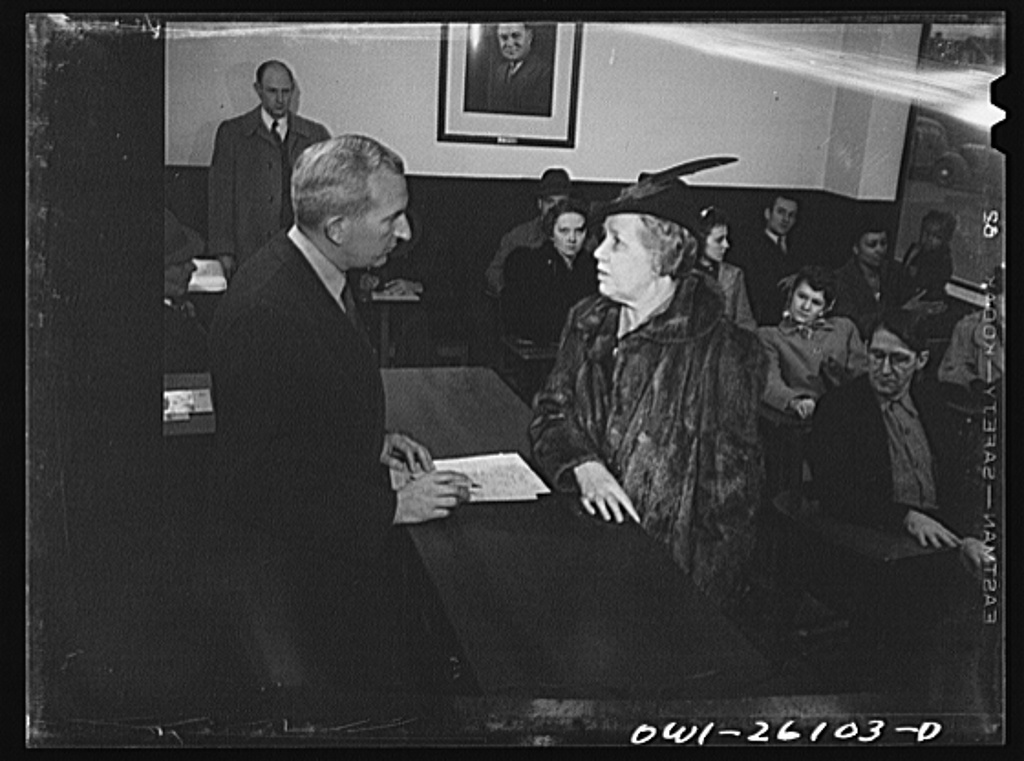
Candidates waiting at an employment agency, where screening often starts before any employer interview. Photograph: the subject
Image Credits: Wikimedia Commons
What candidates can dispute and correct
A background report is only as good as its sources, and sources make mistakes. Court records can carry the wrong person, old convictions can linger past their reporting limit, and employment dates can be misrecorded by a past employer. The FCRA dispute right exists because those errors are common enough to matter.
A candidate who spots an error should dispute it with the reporting company, not just with the employer. The reporting company must then reinvestigate, and the employer should wait for the result before finalising a rejection based on that item. Joint guidance from the Equal Employment Opportunity Commission and the Federal Trade Commission confirms that candidates must be told of a potential adverse action and given the report plus the summary of rights first.
Candidates also hold a right to consistency. An employer that checks only some candidates in the same role, or that treats identical records differently without a job related reason, risks a discrimination claim. Standard packages by role, applied to every finalist for that role, protect both sides and make the process easier to defend.
There are limits to what a check may consider. Some jurisdictions restrict the use of old convictions, ban credit checks for most roles, or forbid asking about salary history. An employer that ignores those limits can win the information and lose the lawsuit, which is why screening firms sell compliance as part of the service.
What a check cannot fairly decide
A background check answers questions about records, not questions about character. A clean record does not prove someone will perform well, stay loyal, or treat colleagues kindly, and a single old offence does not prove someone will repeat it. Employers that treat a report as a verdict rather than as one input tend to reject good candidates and miss real risks that no database holds.
Timing matters too. A check run before interviews wastes money on candidates who will never be hired, while a check run after an offer has been accepted can feel like a trap to the candidate. Most employers therefore place it at the finalist stage, where the cost is justified and the candidate still has leverage to dispute errors.
Finally, a check cannot replace the rest of hiring. Interviews, work samples, and probation periods test skills and behaviour that records never capture. The strongest hiring systems use the check for what it does best, which is verifying facts, and use other tools for everything else.
Frequently asked questions
Do all jobs run background checks?
No, most large and mid-size employers screen, but many small businesses skip formal checks. Regulated roles in healthcare, education, finance, and aviation are far more likely to require one by law.
Can an employer check my background without telling me?
Under the FCRA, an employer using a third party report must give a standalone written disclosure and get written permission first. A check run without those steps breaks the required sequence.
What happens if my report contains an error?
You receive a copy of the report and a summary of rights before any final rejection, and you can dispute the error with the reporting company. The employer should wait a reasonable time for the dispute before deciding.
Does a criminal record always mean rejection?
No, employers should weigh the nature of the offence, how long ago it happened, and whether it relates to the job. Blanket rejection of every record risks a discrimination claim and ignores relevant differences.
The bottom line
Companies run background checks to confirm facts, protect people, meet legal duties, and defend hiring decisions they can explain. The law does not ban those checks, but it does force a fair sequence, with disclosure, consent, and a chance to correct errors before rejection. Candidates who understand that sequence can spot an unlawful check, fix a wrong record, and judge whether an employer's process deserves their trust.
If you are job hunting, keep your own records straight, since dates and titles are the items most often disputed. Accuracy on your side makes the check a formality instead of a fight.
Tags: background checks, hiring, FCRA, employment screening
The Rive News research desk writes plain language explainers from public sources, with every key claim tied to a named document or dataset.
Related
- What a background check actually checks
- Why background checks take so long to finish
- What reference checks ask former employers
- Why companies do multiple interview rounds for one job
Subscribe for one practical explainer each week, written in plain language and checked against public sources.
Rive News standards: no invented quotes, no invented statistics, and every number traced to a public source.
Related stories
How to Ask for a Raise With Data, Not Emotions
Ask for a raise with market data and documented results, not emotions. Research your rate from BLS wage tables, build an evidence file, run

How to Explain a Career Gap on Your Resume Honestly
A career gap is not a red flag if you explain it honestly: give a reason, show what you did, and point forward. Recruiters reveal the exact

How to Switch Careers at 30 With No Experience in the Field
A career change at 30 means repackaging a decade of transferable skills, not starting over. Map your skills, earn one certification,