
What is the difference between a CV and a resume?
Key takeaways
- A resume is a short, targeted summary of your skills written for one specific job; a CV is a complete, multi-page record of your academic and professional history.
- In the US and Canada, industry jobs expect resumes while academic and research roles expect CVs; in the UK and much of Europe, "CV" means what Americans call a resume.
- Rewrite your resume for every application, keep your CV as a permanent running record, and check the posting to see which document it asks for.

Candidates meet interviewers across tables at a career fair, where handing over the right document sets the tone. Photograph: bpsusf
Image Credits: Wikimedia Commons (CC BY 2.0)
A resume is a short, tailored pitch. It answers one question for one employer: why are you right for this job.
A CV is the opposite of short. It is the full record of everything you have done, from degrees to publications to grants.
Mixing them up costs real opportunities. Send a 10-page CV to a hiring manager who expected a one-page resume and it gets skimmed, not read. Send a one-page resume to an academic committee that asked for a CV and you look underqualified.
This article explains CVs and resumes, including what a resume is, what a CV is, how they differ in length, content, and use, when to send each one, and how to convert between them.
What is a resume?
A resume is a short, focused summary of your skills and experience, written for one specific job. Every line earns its place by matching what the employer asked for.
In the United States it is typically one to two pages, according to Indeed's career guide and Harvard's School of Public Health CV guide. The University of North Carolina's Writing Center puts it even more plainly: resumes are usually no more than one page.
A resume is flexible. You rewrite and reorder it for each application, cutting anything that does not fit the role. Typical sections include contact details, education, work experience with dates and duties, and skills.
The short format is deliberate because recruiters scan fast. Knowing what recruiters actually look for in the first seconds explains why every line on your resume must pull its weight.
Resumes usually travel with a cover letter, which the UNC Writing Center describes as the written record of what you sent and to whom. Keep that letter short as well: here is how long your cover letter should be in 2026.
What is a CV?
CV stands for curriculum vitae, Latin for "course of life." It is the full record: every degree, job, publication, presentation, grant, and award, organized chronologically.
There is no page limit. A graduate student early in their career might have a CV of two to three pages, while a seasoned researcher's CV can run into double digits, according to the UNC Writing Center. Indeed's career guide notes three to six pages as common for academics, and Harvard's career office says most graduate student CVs run two to five pages.
Harvard's School of Public Health career guide draws the identity line neatly: in the US, a resume presents your professional identity, while a CV presents your scholarly identity. The CV lists publications, presentations, grants, honors, and teaching in detail.
Unlike a resume, a CV barely changes between applications. It is a living document that you update as your career grows, and you keep one master copy for years. Think of it as the archive from which everything else is drawn.
How they differ in length, content, and use
Length is the most visible split. A resume stays at one to two pages; a CV grows with your career and has no ceiling.
Content follows purpose. A resume selects only what is relevant to one opening. A CV includes the complete academic and professional record, including items a resume would cut, like full publication lists and conference presentations.
Tailoring is the third split. You customize a resume for each job, but your CV stays largely the same no matter where you apply, as the University of Cincinnati's career office explains.
The simple rule from the career guides is this: resume for industry and non-academic jobs, CV for academic posts, research positions, fellowships, grants, and graduate programs. When the posting names a document, follow it.
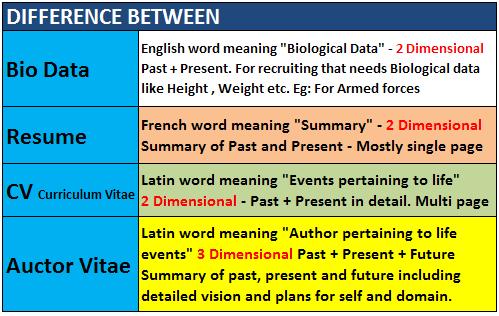
A chart comparing biodata, resume, curriculum vitae, and auctor vitae across meaning and dimensions. Photograph: Ken Georgie Mathew
Image Credits: Wikimedia Commons (CC BY-SA 4.0)
When to send a resume and when to send a CV
In the US and Canada, send a resume for almost every industry job: tech, business, healthcare operations, government. Send a CV for faculty jobs, research positions, postdocs, grants, and doctoral program applications.
The words themselves change meaning abroad. In the UK, Ireland, New Zealand, and much of Europe, employers ask for a "CV" but mean the short document Americans call a resume, according to Indeed's regional guides. A British hiring manager asking for your CV still expects a brief, targeted document, not twenty pages.
Career changers face a special case. A resume lets you lead with transferable skills instead of a chronological work history, which a CV cannot hide from. This approach is covered in detail in a guide to switching careers with decades of experience.
"Understanding the differences between a CV and a resume is crucial; it allows you to present your qualifications effectively and tailor your application to the specific expectations of employers in your field," Lorraine Atik, a senior recruiting consultant, told Indeed Canada.
How to convert your CV into a resume
Start with your CV as the source file and cut it down. Keep the jobs and skills that match the posting, and drop full publication lists, old conference talks, and anything older than about ten to fifteen years unless it is directly relevant.
Reframe duties as achievements. A CV line that reads "taught undergraduate statistics" becomes a resume bullet like "taught statistics to 120 undergraduates; course ratings rose 18 percent." Numbers make the short format work.
Going the other way, expand your resume into a CV by adding back everything you cut: every role in chronological order, all publications, presentations, grants, awards, teaching, and service. If you have a gap in your work history, the CV's full chronology is where you account for it honestly, as explained in this guide to explaining a career gap on your resume.
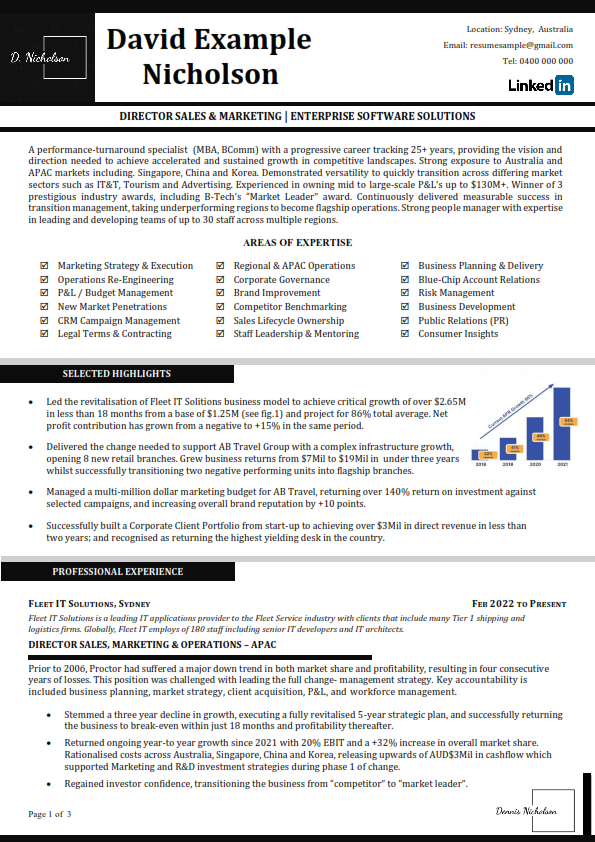
A sample director-level resume using a chronological, achievement-focused layout across three pages. Photograph: Colin8317a
Image Credits: Wikimedia Commons (CC BY-SA 4.0)
Frequently asked questions
Can I use a CV and a resume for the same job?
No, send only the document the posting asks for. Submitting both signals that you did not read the instructions. If the posting is silent, follow the industry norm: resume for industry roles, CV for academic ones.
How long should my CV be if I am just starting out?
Two to three pages is normal for an early graduate student, according to the UNC Writing Center. List your education, research experience, teaching, presentations, and awards in full. Length comes naturally as publications and grants accumulate.
Do employers outside the US want a CV or a resume?
It depends on the country. In the UK, Ireland, New Zealand, and much of Europe, "CV" is the standard term for the short job-application document. In the US and Canada, "resume" covers industry jobs and "CV" is reserved for academic and research roles.
Should my resume list every job I have ever had?
No. A resume includes only the experience relevant to the job you want, condensed to one or two pages. Older or unrelated roles get cut, which is exactly why your CV exists as the complete record.
Can I just send my CV everywhere to be safe?
That backfires. A multi-page CV handed to an industry hiring manager reads as unfocused and usually gets skimmed. Trim the CV into a tailored one-page or two-page resume for each job instead.
The bottom line
A resume is your tailored one-to-two-page pitch for a specific job; a CV is the complete running record of everything you have done. Keep both current, match the document to the posting, and let a recruiter see the short version while a hiring committee sees the full one. Your next step: open the job description you care about most and cut your CV down into a one-page resume that mirrors its keywords.
---
Tags: CV, resume, job applications, career advice, academic jobs
Rive News is the research desk behind these guides. It builds explainers from public sources so readers can check every claim.
Latest in Career
- What recruiters actually look for in the first seconds
- How long your cover letter should be in 2026
- Switching careers with decades of experience
- Explaining a career gap on your resume
Subscribe for one practical career guide in your inbox every morning.
Corrections: we fix errors promptly. Send the article URL and the correction to the editorial desk.
© 2026 Rive News. All rights reserved.
Related stories

How to Ask for a Raise With Data, Not Emotions
Ask for a raise with market data and documented results, not emotions. Research your rate from BLS wage tables, build an evidence file, run

How to Explain a Career Gap on Your Resume Honestly
A career gap is not a red flag if you explain it honestly: give a reason, show what you did, and point forward. Recruiters reveal the exact

How to Switch Careers at 30 With No Experience in the Field
A career change at 30 means repackaging a decade of transferable skills, not starting over. Map your skills, earn one certification,