
How to answer why should we hire you without sounding arrogant
Key takeaways
- The question is really "what makes you the right fit for our needs", so every good answer starts with what the employer wants, not with your resume.
- Confidence without arrogance comes from evidence: let specific results do the boasting while your words stay plain and measured.
- The strongest structure is simple: restate their top needs, match each to proof from your past work, and connect it to what you would do for them.

A candidate sits before a three-person interview panel. Your job in the room is to connect your skills to their needs, not to recite your resume. Photograph: Ministério dos Assuntos Parlamentares e Comunicação Social/Wikimedia Commons
Image Credits: Wikimedia Commons
"Why should we hire you?" is the interview question that makes most candidates squirm.
Answer too softly and you sound unsure of yourself. Answer too boldly and you sound like the decision is already made.
The way out of that trap is to change who the answer is about. The question sounds like it asks for self-praise, but interviewers are really asking something else: what makes you the right fit for what we need. JobStreet's career advice puts it plainly: the employer wants to know if you are the perfect fit for the job, so your answer must address their needs for the role.
This article explains how to answer "why should we hire you". It covers what the interviewer is really asking, the three-part structure that keeps confidence humble, sample answers that work, and the mistakes that tip an answer into arrogance.
What the interviewer is really asking
Strip away the wording and the question is a fit check. They have a problem, an empty role with specific demands, and they want to hear you connect your past to their future.
As Global Finances Daily frames it, the hiring manager is the customer and you are both the sales rep and the product. The question is why they should choose this product over the others on the shelf.
That framing decides the tone. A sales pitch about how great the product is can sound arrogant.
A pitch about how the product solves the customer's problem sounds like service. The second version is what you want.
This is also why rambling about yourself fails. Anything you say that does not connect to their stated needs is noise to the interviewer. Read the job posting before the interview and underline the three or four things they keep repeating.
Those are the "A, B, and C" your answer must speak to. Global Finances Daily recommends this structure: "You should hire me because you've said you want someone with A, B, and C. I fit all of your requirements."
If you are early in your career, the same principle applies with different raw material. Give a Grad a Go's interview guide shows graduates answering with university projects and part-time work, tying each one to a stated need of the role. The mechanism is identical. Only the evidence changes.
The three-part formula that keeps confidence humble
A strong answer has three moves, in this order. First, name their need in their own words.
Second, offer proof from your past that you meet it. Third, connect that proof to what you would do for them.
Naming their need first is what prevents arrogance. When you open with "From what you've described, you're looking for someone who can..." you position yourself as a listener, not a braggart. You are responding to them, not announcing yourself.
Proof is where the confidence comes from, and it is also what keeps the tone humble. JobStreet advises discussing your unique qualifications, giving specific examples of success in similar roles, and explaining how your skills align with the company's goals. Notice what that does: the numbers and results carry the weight, so your voice can stay calm.
The closing move points forward. Something like "That is why I think I could contribute to your team quickly" keeps the focus on their future, not your past glory.
If you are explaining a career gap elsewhere in the interview, keep the same forward-facing tone there too.
Why evidence brags so you don't have to
Here is the core of the whole thing. Arrogance is a claim without proof.
Confidence is a claim with proof. The same sentence lands completely differently depending on whether evidence is attached.
"I'm a great leader" is a claim. "In my last role I led a team of eight through a systems changeover with no missed deadlines" is a fact. The second version is stronger, and it never needs the word "great".
Measurable results let the interviewer draw the flattering conclusion themselves. That is far more persuasive than you drawing it for them.
Softening words also help, used sparingly. "I believe I'm a strong fit because..." reads as grounded.
"I'm obviously the best candidate" reads as the opposite. The difference is not about being timid. It is about letting the facts make the case.
Crediting others is the other classic humility move, and it costs nothing. "My team and I" instead of "I" signals the self-awareness interviewers associate with good colleagues.
Just do not disappear from your own story. Name your specific part clearly.
Sample answers that work
Each of these follows the same bones: their need, your proof, their future.
The experienced candidate: "From the posting, you're looking for someone with managerial experience who can steady operations during a tough stretch. I have a decade in hospitality, and through the pandemic I kept our sales losses to a minimum of 2% year-on-year."
"That experience, plus what I've learned about running a team under pressure, is why I think I'd be a strong fit." This mirrors JobStreet's example good answer, which works because every claim is tied to a number.
The skills switcher: "You mentioned this role needs someone comfortable with data and with explaining it to non-technical teams. In my current role I built the weekly reporting the sales team actually reads, and I ran the training sessions that got them using it."
"I'm excited to bring that combination to your team." If you are mid-career switch, this is the template: translate old work into their vocabulary.
The graduate: "Based on what you've said today, time management under pressure is central to this role. At university I organized multiple events with hard deadlines while working across two teams with two managers, prioritizing daily to hit both sets of deadlines." That follows the graduate examples from Give a Grad a Go, which anchor each claim in a concrete situation.
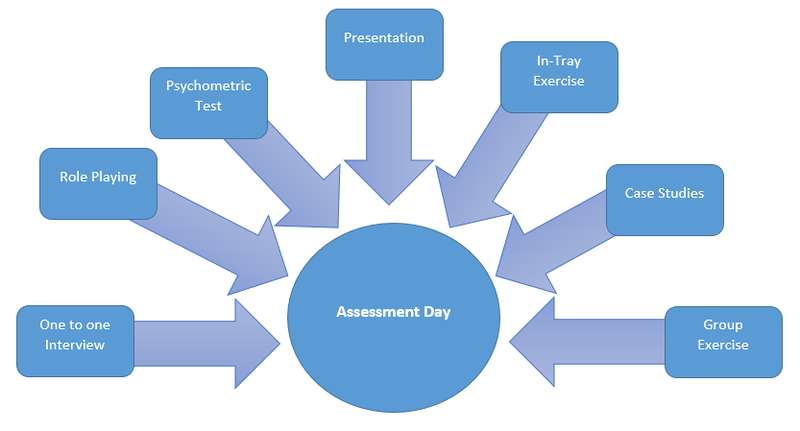
The stages of a typical assessment day: one-to-one interviews, group exercises, presentations, and case studies. Each stage is another chance to show fit with evidence. Photograph: Amna Kashif/Wikimedia Commons
Image Credits: Wikimedia Commons
The mistakes that tip an answer into arrogance (or desperation)
A few patterns consistently sink answers, and none of them are about being too confident. They are about being focused on yourself instead of the employer.
Talking about what you want from the job is the classic one. Global Finances Daily is blunt about it: never say they should hire you because you need the job or because of the perks.
JobStreet's example bad answer, "I need the money. And your company has great perks," shows how fast self-focus curdles.
Reciting your resume without connecting it is the second trap. A list of achievements with no link to their needs sounds like bragging precisely because it serves no purpose but self-display. Every fact you mention should end with an invisible "and here is why that matters to you".
Trash-talking other candidates or your current employer is the third. It tries to make you look good by comparison, and interviewers reliably read it as insecurity. Keep every sentence about what you bring, never about what others lack.
Finally, memorizing a script word for word usually backfires. Know your three proof points cold, then say them in your own words each time. A pause to think reads as sincerity. A perfectly polished paragraph reads as performance.
Prepare your answer in twenty minutes
Read the job posting and highlight the three needs that appear most often. For each one, write down one concrete result from your past that proves you meet it. A number is ideal: a percentage improved, a deadline met, a team size, a budget managed.
Two sentences per need is plenty. Then practice the bridge out loud once: their need, your proof, your forward-looking close.
It should take about sixty to ninety seconds. Longer than that and you are giving a speech. The interviewer asked a question and deserves an answer.
One more step pays off disproportionately: research the company for ten minutes. Sensei AI's interview guidance notes that candidates who connect their answer to the company's culture and goals stand out. A single specific detail makes the whole answer feel tailored rather than generic.

A one-to-one interview in progress. Sixty to ninety seconds of needs-plus-evidence is the right length for this answer. Photograph: Andriatriv/Wikimedia Commons
Image Credits: Wikimedia Commons
Frequently asked questions
How long should the answer be?
Sixty to ninety seconds. That is enough for their need, your proof, and a forward-looking close. Anything longer starts to sound like a monologue, and anything much shorter sounds like you had nothing prepared.
What if I have no experience for the role?
Use the same formula with different evidence: coursework, internships, volunteer work, and projects. Sensei AI's sample answer for inexperienced candidates leans on exactly this, framing quick learning and motivation as the fit. What you lack in history, make up in specific, relevant proof.
Should I mention weaknesses in this answer?
No. This question is a fit pitch, not a confessional.
Weaknesses belong in the "greatest weakness" question, where you can frame them with growth. Mixing them in here dilutes the one job this answer has.
Is it arrogant to say "you should hire me"?
Not if the sentence continues with their needs and your evidence. "You should hire me because you've described needing X, and I have done X" is a logical claim, not a boast. It only sounds arrogant when the "because" is missing.
The bottom line
The question is not an invitation to praise yourself. It is an invitation to show you understand their problem and have solved something like it before. Lead with their needs, back every claim with evidence, and let the results do the boasting.
Prepare three proof points from the job posting, keep the answer under ninety seconds, and end looking forward. That is confident, it is humble, and it is exactly what the interviewer is listening for.
Rive News is the research desk behind the Rive News production run, writing practical explainers across gardening, careers, education, and more.
Latest in career
- How to explain a career gap on your resume honestly
- How to negotiate salary when they ask expectations first
- How to switch careers at 30 with no experience
- What recruiters look for in a resume in 6 seconds
Get one practical explainer in your inbox every morning. Subscribe to the Rive News newsletter.
Corrections: spotted an error in this article? Email the research desk and we will verify and fix it promptly.
Related stories

How to Ask for a Raise With Data, Not Emotions
Ask for a raise with market data and documented results, not emotions. Research your rate from BLS wage tables, build an evidence file, run

How to Explain a Career Gap on Your Resume Honestly
A career gap is not a red flag if you explain it honestly: give a reason, show what you did, and point forward. Recruiters reveal the exact

How to Switch Careers at 30 With No Experience in the Field
A career change at 30 means repackaging a decade of transferable skills, not starting over. Map your skills, earn one certification,