
Why Kids Learn Languages Faster Than Adults
Key takeaways
- Adults actually learn faster at first; children's advantage is in long-term mastery, not speed.
- A 2018 study of nearly 670,000 people found grammar-learning ability holds until about 17-18, then declines slowly.
- Native-like proficiency requires starting by about age 10; accent is the part of language most affected by age.
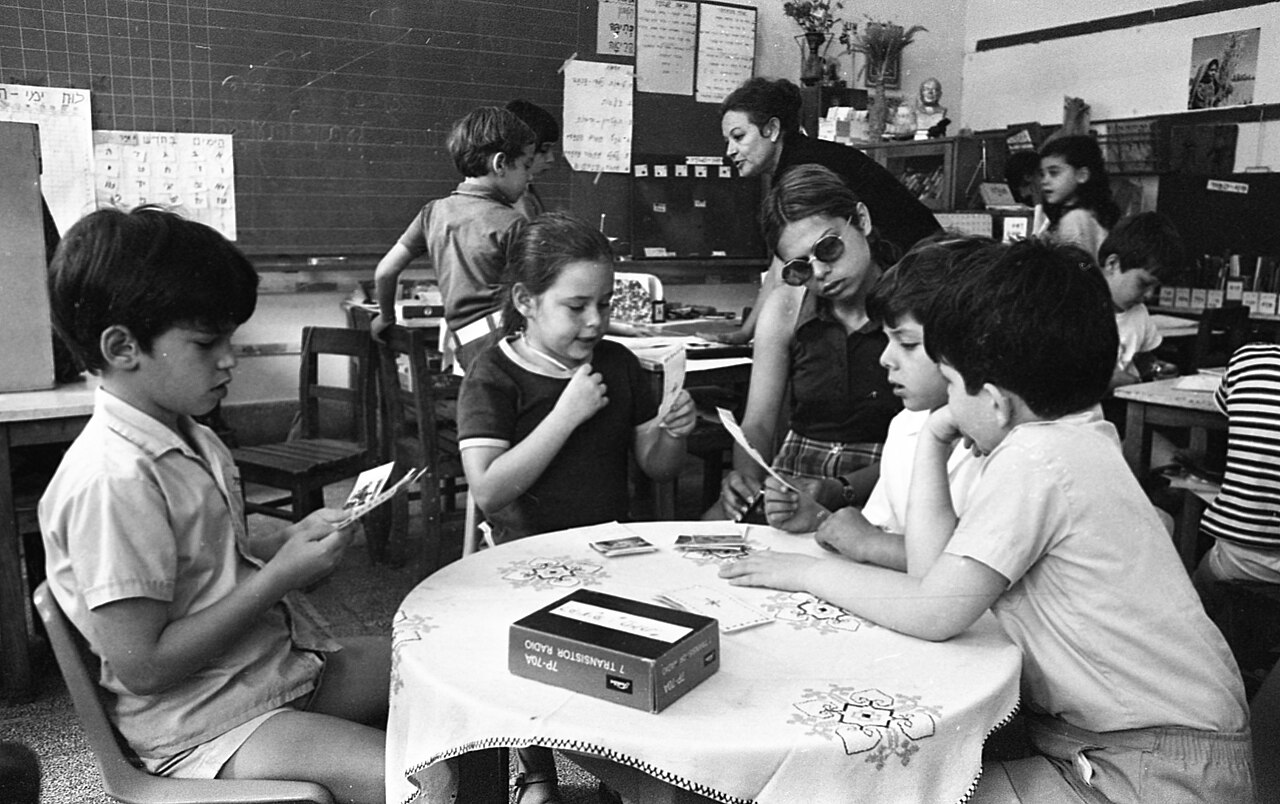
Image Credits: Wikimedia Commons / IPPA photographer
Every expat family has seen it. The parents take classes for years and still stumble over grammar.
The seven-year-old picks up the local language on the playground in months and ends up correcting the parents. The folk explanation is simple: children's brains are sponges, and adults have missed the window.
The folk explanation is half wrong. Research shows adults are actually faster learners in the early stages of a new language. They use strategies, transfer knowledge from their first language, and produce sentences quickly, while young children can take months to say much at all.
The children's advantage is not speed. It is the final level they can reach: given enough years, the younger the start, the closer to native-like mastery.
This article examines the evidence behind the slogan, including the critical period hypothesis from Lenneberg to the present, the landmark 2018 study of nearly 670,000 learners, the Johnson and Newport immigrant study, and the surprising finding that adults start faster but children finish higher.
The critical period hypothesis
The idea began in neuroscience, not language teaching. In Speech and Brain Mechanisms (1959), neurosurgeon Wilder Penfield and Lamar Roberts argued from clinical observation that the young brain has a plasticity the adult brain loses: children who suffered damage to language areas often recovered speech by reorganizing it into other brain regions, while adults with comparable injuries usually did not.
Eric Lenneberg formalized the claim for language in the 1960s. He hypothesized that language acquisition is affected by biological growth, and that after puberty, around age 13, the brain reaches a biologically mature state that makes new language acquisition harder. The popular version hardened into a slogan: learn before puberty or never sound native.
Modern researchers prefer the term "sensitive period" over "critical period," precisely because the decline with age is gradual rather than a sudden deadline. The window is real, but it is a slope, not a slammed door. And it affects different parts of language differently: accent is the most age-sensitive, grammar less so, and vocabulary shows no critical period at all.
The distinction between speed and ultimate attainment is the key that unlocks the whole debate. Snow and Hoefnagel-Hohle reported in 1978 that adults tend to perform better than children in the early stages of learning a second language. Adults quickly learn to produce sentences, while young children can take months.
But the initial adult advantage is temporary. In the long term, the younger the exposure to a second language, the higher the level of mastery ultimately achieved.
Johnson and Newport (1989): the immigrant study
The strongest early evidence came from healthy people learning a second language at different ages. In their landmark 1989 study, Jacqueline Johnson and Elissa Newport tested Chinese and Korean immigrants to the United States on their intuitions about English grammar.
All participants had lived in the country for years, so everyone had ample exposure. The variable was age of arrival.
The finding was clear and orderly. Those who had arrived before about age seven performed like native speakers.
From roughly seven to fifteen, scores declined steadily with age of arrival. Among those who arrived as adults, performance was lower and more variable, no longer tracking age in the same tidy way.
This was the classic sensitive-period pattern: not an abrupt switch that flips at puberty, but a steady, age-graded decline in the ultimate command of grammar. The study, with 46 participants tested on grammaticality judgments, became one of the most cited results in second-language acquisition and the empirical backbone of the hypothesis.
The 670,000-person study
The largest test came in 2018. Joshua Hartshorne, then a postdoc at MIT, with Joshua Tenenbaum and Steven Pinker, analyzed a grammar quiz taken by nearly 670,000 people, by far the largest dataset ever assembled for a study of language-learning ability. Participants reported their current age, the age they began learning English, and other background details; complete data survived for 669,498 people.
The results redrew the timeline. Grammar-learning ability remains strong until about age 17 or 18, at which point it drops.
The critical period for learning language is much longer than cognitive scientists had previously thought. The debate had been over whether ability declines from birth, starts declining at 5, or starts declining at puberty; the data pointed to a late cutoff.
But the study also found a stricter limit for the highest level of mastery. It is nearly impossible to achieve proficiency similar to that of a native speaker unless you start learning by about age 10. As Hartshorne put it: "If you want to have native-like knowledge of English grammar you should start by about 10 years old.
We don't see very much difference between people who start at birth and people who start at 10, but we start seeing a decline after that. "
People who start between 10 and 18 still learn quickly, the researchers found, but since they have a shorter window before their learning ability declines, they do not reach native-speaker proficiency. The window for native-like grammar is roughly birth to 10; the window for efficient learning extends to 17 or 18; after that, learning continues but slows and plateaus lower.

What children actually do better
Three advantages stack up for young starters, and none of them is raw speed.
First, time and immersion. Children learning a second language typically get thousands of hours of immersive input over years.
Adults rarely match that dose. Part of the child advantage is simply more hours at a plastic age.
Second, the "less is more" hypothesis. Elissa Newport proposed that children's limited cognitive capacity is paradoxically an advantage for grammar: because children cannot hold whole complex sentences in memory, they are forced to extract the smaller building blocks, the grammatical patterns themselves. Adults, with bigger working memories, memorize whole chunks and may miss the underlying system.
Third, accent. The one domain where the age effect is sharpest is phonology: sounding native.
The Taalhammer review of the literature concludes that the only thing age reliably puts out of reach is a flawless native accent. Grammar can still be learned to a very high level well into adulthood, and vocabulary has no critical period at all.
For adults, the news is encouraging, not discouraging. Adults learn faster initially, can reach very high grammar levels, and face no age barrier on vocabulary.
The practical advice from the research: start as early as you can for the highest ceiling, but starting at 30 still beats never starting. And for parents weighing bilingual upbringing, what research says about bilingualism and the brain covers the cognitive side of the question.
For learners of any age, the study methods matter as much as the starting age. Testing yourself beats rereading in every age group tested, and teaching someone else consolidates new vocabulary faster than review alone.

FAQ
Is it too late to learn a language as an adult?
No. Adults learn faster than children in the early stages, can reach very high grammar levels, and face no critical period for vocabulary. The age effect mainly limits native-like accent and the absolute ceiling of grammar, and even the grammar cutoff sits around 17-18, not early childhood.
What is the best age to start a second language?
For native-like proficiency, the 2018 Hartshorne study points to starting by about age 10. But starting at any age beats not starting: adults remain good learners, just with a lower ultimate ceiling on accent and some aspects of grammar.
Do bilingual children get confused between languages?
Research finds children who learn two languages from an early age do not get confused between them and may develop better understanding of how language works than monolingual children. Early bilingualism is an advantage, not a risk.
Why do kids seem to learn so fast then?
What looks like speed is usually immersion plus time: thousands of hours of input over years. In controlled comparisons, adults actually produce sentences sooner. Children's real edge is long-term: more plastic phonology and a longer runway before the sensitive period closes.
The bottom line
Kids do not learn languages faster than adults; they learn them further. Adults win the sprint, children win the marathon.
The 670,000-person Hartshorne study set the grammar-learning cutoff at 17-18, with native-like mastery requiring a start by about 10, while Johnson and Newport's immigrant study showed the steady age-graded decline beneath it. Accent is the most age-sensitive skill; vocabulary has no deadline at all.
Latest in Education & Study
- What research says about bilingualism and the brain
- Testing effect: why quizzing beats rereading
- Why teaching someone else helps you learn
- Why we forget things right after a test
Want one evidence-based study tip in your inbox each week? Subscribe to the Rive News newsletter.
Related stories

Why Do I Blank Out During Tests Despite Studying: Test Anxiety and Retrieval Failure
Blanking out in exams is retrieval failure, not missing knowledge. Anxiety drains working memory; rereading builds false confidence. Here

How to Study for Exams Without Burning Out
Sleep 7-8 hours, study in 25-50 minute blocks, and exercise daily. The science-backed way to study for exams without burning out, and what

Why Do I Forget What I Just Read? Science Has an Answer
You forget what you just read because of the forgetting curve, mapped by Ebbinghaus in 1885. Science explains why memory fades fast and how