
Why Do I Forget What I Just Read? Science Has an Answer
Key takeaways
- Forgetting right after reading is normal. Hermann Ebbinghaus showed in 1885 that memory of new material drops fastest in the first hours, then levels off.
- Meaningless, unconnected material fades fastest. He found that a poem was ten times easier to learn than his nonsense syllables.
- Each review flattens the curve. Spaced repetition works because every retrieval makes the memory more resistant to decay.

Finishing a chapter and drawing a blank is one of the most common learning frustrations. Public domain photograph: doe-oakridge/Wikimedia Commons
Image Credits: Wikimedia Commons
You finish a page, look up, and realize you cannot say what it just told you. The words passed through your eyes, but nothing stuck. It feels like a personal failure, but it is one of the oldest findings in psychology.
Memory does not fade at a steady rate. It collapses quickly at first and then levels off into a slow decline. The German psychologist Hermann Ebbinghaus mapped that pattern in 1885. More than a century of research has mostly confirmed him.
This article explains why we forget what we just read: the forgetting curve itself, why the brain dumps new information so fast, what makes some material stick while other material vanishes, and how to work with the curve instead of against it.
The forgetting curve: what Ebbinghaus actually found
From 1880 to 1885, Ebbinghaus ran experiments on himself. He memorized lists of nonsense syllables, meaningless three-letter combinations like "WID" and "ZOF". He tested his own recall at intervals from minutes to a month. He published the results in 1885 as Memory: A Contribution to Experimental Psychology.
The numbers are striking. Roughly 42 percent of what he learned was gone after 20 minutes. After one hour, about 56 percent was forgotten.
After one day, about two-thirds. After a month, only around one-fifth remained. The decline was steepest in the first day and then flattened into a long, shallow tail.
Ebbinghaus described the curve with a formula: R = e to the power of minus t over S. R is retention. t is time since learning. S is the strength of the memory. The key insight is S.
When a memory is new and weakly encoded, the curve drops fast. When it is well rehearsed, the curve flattens. That single variable is the entire logic behind spaced repetition.
In 2015, researchers published a replication of Ebbinghaus's original method in PLOS ONE. They found results similar to his, per the European Business Review. Different studies land on slightly different percentages depending on the material and the learner. But the shape of the curve holds: most forgetting happens early, then it levels off.
Why your brain dumps new information so fast
Your memory system is a filter, not a recorder. It keeps what proves useful and discards the rest. A single pass through a page rarely proves usefulness. Reading without engagement creates a weak trace, and weak traces decay.
Ebbinghaus accidentally proved this too. He found that meaningful material, like a poem, was about ten times easier to memorize than his arbitrary syllable lists.
The brain latches onto connections, rhythm, and meaning. Isolated facts with nothing to hook onto slide off.
Distraction during reading makes the trace even weaker. If you were thinking about something else while your eyes moved across the page, the encoding was shallow from the start. Shallow encoding plus the steep part of the curve equals a blank stare five minutes later.
Psychologist Daniel Schacter, in his book The Seven Sins of Memory, calls this kind of loss "transience": the process of forgetting that occurs with the passage of time. It is not damage or disease. It is the default setting.
What makes some things stick
Repetition strengthens S, the stability variable in Ebbinghaus's formula. Each time you successfully pull a memory back, the trace gets more resistant to decay. That is why rereading the night before a test feels productive but fails. It strengthens the memory right when the curve is steepest, then you walk away and the curve does its work.
Meaning multiplies the effect. Ebbinghaus needed ten times the effort for nonsense syllables because they had no associations.
When you connect new material to something you already know, you give the brain hooks to grab. That is why examples and stories are remembered while abstract definitions are not.
Sleep matters as well. Memory consolidation is the process that moves traces into longer-term storage. It happens heavily during sleep. An all-night study session that skips sleep undermines the very process it is trying to use.
How to remember more of what you read
Work with the curve instead of pretending it is not there. These methods all have the same goal: raise S before the steep part of the curve does its damage.
Retrieve, do not just reread. After each section, close the book and say out loud what it said.
Forcing the brain to pull the memory back is the retrieval that strengthens it. This is active recall, and it beats rereading in nearly every head-to-head study.
Space your reviews. Review new material after about a day, then after a few days, then after a week.
Each successful review flattens the curve further. Flashcard systems and spaced-repetition apps are built exactly on Ebbinghaus's math.
Make it meaningful on the first pass. Pause and ask what a paragraph connects to.
Argue with it. Summarize it in one sentence. The ten-times effect Ebbinghaus found for meaningful material is free if you engage while you read.
Read in an environment that lets you focus. Put the phone away. A single interrupted read creates a weaker trace than a shorter focused one.
Frequently asked questions
Is forgetting what I just read a sign of bad memory?
No. It is the normal behavior of human memory.
Ebbinghaus's curve shows that rapid early forgetting happens to everyone, and modern replications confirm it. A blank mind after one passive read is the expected result, not a defect.
Why can I remember song lyrics but not what I studied?
Lyrics come with rhythm, melody, emotion, and dozens of repetitions. That is exactly what builds strong memory traces. Study material read once, without engagement, has none of those advantages. The brain is not biased against you. It is biased toward repetition and meaning.
Does cramming ever work?
Cramming can work for a test the next morning because you are tested while the memory is still fresh. For anything you need to know a month later, it fails badly. Ebbinghaus's data shows only about one-fifth retained after 31 days without review.
How many times do I need to review something?
There is no magic number. Each review raises the stability of the memory and flattens the curve.
Most spaced-repetition schedules start with a review after one day, then stretch the gaps. The right interval is the longest gap at which you can still recall the material.
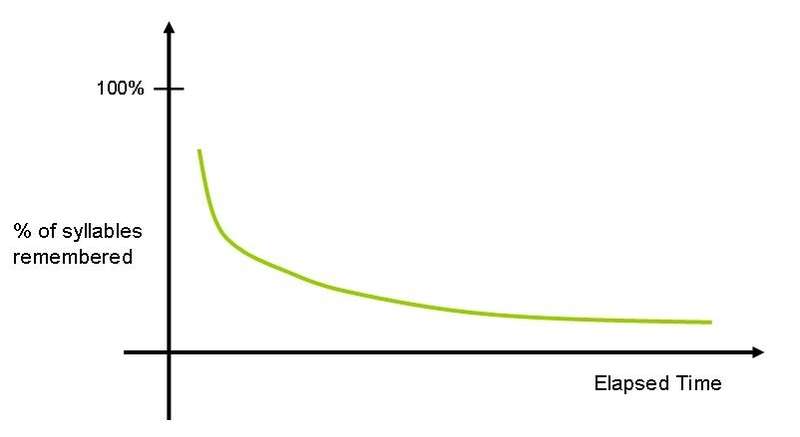
The forgetting curve: retention drops fastest in the first hours after learning, then levels off. Diagram: Nheise/Wikimedia Commons
Image Credits: Wikimedia Commons
The bottom line
Forgetting what you just read is not a character flaw. It is a 140-year-old curve doing exactly what it always does, dropping fastest in the first hours after you learn something.
It's a good idea to build one habit this week: after every chapter or article, close it and recall the main points before moving on. That single retrieval flattens your curve more than an hour of rereading ever will.
Topics: memory, forgetting curve, study skills, spaced repetition, cognitive science
Rive News's research desk covers practical how-to topics with sourced, verifiable information.
Latest in Education
- What Is Active Recall and How to Use It for Studying
- How Spaced Repetition Actually Works: The Forgetting Curve and Optimal Intervals
- What Do Recruiters Actually Look for in 6 Seconds?
Subscribe to the Rive News newsletter for weekly practical guides.
Sources:
- Wikipedia (en.wikipedia.org)
- Flashcardify (flashcardify.me)
- European Business Review (europeanbusinessreview.com)
Corrections: we correct errors promptly. Contact the newsroom with documentation.
Copyright 2026 Rive News. All rights reserved.
Related stories

Why Do I Blank Out During Tests Despite Studying: Test Anxiety and Retrieval Failure
Blanking out in exams is retrieval failure, not missing knowledge. Anxiety drains working memory; rereading builds false confidence. Here

How to Study for Exams Without Burning Out
Sleep 7-8 hours, study in 25-50 minute blocks, and exercise daily. The science-backed way to study for exams without burning out, and what
Learn a Language as an Adult: What Actually Works
Adults can learn languages well with the right method. The Foreign Service Institute puts Spanish at 600-750 class hours; consistent daily