
How Does a 1099 Worker Pay Taxes Differently From a W-2 Employee?
Key takeaways
- A 1099 worker pays the full 15.3% self-employment tax, double the 7.65% FICA share a W-2 employee sees deducted from each check.
- W-2 taxes are withheld automatically every pay period; a 1099 worker sends quarterly estimated payments to the IRS themselves.
- The tax code softens the gap by letting contractors deduct half the self-employment tax and write off business expenses.
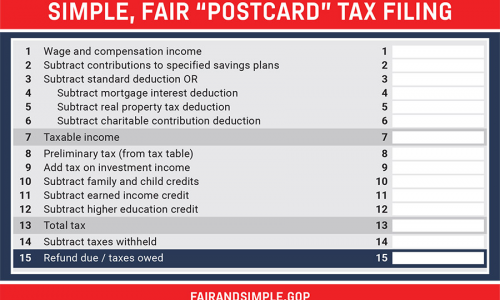
A graphic of a proposed "postcard" simplified tax return, from a congressional tax-simplification campaign. Photograph: Office of Congressman Duncan D. Hunter / Wikimedia Commons
Image Credits: Wikimedia Commons / Office of Congressman Duncan D. Hunter (postcard tax form); Underwood & Underwood (1920 tax forms); Plinskarch (Form 1040)
The one question that explains everything
When you move from W-2 employment to 1099 contract work, your relationship with the IRS changes in one fundamental way: who sends the money. A W-2 employer withholds income tax and half your payroll taxes every pay period, automatically, before the money ever reaches you. A 1099 worker receives the full payment untouched and owes the IRS everything themselves, including taxes most new contractors never see coming.
This article compares the two systems side by side: the tax rates, who pays what, how the money reaches the IRS, and the deductions that level the field. It covers tax year 2026 figures where they are published.
The 15.3% vs 7.65% gap
The single biggest difference is the payroll tax for Social Security and Medicare. W-2 employees split it with their employer under the Federal Insurance Contributions Act (FICA): you pay 6.2% for Social Security and 1.45% for Medicare, and your employer pays the same amounts from its own funds. Your share totals 7.65%, and the employer's matching 7.65% never touches your paycheck.
Independent contractors have no employer to split with. Under the Self-Employment Contributions Act (SECA), you owe the full 12.4% for Social Security and 2.9% for Medicare on your net self-employment earnings, totaling 15.3%. That is exactly double the employee share, and it hits before income tax is even calculated.
The Social Security portion applies only up to the annual wage base, which the Social Security Administration set at $184,500 for 2026. Earnings above that threshold still face the 2.9% Medicare tax (plus a 0.9% Additional Medicare Tax above $200,000 for single filers), but not the 12.4% Social Security portion. The same $184,500 cap applies to a W-2 employee's 6.2% share.
How the money reaches the IRS
The IRS runs on a pay-as-you-go system: it expects tax payments spread throughout the year, not one lump sum in April. The two worker types satisfy that expectation very differently.
For a W-2 employee, the employer does the work. Using the information on the employee's Form W-4, the employer estimates annual tax liability and withholds federal income tax, state tax, and FICA from each paycheck, remitting everything to the government. The employee's only job is keeping the W-4 accurate.
A 1099 worker has no withholding at all. If you expect to owe $1,000 or more when you file, you generally must make quarterly estimated tax payments using Form 1040-ES. For tax year 2026, the four due dates are April 15, June 15, and September 15 of 2026, then January 15, 2027.
These payments cover both income tax and self-employment tax. Missing them triggers an underpayment penalty calculated with the IRS's published quarterly interest rates.
The deductions that narrow the gap
The tax code softens the contractor's heavier load in two ways. First, you can deduct half of your self-employment tax when calculating adjusted gross income. The deduction appears on Schedule 1 of Form 1040 and reduces the income subject to federal income tax.
The logic mirrors the W-2 world: an employee never pays income tax on the employer's half of FICA, so the deduction creates rough parity. Note that it reduces income tax only; you still pay the full 15.3% on your net earnings.
Second, contractors deduct business expenses on Schedule C, the IRS form for sole proprietorship profit or loss. Mileage, home office costs, equipment, software, and professional services all reduce the net earnings that both income tax and self-employment tax are calculated on. A W-2 employee generally cannot deduct unreimbursed employee expenses at all.
One more structural detail works in the contractor's favor: self-employment tax is calculated on only 92.35% of net earnings, not the full amount. That shaves a little off the headline 15.3%.
Filing looks completely different
A W-2 employee's filing is simple: the employer sends a W-2, the numbers transfer to Form 1040, and the return reconciles what was withheld against what was owed.
A 1099 worker's filing is a small production. Clients who paid you $600 or more send Form 1099-NEC.
You report the income and expenses on Schedule C to find net profit. You calculate self-employment tax on Schedule SE.
Then you carry everything to Form 1040, along with the half-SE-tax deduction on Schedule 1. Quarterly payments made during the year are credited against the total.
The record-keeping burden is the hidden cost. Contractors need organized records of income and expenses maintained throughout the year, because every deduction must be documented. A separate bank account for the business and a habit of setting aside 25% to 35% of each payment for taxes are the two practices that separate smooth filers from panicked ones.

IRS tax forms being processed in 1920, from the era when the modern filing system took shape. Photograph: Underwood & Underwood / Wikimedia Commons
Side-by-side comparison
| Factor | 1099 Contractor | W-2 Employee |
|---|---|---|
| Tax form received | 1099-NEC (if paid $600+) | W-2 |
| Payroll tax | Full 15.3% self-employment tax | Employee half: 7.65% FICA |
| Income tax collection | Quarterly estimates (Form 1040-ES) | Withheld each pay period |
| Filing | Schedule C + Schedule SE + 1040 | W-2 entries on 1040 |
| Business expenses | Deductible on Schedule C | Generally not deductible |
| Half-SE-tax deduction | Yes, on Schedule 1 | Built in (employer half untaxed) |
| Benefits | Self-funded | Often employer-subsidized |
An illustration of Form 1040, the individual return both worker types file at year end. Photograph: Plinskarch / Wikimedia Commons
Frequently asked questions
Do 1099 workers always pay more tax than W-2 employees?
On the same gross amount, usually yes, because of the full 15.3% self-employment tax. But business deductions, the half-SE-tax deduction, and retirement contribution room can narrow or even reverse the gap at higher incomes.
What happens if I skip quarterly payments?
You owe the full amount in April plus an underpayment penalty, calculated as interest on what you should have paid and for how long it was late. The penalty is interest-based, not a fixed fine.
Can I be both W-2 and 1099 in the same year?
Yes, and many people are. W-2 withholding can be adjusted upward on your W-4 to cover the 1099 income, which sometimes removes the need for separate quarterly payments.
Does the 20% pass-through (QBI) deduction apply?
Many self-employed filers can deduct up to 20% of qualified business income under Section 199A, subject to income limits and service-business rules. It is a significant benefit W-2 employees do not get.
When is a worker legally 1099 vs W-2?
Classification depends on behavioral and financial control, not on what the contract says. Misclassification is common and heavily penalized; the IRS looks at who directs the work, not the label.
This article is for general information only and is not financial advice.
The bottom line
The difference between 1099 and W-2 taxes comes down to automation and the extra 7.65%. Employees get withholding and a split payroll tax handled by the employer; contractors get the full 15.3% and a quarterly payment schedule they must run themselves.
In exchange, contractors get Schedule C deductions and the half-SE-tax write-off. Know the 2026 dates, keep clean records, and set aside tax money from every payment.
This article explains tax rules and is not tax advice. For your own situation, consult a qualified tax professional.
Latest in Personal Finance
- Learn what happens when your bank says funds are pending on a deposit.
- See the difference between direct debit and standing order in plain terms.
- Find out how a credit limit change affects your score when you ask.
Subscribe for one plain-English money explainer every morning.
Related stories

How your APR is divided by 365 to get daily interest
Lenders divide your APR by 365 for a daily rate, then apply it to your average daily balance. This guide walks through every step

What is the difference between APR and effective annual rate?
APR ignores compounding inside the year; the effective annual rate includes it. A 12.99% APR card really costs 13.80% a year. Worked

APY vs interest rate: what compounding does to your money
APY includes compounding; the interest rate does not. A 5% rate compounded monthly is really 5.12% APY. Here is how the math works and what