
What a credit score range is and what the bands mean
By Rive News / Research desk | Rive News / Published October 27, 2026 at 9:00 AM PKT
This is general educational information, not financial advice.
Key takeaways
- Most consumer credit scores run from 300 to 850, and lenders group that range into bands such as poor, fair, good, and exceptional.
- On the FICO scale, 670 to 739 counts as good, 740 to 799 as very good, and 800 or above as exceptional.
- Bands are guides, not guarantees: lenders set their own cutoffs and also weigh income, debts, and application details.

Several credit cards, the kind of accounts that feed a credit report. Photograph: Lotus Head
Image Credits: Wikimedia Commons
A credit score is a three-digit number that summarizes how a person's borrowing history looks to lenders. It is built from credit report data and is meant to estimate how likely that person is to repay borrowed money.
That number alone can be hard to interpret, so scoring companies split the scale into bands. Each band carries a label, and each label signals a different level of risk to a lender.
This article explains what a credit score range is and what the bands mean, including the FICO bands, the VantageScore bands, what lenders do with them, and why one person can hold several different scores.
What a credit score range is
A credit score range is simply the full span a scoring model can produce. For the two dominant consumer models, FICO and VantageScore, that span runs from 300 to 850.
Bands divide that span into labeled segments. They exist because a raw number such as 712 means little on its own, while its band, good, tells a lender roughly where the borrower sits relative to other consumers.
Bands are not laws. Creditors can set their own standards for what they consider poor, good, or excellent, and they may use different models or versions for different products.
The FICO bands
FICO, introduced in 1989 by the Fair Isaac Corporation, is the most commonly used credit measure. Its base scores group into five bands, as published by myFICO:
- Poor: below 580, well below the average score of US consumers, signaling a risky borrower to lenders.
- Fair: 580 to 669, below average, though many lenders will approve loans with this score.
- Good: 670 to 739, near or slightly above average, and considered a good score by most lenders.
- Very good: 740 to 799, above average, signaling a very dependable borrower.
- Exceptional: 800 to 850, well above average, signaling an exceptional borrower.
The average US FICO score is 715, according to Fidelity's summary of FICO data, which sits inside the good band. That average is a useful anchor: a score near it is ordinary, not weak, even though higher bands attract better terms.
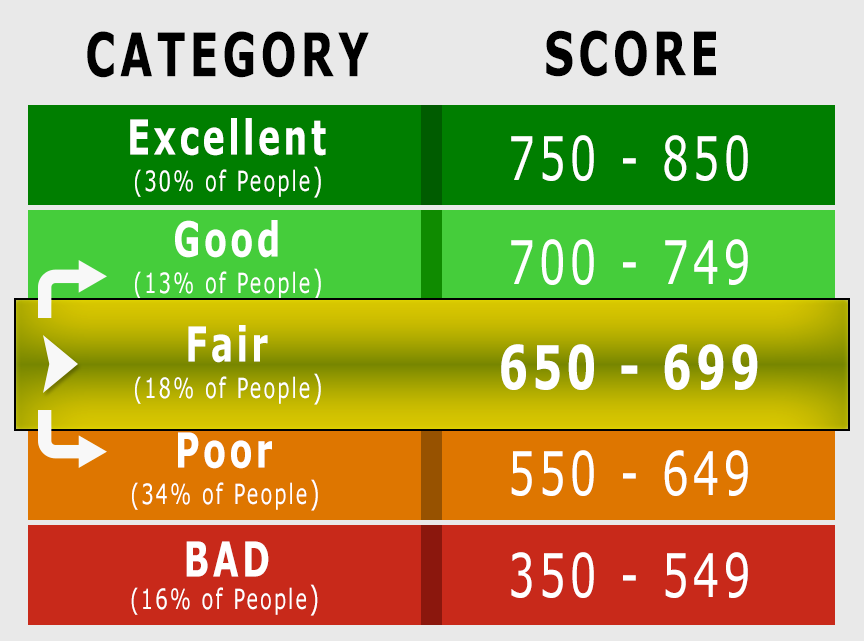
A gauge showing a fair credit score, one of the bands on the 300 to 850 scale. Photograph: Daniil Vin
Image Credits: Wikimedia Commons
The VantageScore bands
VantageScore uses the same 300 to 850 span but different labels and cutoffs. Capital One's comparison lists its bands as superprime at 781 to 850, prime at 661 to 780, near prime at 601 to 660, and subprime at 300 to 600.
The practical difference is visible at the boundaries. A score of 670 counts as good under FICO but only prime under VantageScore, while a score of 600 is subprime in one system and near the bottom of fair in the other.
Neither model is wrong. They weigh the same underlying report data differently, and lenders choose which model fits the product they are offering.
What lenders do with bands
Lenders use bands as a first sorting step. A higher band usually means more products to choose from, a better chance of approval, and lower interest rates, while a lower band means fewer options and higher rates.
Bands also set expectations inside the lender. Applicants in the fair band and below are often described as subprime borrowers, which means the lender prices in a higher expected rate of missed payments.
Approval is never guaranteed by a band, however. Lenders also review affordability, income, existing debts, reserves, and recent events on the application, and a strong band does not override those checks.
Why you have more than one score
Most people hold several scores at once, and that is normal. FICO and VantageScore produce different numbers, each bureau, Equifax, Experian, and TransUnion, may hold slightly different report data, and mortgage or auto lenders may use industry-specific models.
Scores also change over time because report data changes. New accounts, payments, balances, and inquiries all feed in, so a score checked in January and one checked in June can sit in different bands.
Compare scores only when the model, version, bureau, and date match. Comparing a FICO score from one bureau with a VantageScore from another is comparing two different rulers.
What moves a score between bands
Two categories dominate FICO scores. According to Experian, payment history makes up about 35% of a FICO score, and credit utilization, how much of available credit is in use, accounts for about 30%.
Length of credit history, new credit, and credit mix make up the rest. New hard inquiries typically cost only a few points, and their effect fades, while a missed payment can weigh far more heavily.
That weighting explains why bands move slowly. A single action rarely jumps a score across a band boundary, but months of on-time payments and lower balances can shift it steadily upward.
Frequently asked questions
What is a good credit score?
On the FICO scale, good runs from 670 to 739, and 670 or above is generally considered good. On the VantageScore scale, good, or prime, runs from 661 to 780.
What is the lowest credit score band?
On the FICO scale, anything below 580 is poor, the lowest band. On the VantageScore scale, scores from 300 to 600 are subprime, with 300 to 499 sometimes labeled very poor.
Is 800 a good credit score?
Yes. A FICO score of 800 or above is exceptional, the highest band, and a VantageScore of 781 or above is superprime. Both signal a very low-risk borrower, though approval still depends on the full application.
Can my score be in different bands at different bureaus?
Yes. Each bureau may hold different information, and different scoring models weigh that information differently. Check which model, version, and bureau produced each score before comparing them.
The bottom line
A credit score range is a ruler, and its bands are the marks along it: poor, fair, good, very good, and exceptional on the FICO scale, with a parallel set of labels under VantageScore. Knowing your band tells you roughly how lenders will read your history, but it is not a verdict on your finances.
Use bands for planning: check which model and bureau produced your score, note which band you sit in, and focus on the habits that move scores, on-time payments and lower balances, rather than chasing a single number.
This is general educational information, not financial advice.
Tags: credit scores, FICO, borrowing
Rive News is a research desk covering everyday science, home, health, and money topics in plain language.
Related
- How Does a Credit Score Actually Get Calculated
- Why is your credit score dropping for no reason? 8 silent triggers
- Hard and Soft Credit Inquiries: Differences That Affect Your Score
- How a Credit Freeze Works and When to Place One
Subscribe for one plain-language explainer each morning.
Rive News publishes research-desk explainers; corrections are noted on the article page.
Related stories

How your APR is divided by 365 to get daily interest
Lenders divide your APR by 365 for a daily rate, then apply it to your average daily balance. This guide walks through every step

What is the difference between APR and effective annual rate?
APR ignores compounding inside the year; the effective annual rate includes it. A 12.99% APR card really costs 13.80% a year. Worked

APY vs interest rate: what compounding does to your money
APY includes compounding; the interest rate does not. A 5% rate compounded monthly is really 5.12% APY. Here is how the math works and what