
How Do Exchange Rates Decide What Your Money Is Worth Abroad
Key takeaways
- An exchange rate is the price of one currency in terms of another, and it sets what your money buys abroad.
- Supply and demand drive floating rates, shaped by interest rates, inflation, trade, and investor confidence.
- The rate you get as a traveler is worse than the headline rate, because fees and margins take a cut.
An exchange rate tells you how much of one currency you get for another. If one dollar buys 0.85 euros, your money is worth 0.85 euros in the market at that moment. That single number shapes hotel bills, meal prices, and shopping totals on every trip abroad.
This article explains what an exchange rate is, what moves it, and how it decides what your money is worth abroad. It covers floating and fixed systems, the forces behind rate moves, and the gap between headline rates and the rate you actually receive.
What an exchange rate really is
An exchange rate is a price. It is the price of one currency measured in another currency. Just as a loaf of bread has a price in dollars, a dollar has a price in euros, yen, or pesos.
Rates move all the time in floating systems. A rate quoted in the morning can differ by the evening.
The foreign exchange market is the largest financial market in the world. Banks, businesses, investors, and central banks trade currencies there around the clock. Their orders set the going rate.
How exchange rates decide what your money buys
Start with a simple trip budget. Suppose you carry 1,000 dollars and the rate is 0.85 euros per dollar.
Your 1,000 dollars convert to 850 euros. If the rate moves to 0.92 euros per dollar before your trip, the same 1,000 dollars convert to 920 euros.
You did not earn more, save more, or change your plans. The market changed what your money was worth.
The same logic works in reverse. A weaker home currency buys less abroad.
Hotel rooms, taxis, and meals cost more in home currency terms, even when local prices stay flat. Travelers feel this fast, because they convert money in lump sums and pay local prices daily.
Exchange rates also decide what imports cost at home. When a currency weakens, imported goods get pricier.
When it strengthens, imports get cheaper.
Supply and demand set the price
The core driver of exchange rates is supply and demand. If more people want a currency than are selling it, its price rises. If more people sell it than want it, its price falls.
Demand for a currency comes from buyers of that country's exports, investors buying its assets, and travelers heading there. Supply comes from importers paying for foreign goods, investors moving money out, and travelers heading elsewhere.
A well-known example shows how large these swings can be. Over a five-year stretch described by ThisMatter, the British pound ranged from 1.41 to 1.08 against the US dollar, a swing of more than 30 percent. A traveler carrying dollars to Britain would have felt that swing directly in every purchase.
Interest rates are one of the strongest demand levers. When a country's interest rates rise relative to other countries, foreign investors seek higher returns there. They must buy the local currency to invest, and that demand pushes the rate up.
Inflation works in the opposite direction. If prices rise faster in one country than in others, its exports get less competitive.
Demand for its currency tends to fall, and the currency tends to weaken.
Floating, fixed, and managed systems
Not every currency floats freely. The International Monetary Fund classifies exchange arrangements along a spectrum, from no separate legal tender to independently floating rates. Where a currency sits on that spectrum shapes how much its rate can move.
In an independently floating system, the market sets the rate. Official intervention aims to slow sharp swings, not to fix a level. The US dollar, the euro, and the yen broadly work this way.
In a fixed peg, a country ties its currency to another currency or a basket of currencies. The monetary authority buys and sells foreign exchange to hold the parity. The IMF describes a conventional fixed peg as one where the rate stays within narrow margins, often less than plus or minus 1 percent around a central rate.
Between those poles sit managed floats and crawling pegs. In a managed float, the authority steps in without a fixed target, guided by reserves, trade balances, and market conditions. In a crawling peg, the rate adjusts in small steps, often in response to inflation gaps with trading partners.
For travelers, the regime matters. A pegged currency feels stable until the peg changes.
A floating currency moves daily, so trip costs shift with the market.
Why the same money buys different amounts in different places
Exchange rates are only half the story. Local prices decide the rest. A strong currency in an expensive city can still buy less than a weak currency in a cheap town.
Economists use purchasing power parity to compare this. The idea is simple: the same basket of goods should cost the same everywhere once converted at a fair rate. In practice, it rarely does, because rents, wages, and services differ by place.
The Economist's Big Mac Index is a lighthearted version of this test. It compares the price of a Big Mac in local currency with the US price, then checks the implied rate against the market rate. Gaps show that market rates and local buying power are not the same thing.
This gap is why two trips with equal budgets feel different. A favorable rate plus low local prices stretches money far.
A favorable rate in a pricey city may only bring costs back to normal.
The rate you see is not the rate you get
Headline rates are wholesale rates between banks. Travelers rarely get them. Banks, card networks, airport kiosks, and exchange booths each add a margin or a fee.
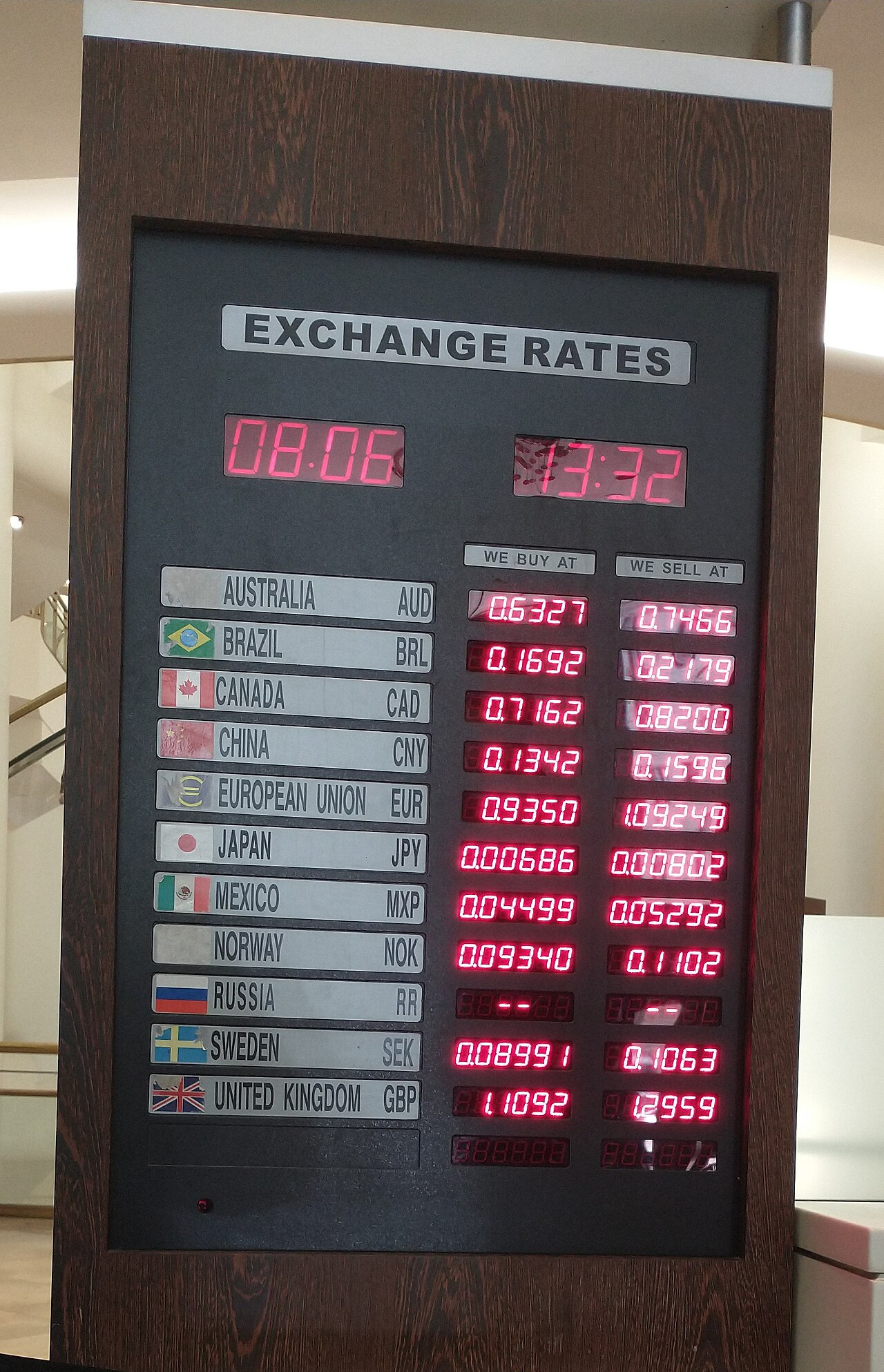
The spread between the buy rate and the sell rate is the simplest form of this cost. A booth might buy dollars at one rate and sell euros at a worse one.
The gap is its profit. Airport booths often have wider gaps than city banks or ATMs.
Card payments add their own layer. Some cards charge a foreign transaction fee, often around 1 to 3 percent, on top of the network conversion.
Others charge no such fee.
Cash withdrawals abroad can help or hurt. A local ATM often converts at a rate close to the wholesale rate, but the ATM owner and your home bank may each add fees. Declining the ATM's own conversion offer and letting your home bank convert usually gives a better rate, because the ATM's offer carries a wide margin.
What moves rates before and during your trip
Rates move on news. A central bank decision, an inflation report, an election result, or a trade announcement can shift a currency within hours. Travelers cannot predict these moves, but they can avoid the costliest reactions to them.
One common mistake is converting all trip money at the worst moment. Airport panic buying, last-minute exchanges, and single-day conversions lock in whatever rate happens to hold that day. Spreading conversions across several days averages the rate and cuts the risk of one bad day.
Another mistake is ignoring fees while chasing the rate. A booth with a great posted rate and a large flat commission can cost more than a bank with a plain rate and no commission. The total received matters, not the poster.
A third mistake is paying in home currency abroad. When a shop or ATM offers to charge you in your own currency, the conversion usually carries a heavy margin. Paying in local currency and letting your card network convert tends to cost less.
How to make your money go further abroad
Start by comparing the total cost of each conversion method. Check your bank's foreign transaction fee, your card's fee, and the ATM fees at your destination.
Use a card with no foreign transaction fee for most spending. Keep a small amount of local cash for markets, tips, and places that do not take cards. Withdraw cash in larger sums to spread out flat ATM fees, but avoid carrying large amounts for safety.
Watch the rate in the weeks before you travel, without trying to time it precisely. If your home currency strengthens, converting a portion early can lock in part of the gain. If it weakens, waiting may help, but no one can call the turn with confidence.
Track spending in local currency, not home currency. Mental conversion at every purchase invites overspending when the rate looks generous. A daily budget in local money keeps totals honest.
FAQ
How do exchange rates decide what your money is worth abroad?
An exchange rate sets how many units of foreign currency one unit of your currency buys. Multiply your trip budget by the rate to get your spending power. A stronger home currency buys more abroad, and a weaker one buys less.
Why do exchange rates change every day?
Floating rates change with supply and demand in the foreign exchange market. Interest rates, inflation, trade flows, investor sentiment, and political news all shift that balance. Rates in fixed systems move less, but they can still be reset by the authorities.
Why is the airport rate worse than the rate I saw online?
Online quotes usually show wholesale or mid-market rates. Airport booths add margins and fees for convenience and rent.
City banks, ATMs, and fee-free cards usually give closer to the market rate.
Should I convert money before I travel or at my destination?
It depends on fees and rates in each place. A small amount of local cash before departure covers arrival costs.
Larger sums often convert better through local ATMs or banks at the destination.
Does a strong currency always mean a cheap trip?
No. Local prices matter as much as the rate.
A strong currency in an expensive city may buy no more than a weak currency in a cheap town. Check typical prices for food, lodging, and transport alongside the exchange rate.
The bottom line
An exchange rate is the price of your money in another currency. Supply and demand set it, interest rates and inflation push it around, and the regime decides how far it can move. Your trip budget is the rate multiplied by your cash, minus the fees and margins along the way.
You can control how you convert, when you convert, and how you track spending.
This article is for general information, not financial advice.
Tags: exchange rates, currency, travel money, personal finance
Latest in Finance
- How net pay differs from gross pay
- How pensions and retirement saving work
- Needs vs wants in a monthly budget
- Why an insurance deductible matters at claim time
Subscribe for one practical money explainer each week.
Related stories

How your APR is divided by 365 to get daily interest
Lenders divide your APR by 365 for a daily rate, then apply it to your average daily balance. This guide walks through every step

What is the difference between APR and effective annual rate?
APR ignores compounding inside the year; the effective annual rate includes it. A 12.99% APR card really costs 13.80% a year. Worked

APY vs interest rate: what compounding does to your money
APY includes compounding; the interest rate does not. A 5% rate compounded monthly is really 5.12% APY. Here is how the math works and what