
Why do I get out of breath so fast when running?
Key takeaways
- Getting winded means oxygen demand has outrun your body's oxygen delivery system. It is normal and trainable.
- Your heart's stroke volume, your lungs, and your muscles' ability to extract oxygen all set your ceiling. All of them adapt.
- Breathlessness that feels out of proportion to your effort, or comes with chest pain or dizziness, deserves a doctor's visit.

A runner out for a solo jog on an open road. Photograph: Basotxerri/Wikimedia Commons
Image Credits: Wikimedia Commons
Getting out of breath while running means your muscles are asking for more oxygen than your heart, lungs, and blood vessels can deliver right now. Your leg muscles burn oxygen to make energy, and the harder they work, the more they need. When delivery falls behind demand, your brain ramps up breathing rate and heart rate, and you feel winded.
That gap is not a character flaw or a broken body. It is physiology. Every beginner runner who has stopped after two minutes wondering why walking feels fine has been through the same thing. This article answers the question "why do I get out of breath so fast when running." It covers why the oxygen gap opens, how your delivery system ramps up, what your fitness baseline has to do with it, and when breathlessness deserves a doctor's visit.
Why getting winded happens
Running is one of the most oxygen-hungry things a human can do. At rest, your body sips oxygen. At a run, your working muscles can demand many times more of it. Oxygen is the raw material your muscle cells use to generate ATP, the molecule that powers every contraction.
Harvard Health Publishing describes VO2 max, the maximum oxygen your body can use during exercise, as a direct measure of this supply chain in action.
When you start running faster than your aerobic system can support, the body does not politely ask for more oxygen. It panics a little. Breathing gets deeper and faster, your heart pounds, and within a minute or two you hit a wall.
This is simply demand exceeding supply.
Here is the key insight: the size of that supply line is not fixed. It is your current fitness level. A trained runner's body moves and uses far more oxygen per minute than a beginner's. That is why the same pace feels easy for one person and brutal for another.

A jogger keeps an easy pace down an empty city avenue. Photograph: Anthony Quintano/Wikimedia Commons
Image Credits: Wikimedia Commons
How oxygen delivery ramps up
Your oxygen delivery system has three main parts: the heart that pumps blood, the lungs that load it with oxygen, and the muscles that extract that oxygen from the blood. When you run, all three throttle up together.
Your heart is usually the limiting factor. Cardiac output, the total blood your heart pumps per minute, is the product of stroke volume (blood moved per beat) and heart rate.
Your maximum heart rate barely changes with training, so fitness gains come mostly from stroke volume. A stronger, more compliant heart moves more blood with every beat.
That is not a metaphor. In one widely cited study by Jan Helgerud and colleagues, interval training increased stroke volume by about 10 percent. That accounted for a large share of the measured VO2 max improvement.
The heart was not beating faster. It was pumping more per beat.
The muscles adapt too. Training builds more mitochondria, the tiny structures inside muscle cells that use oxygen to make energy, and more capillaries to carry blood to each fiber. Runner's Blueprint, summarizing published research, reports that mitochondrial content can rise 25 to 30 percent after just a few weeks of high-intensity interval training, alongside denser capillary networks.
Put it together and the picture is clear: a beginner gets winded fast because the whole chain is narrow. The heart moves less blood per beat, fewer capillaries serve each muscle fiber, and the mitochondria in the muscles are fewer and less efficient. Every link improves with consistent training.
What your fitness baseline has to do with it
Two beginners can run the same pace and have wildly different experiences. Genetics, age, body weight, and recent activity all set your starting point. Someone who has been sedentary for a year is starting with a narrower oxygen pipeline than someone who cycles to work.
Deconditioning works in reverse, too. Take a few weeks off and your aerobic system starts shrinking back down, because the body does not spend energy maintaining capacity it is not using. That is why a runner returning after a break often feels like a beginner again.
There is also a quirk worth knowing: VO2 max responds fastest in the least trained people. Uphill Athlete notes that VO2 max typically plateaus within four to six months of consistent high-intensity training. The heart's growth is constrained by the pericardium, the inelastic sheath around it. Beginners therefore see the biggest early gains, and then progress shifts toward economy and endurance at lower intensities.
In plain terms, the first months of running are the most rewarding. Your body is hungry to adapt.
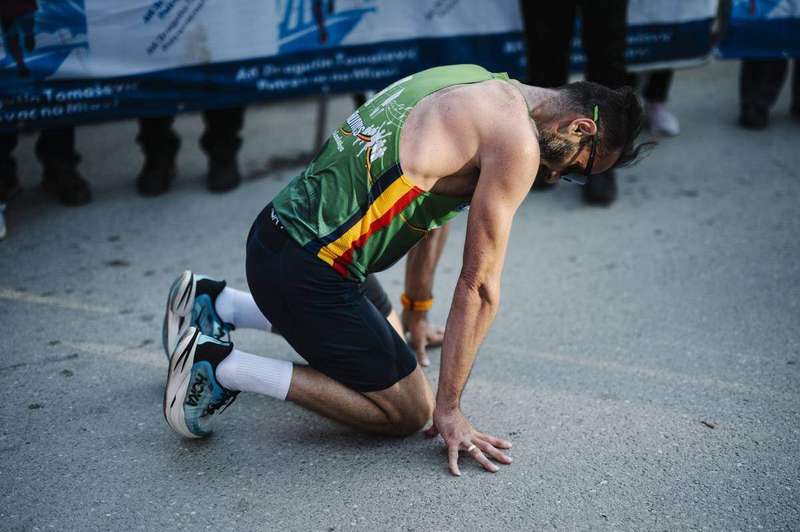
A marathoner catches his breath on the pavement after crossing the finish line. Photograph: Shixart1985/Wikimedia Commons
Image Credits: Wikimedia Commons
When breathlessness deserves a doctor's visit
Most out-of-breath-on-a-run stories end with fitness. Some do not, and it is worth knowing the difference.
Exercise-induced bronchoconstriction is one real cause. The Mayo Clinic explains that airways can narrow during or after physical activity, causing shortness of breath, wheezing, coughing, chest tightness, or unusually poor performance.
Symptoms usually begin during or soon after exercise and can last an hour or longer without treatment. People without an asthma diagnosis can have it too.
Cleveland Clinic cardiologist Michael Faulx, MD, gives a practical rule: see a physician when shortness of breath feels out of proportion to what you would expect for your age and activity level. He also flags two specific red flags: getting short of breath when you lie down to sleep, or waking at night struggling to breathe.
Beyond that, treat these as warning signs during exercise: chest discomfort, unusual breathlessness with or without chest discomfort, dizziness or lightheadedness, and palpitations or skipped beats. If breathlessness is quickly getting worse, or an inhaler brings no improvement, that is an emergency.
None of this is medical advice for your specific case. It is a starting point for a conversation with your own doctor.
Frequently asked questions
Is it normal to be out of breath after only two minutes of running?
Yes, for a beginner it is completely normal. Your oxygen demand jumps the moment you start running, while your delivery system is still sized for walking and daily life. Almost every new runner hits this wall, and it is the exact gap that training closes.
Why can I walk for miles but not run for five minutes?
Walking sits comfortably inside your aerobic capacity, so oxygen supply keeps up with demand indefinitely. Running multiplies the demand. Once you cross the threshold your aerobic system can support, your breathing and heart rate spike to compensate.
Should I breathe through my nose or my mouth when I run?
Breathe however lets you move enough air. At easy paces, nasal breathing works for some runners.
Once intensity rises, your body will insist on mouth breathing because it needs the larger airway. Forcing nasal breathing at hard efforts just adds unnecessary strain.
How long until I stop getting winded so fast?
Most beginners notice real improvement within three to six weeks of consistent running, with the biggest gains in the first few months. Run-walk intervals, where you alternate short runs with walking breaks, are the fastest way to build the aerobic base without blowing up every session.
Outlook
Getting out of breath fast when you start running is your body's honest signal that demand has outrun supply, and supply is the trainable part. Stroke volume rises, mitochondria multiply, capillaries branch out, and the same pace that wrecked you in week one becomes your warmup pace in week ten.
The one caution stands: if your breathlessness feels out of proportion, comes with chest pain, wheezing, or dizziness, or simply worries you, talk to your doctor before pushing through it. It's a good idea to see a doctor if breathlessness is new, persistent, or paired with any of the warning signs above.
For everyone else, the prescription is beautifully boring: run a little, rest a little, repeat, and let your body build a bigger engine.
Rive News's research desk covers practical health and fitness topics from published sources. This article is for general information only and is not medical advice.
Subscribe to the Rive News newsletter for one practical explainer like this every morning.
Related stories

How long does it really take to build noticeable muscle?
Strength gains start in week one, but visible muscle takes 8-12 weeks for most beginners. What the Oklahoma CT-scan study measured,

Why you feel dizzy after a workout: the 5 common causes
Post-workout dizziness usually comes from a blood pressure dip, dehydration, or low blood sugar. The numbers behind each cause, and when

Why Do Knees Hurt When Squatting but Not Running?
Knees hurt when squatting but not running because deep bends multiply force on the kneecap. Learn the mechanics, common causes, fixes,