
Why Is Airplane Food So Bland at Altitude?
Key takeaways
- A 2010 Fraunhofer Institute study found that altitude reduces sensitivity to sweet and salty flavors by up to 30 percent, while sour, bitter, and spicy tastes stay largely intact.
- Cabin humidity around 12 percent dries out your nose, and smell does most of the work of tasting, so dry air means dull flavor.
- Airlines fight back with heavy seasoning and umami-rich ingredients like tomato, soy, and parmesan, which cut through the dullness.

A typical economy class meal tray. At cruising altitude, your senses perceive its flavors very differently than on the ground. Photograph: Sunnya343/Wikimedia Commons
Image Credits: Wikimedia Commons
Airplane food has a reputation problem. Passengers blame the airline, the caterer, and the reheating.
But a big part of the blame belongs to the cabin itself. The same meal served on the ground would taste noticeably different.
The blandness is mostly a perception problem, not a cooking problem. Your taste buds and your nose work worse at 35,000 feet. This article explains why airplane food tastes bland at altitude, including what the landmark 2010 study found, how low humidity and pressure dull your taste, and what airlines do about it.
What the Fraunhofer study found
In 2010, Germany's Fraunhofer Institute for Building Physics ran a study commissioned by Lufthansa to find out exactly what altitude does to taste. Participants tasted the same ingredients in normal ground conditions and in a simulated low-pressure cabin environment. The results were striking.
Sensitivity to salty and sweet flavors dropped by up to 30 percent at altitude, according to the study's findings. Salt was perceived as up to 30 percent less intense and sugar up to 20 percent less intense. Sour, bitter, and spicy flavors, the researchers noted, remained largely unaffected.
Dr. Andrea Burdack-Freitag, an aroma chemist who worked on the project, summed it up in a sentence: "In the air, food and drink tastes as it does when we have a cold. " The comparison is apt.
A cold dulls flavor mainly by blocking smell, and the cabin does something similar through dry air.
The study also offered a practical hint. Dishes rich in umami, the savory fifth taste, held up better at altitude. Asian dishes with intense aromas and umami depth retained their flavor more effectively than milder dishes like plain fish or poultry.
Why low humidity and pressure dull your taste
Three cabin conditions team up against your palate: dry air, low pressure, and noise.
Cabin humidity is startlingly low. A review published by the University of Oxford put humidity at cruising altitude at around 12 percent, which is drier than most deserts. The dry air is partly deliberate: moisture encourages corrosion in the fuselage.
But your nasal passages pay the price. They dry out, and your sense of smell fades.
That matters more than most people realize. A large share of what we call taste is actually smell. When your nose is compromised, food tastes flat, which is exactly the cold analogy from the Fraunhofer researchers.
Lower pressure plays its own role. As the plane climbs and cabin pressure falls, the change in air pressure numbs about a third of the taste buds, according to Discover Magazine's account of the research. Reduced pressure also compounds the drying effect on the nose.
Then there is the noise. Cabin noise can reach around 80 decibels, about the level of a vacuum cleaner, and research has shown that background noise weakens the perception of sweetness and saltiness specifically. Quieter cabins, such as those on private jets, measurably improve how food tastes, which is one reason first class dining feels like a different product.
Why some flavors survive (and even improve)
The Fraunhofer results contain good news for certain foods. Because sour, bitter, and spicy flavors are barely affected by altitude, dishes built on those tastes translate well to the cabin.
Umami is the real winner. Ingredients packed with glutamates, such as mushrooms, tomatoes, soy sauce, and parmesan, cut through the flavor fog of the cabin. That is why tomato juice is such a famous airplane drink: it tastes far less acidic at altitude than on the ground, and its umami depth survives the dullness.
Airlines know this. Caterers increasingly design menus around bold, savory, umami-rich ingredients rather than delicate seasoning that would vanish at 35,000 feet. Heavy salting and spicing, which would be overkill in a restaurant, are calibration for a dulled palate.
The food's journey matters too. Airline meals are prepared on the ground hours before serving, then chilled, transported, loaded, and reheated.
Food scientist Harold McGee has noted that once reheated meat crosses about 160 degrees Fahrenheit, or fish about 140, it turns dry and tough no matter what you do. Some of the blandness is simply the cost of feeding hundreds of people from a galley kitchen.
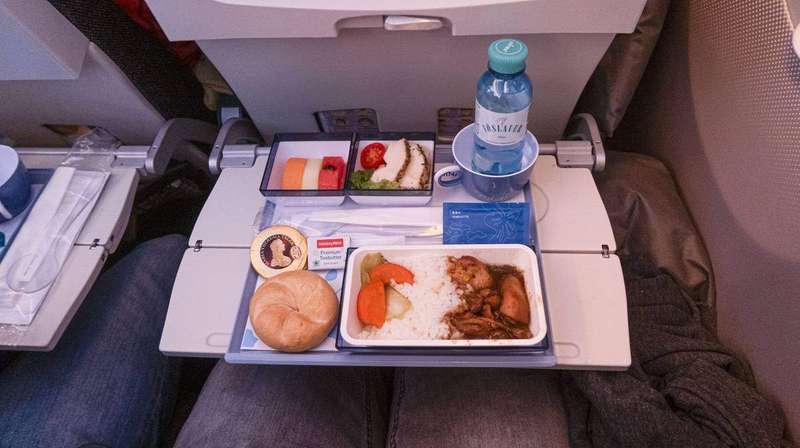
Another economy class tray. Meals are cooked hours before serving and reheated in the galley, which adds to the texture challenge. Photograph: Simply Aviation/Wikimedia Commons
Image Credits: Wikimedia Commons
What airlines do about blandness
Airlines do not just accept the dullness. Catering teams now taste-test recipes in simulated cabin conditions, seasoning more aggressively than they would for ground service.
Menu design has shifted toward altitude-friendly profiles. Curries, tomato-based dishes, and soy-seasoned meals appear disproportionately often on in-flight menus because their flavor architecture survives the cabin. Delicate cream sauces and subtle herbs, which depend on nuance, largely stay on the ground.
Drinks get the same treatment. Full-bodied, fruit-forward wines replace delicate whites that would taste thin and sour at altitude.
Even tea and coffee blends are adjusted for cabin service. Blue Sky News, reporting on the industry's response, notes that airlines now design meals specifically to appeal to taste buds dulled at high altitude, which is why caterers season with such a heavy hand.
Passengers can help themselves a little. Staying hydrated keeps nasal passages working better, and choosing umami-rich options over mild ones is the smartest order you can place at 35,000 feet.
Frequently asked questions
Do airlines season food differently for flights?
Yes. Caterers develop recipes for the cabin, not the ground, using heavier salt, spice, and umami-rich ingredients to compensate for dulled taste. Many test dishes in pressurized, low-humidity environments before they reach the menu.
Why does tomato juice taste better on planes?
Tomato juice is rich in umami, which survives altitude well, and its acidity tastes milder in the cabin. The combination makes it taste smoother and more flavorful at 35,000 feet than it does on the ground.
Does altitude change the food itself or just my perception?
Mostly your perception. The low pressure, dry air, and noise change how your nose and taste buds work, not the chemistry of the meal. The exception is the reheating process, which genuinely dries out proteins if temperatures climb too high.
Can I do anything to make airplane food taste better?
Drink water through the flight to keep your nasal passages moist, pick boldly flavored or umami-rich dishes over mild ones, and bring a small hot sauce or spice packet if you like heat. Spicy flavors are barely dulled by altitude.
The bottom line
Airplane food tastes bland mostly because of you, not the chef. At cruising altitude, dry 12-percent-humidity air shuts down your sense of smell, lower pressure numbs your taste buds, and cabin noise dulls sweet and salty perception by up to 30 percent. Sour, bitter, spicy, and umami flavors survive, which is why airlines lean on bold seasoning and savory ingredients.
The next time a tray lands in front of you, skip the mild chicken and order the curry. Your altitude-adjusted palate will thank you.
Tags: airplane food, travel science, taste, aviation, altitude
Rive News is the research desk behind this explainer series, covering health, science, and everyday questions with sourced reporting.
Subscribe for one evidence-based explainer in your inbox every morning.
Related stories

The 3-1-1 liquids rule for planes: what each number means
TSA's 3-1-1 rule limits carry-on liquids to 3.4-ounce containers in one quart bag. Where the 2006 rule came from, what counts, and how

Carry-on size limits: why airlines each set their own
Airlines set their own carry-on limits because the FAA only requires each carrier to have a policy, not one global size. Why 22 x 14 x
Why Do Ears Pop on Planes, and How Do You Stop It?
Ear popping on planes is your Eustachian tubes equalizing pressure. Learn why descent hurts most, plus the techniques Mayo Clinic