
How Do Background Checks Actually Verify Past Employment?
Key takeaways
- Verification confirms only the jobs you list; no national database holds every job you ever had.
- Screeners use two methods: direct calls to former employers and automated queries of payroll databases.
- Federal law requires your written consent first and gives you the right to dispute errors.
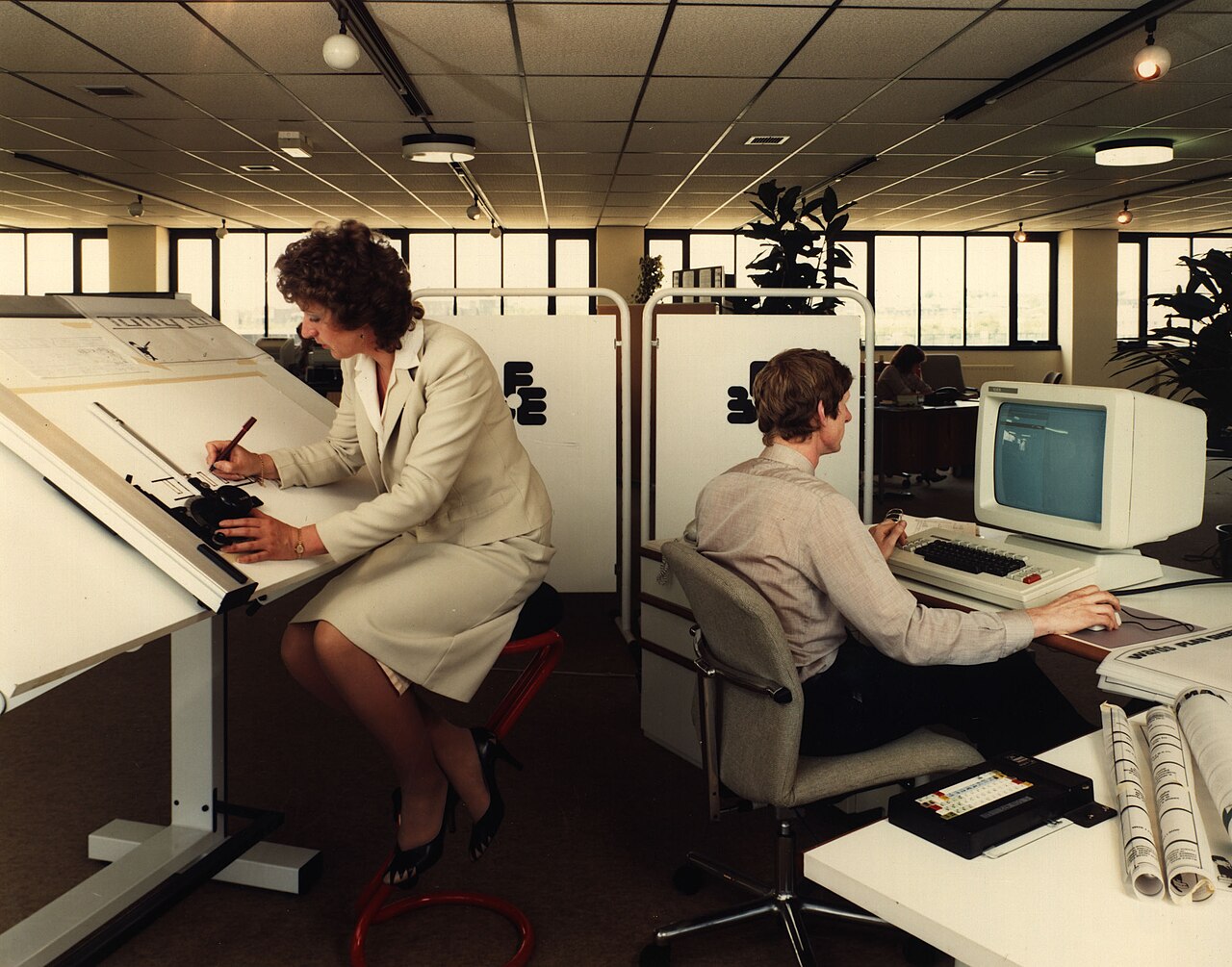
Office workers at their desks. Employment verification is the process of confirming the job history a candidate reports. Photograph: Wikimedia Commons
Image Credits: Wikimedia Commons
A background check does not automatically include your work history. A background check is a set of searches the employer selects, and employment verification is only one possible component.
When it is included, the screener confirms the facts you reported: employer name, job title, and dates of employment. This article explains the actual mechanics, what gets confirmed, what stays hidden, and what rights you have during the process.
There is no master database of your job history
The single most misunderstood fact about employment verification is that no complete national database of jobs exists. There is no government file listing every position you have ever held that an employer can simply pull up. A Social Security number trace does not list your employers, and the IRS does not share W-2 records with screening companies.
That means verification is built on what you provide. The screener checks the jobs you list on your resume or application, plus any jobs the employer chooses to check. A job you leave off your resume usually will not show up, because the screener never asks about it.
This cuts both ways: honest omissions of short or irrelevant roles are normal, but inventing a job or inflating a title will be caught, because the listed claims are exactly what gets tested.
It also means a basic criminal background check shows none of this. Employment verification has to be added to the screening package. Employers add it when confirmed work history matters for the role, including management jobs, positions requiring specific experience, and regulated fields such as finance and healthcare.
The two verification methods
Screeners use two primary methods, and large employers typically use both. The first is direct contact.
A screening representative calls or emails the human resources or payroll department of each former employer and confirms the details from personnel files. This is an administrative process focused on facts, and it is different from a reference check, where a former manager gives subjective feedback about your performance.
The second method is automated database lookup.
The most widely used platform is Equifax's The Work Number, which holds over 813 million employment records contributed by more than 4.88 million employers. When your former employer participates in this database, a hiring company can pull your job title, dates of employment, and sometimes salary data almost instantly rather than waiting for someone in HR to return a call. Automated checks through platforms like this are where the bulk of verifications happen at mid-size and large companies.
Accessing these centralized databases requires the screening company to go through a credentialing process proving it has a permissible purpose for the information. The data comes directly from employer payroll systems, which makes it harder to dispute but also means errors usually trace back to the former employer's own records.
What gets confirmed, and what does not
Employment verification focuses on factual, objective details. The most consistently confirmed data points are the employer name and location, the precise start and end dates of employment, and the job title compared against what you reported. Comparing dates across jobs also reveals gaps, so unexplained breaks in your work history become visible indirectly.
Some details appear only sometimes. Rehire eligibility is confirmed in many checks but withheld by plenty of employers as a matter of policy. Reason for leaving is often not disclosed.
Salary history is confirmed rarely, and only where requested and allowed by law; several states now restrict or ban salary history questions outright. Performance reviews are almost never shared, since former employers limit themselves to facts to avoid defamation risk.
If the screener cannot verify a job through either method, it may ask you for documents. Keep W-2s, 1099s, pay stubs, or offer letters for every job. A former employer that has closed, merged, or lost its records is a common reason for verification gaps, and your own documents are the fastest way to close them.

A businessperson prepares for a meeting. Most employment verifications confirm dates and titles, not performance. Photograph: Wikimedia Commons
Your rights during the process
When a third-party screening company is involved, federal law gives you specific protections. The Fair Credit Reporting Act requires the employer to provide a clear, written disclosure that a background check will be conducted, and you must sign a separate document granting explicit authorization before any screening can begin. A buried line in the job application does not count; the disclosure must stand alone.
Accuracy rules apply too. If the report contains an error, you have the right to dispute it, and the screening company must investigate.
Crucially, if the employer plans to reject you based on the report, it must first give you a copy and a summary of your rights, a step called pre-adverse action. This gives you a window to correct mistakes before the hiring decision becomes final.
Watch for two more legal boundaries. The Equal Employment Opportunity Commission warns that employers cannot use background information in ways that discriminate based on race, national origin, sex, religion, disability, age, or other protected characteristics, whether intentionally or through disparate impact. And some states limit what former employers may disclose, so the exact contents of a verification can vary by location.
How to make verification painless
The best preparation is boring: keep records.
Save offer letters, final pay stubs, and separation notices for every role. If a company rebranded or was acquired, note the old and new names so the screener does not chase a dead entity. If you used a different name during a job, list it.
Be precise on dates. Most verification failures come from small mismatches, like listing January when HR records show February, or rounding a nine-month stint to a year. Month-and-year accuracy is usually enough, but do not inflate.
If you are unsure, check your own records before the application goes in.
Finally, warn your references and former HR contacts that a verification call is coming. A heads-up shortens turnaround, which typically runs one to three business days for a standard employment check.
If you know a former employer is unreachable, tell the hiring company upfront and offer documents. Transparency about a gap beats a screener discovering it.
Frequently asked questions
Do background checks show every job I have ever had?
No. There is no national database of complete employment records. Verification covers the jobs you list on your resume or application, plus any jobs the employer chooses to check.
A job you leave off usually stays off.
Will a background check show my salary?
Rarely. Salary history is confirmed only when requested and allowed by law.
Many states now ban salary history questions, and most employers do not ask for pay data during verification.
How far back do employment checks go?
Most employers verify the last seven to ten years, or the jobs relevant to the role. There is no single legal limit, but older roles are checked less often, and records get harder to find with time.
Can I refuse to let them contact a current employer?
Yes. Candidates can withhold permission to contact specific employers, and most applications include a checkbox for "do not contact current employer." The hiring company will usually wait until an offer is imminent before contacting them.
The bottom line
Background checks verify past employment by confirming what you report, not by discovering your whole work history. Screeners call former employers directly and query payroll databases like The Work Number, confirming names, titles, and dates. Knowing the mechanics helps you prepare: keep your records, report dates accurately, and use the dispute rights the law gives you if something comes back wrong.
Latest in Career & Jobs
- Do recruiters really look at your resume for 6 seconds - what the research actually says.
- How to make your LinkedIn profile attract recruiters - profile tweaks that get inbound interest.
- Transferable skills examples by industry - translate your experience for a new field.
- What to do when you hate your job but cannot quit yet - practical steps for a stuck career phase.
Subscribe for one clear career explainer every weekday morning.
Related stories
How to Ask for a Raise With Data, Not Emotions
Ask for a raise with market data and documented results, not emotions. Research your rate from BLS wage tables, build an evidence file, run

How to Explain a Career Gap on Your Resume Honestly
A career gap is not a red flag if you explain it honestly: give a reason, show what you did, and point forward. Recruiters reveal the exact

How to Switch Careers at 30 With No Experience in the Field
A career change at 30 means repackaging a decade of transferable skills, not starting over. Map your skills, earn one certification,