
Why Do Companies Run Panel Interviews Instead of One-on-One?
Key takeaways
- Panels dilute individual interviewer bias: one person's gut feeling carries less weight when several evaluators score the same conversation.
- A panel compresses three to five separate one-on-one meetings into a single session, shortening the hiring timeline for everyone.
- The format only works when panelists judge independently with separate scorecards; otherwise it encodes the loudest voice as consensus.
Walking into a room with four interviewers staring back is nobody's idea of fun, yet the panel format keeps spreading. It is the default for senior hires, cross-functional roles, and any position where several teams want a vote.
Companies did not adopt it to intimidate candidates, though. They adopted it because the one-on-one format has well-documented flaws, and a panel, done right, fixes several of them at once.
This article explains why companies prefer panels: bias dilution, standardized scoring, time compression, and broader perspective. It also covers the honest caveat, that panels can fail in a specific way, and what that means for candidates preparing for one.
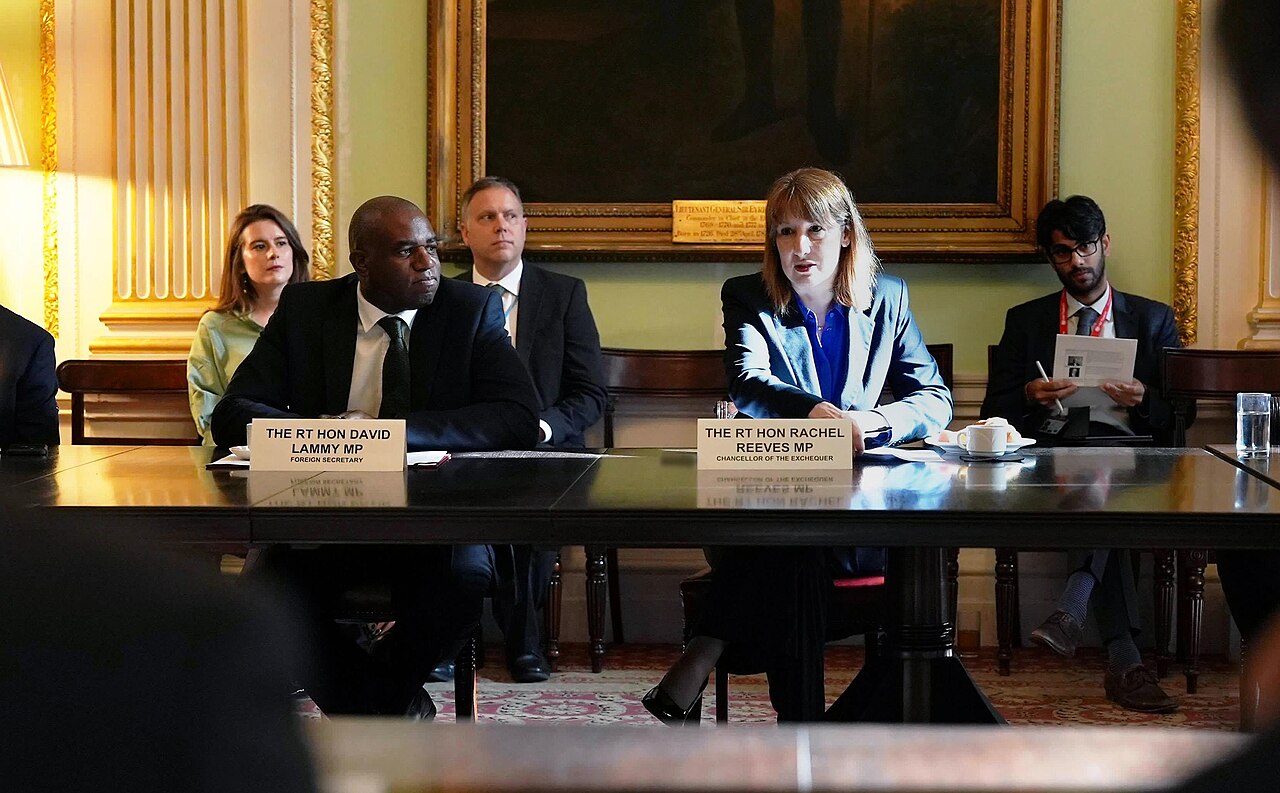
A business meeting in progress around a table. Photograph: Foreign, Commonwealth & Development Office
Image Credits: Wikimedia Commons / Foreign, Commonwealth & Development Office, The SABR Office
One interviewer is a noisy measuring instrument
The deepest argument for panels comes from industrial-organizational psychology. An interview score is not a precise measurement; it is a noisy human judgment.
A single interviewer's score correlates with eventual job performance only modestly, in the 0.2 to 0.3 range at best, and individual leniency effects are large and stable, according to Residency Advisor's review of the interview research literature. Some interviewers are always tough graders. Others inflate.
A candidate's fate can swing on which grader they happen to draw. Multiple interviewers change the math: if each panelist's judgment is Score = true ability + rater bias + random error, then averaging several independent judgments shrinks the random component.
The idiosyncratic dislike one interviewer has for a candidate's school, accent, or presentation style gets diluted instead of deciding the outcome. Residency Advisor reports that structured interviews with multiple raters tend to show smaller demographic score gaps than unstructured single-interviewer formats, though the effect depends heavily on how the panel is designed.
There is also the halo effect problem. In a one-on-one, an affable candidate can mask skill deficits through charm, because one person is simultaneously asking questions, listening, tracking time, taking notes, and reading body language.
As Strategic HR Inc. notes, citing the Society for Human Resource Management, those competing tasks create distractions that cause a lone interviewer to miss important cues.
A panel splits the load: one person asks, others observe, and claims get audited in real time. A candidate's answer about managing deadlines might satisfy a director while the project manager on the panel instantly spots the logistical holes.
Panels standardize the evaluation
A second reason companies prefer panels is consistency. Sequential one-on-one interviews drift.
Interviewer one asks about leadership, interviewer two spends twenty minutes on hobbies, and interviewer three rehashes the resume. Candidates end up evaluated on different evidence, which makes comparison unfair.
Panels typically work from a shared, standardized question set, so every candidate for the same role gets the same core inquiries. That uniformity is paired with a common scoring rubric that all panel members use to evaluate responses, according to Climb the Ladder's breakdown of the format. Everyone measures the same competencies against the same scale, which makes the debrief a discussion of evidence rather than a contest of impressions.
The debrief itself is a bias check. Panelists must articulate and defend their assessments to peers immediately after the interview, which steers the evaluation toward observable data instead of private intuition.
This peer review acts as a brake on rash decisions and forces vague objections into specifics. Candidates who explain career gaps honestly benefit from this structure, since a structured panel is more likely to weigh the explanation than an unstructured one-on-one driven by first impressions.
Attendees at an annual business meeting. Photograph: The SABR Office
The timeline compresses dramatically
The most practical reason is logistics. The traditional model sends a candidate through three to five separate sequential interviews with different stakeholders, stretching the hiring cycle over weeks.
Panels compress those touchpoints into a single evaluation block. When five stakeholders can evaluate the candidate simultaneously, the company reaches a decision faster and the candidate spends far less total time in interviews.
This compression has a second-order effect on fairness too. When one-on-ones are spread across separate days, the candidate's energy, the interviewers' moods, and even the news cycle vary between sessions, injecting noise that has nothing to do with ability.
One intense session is stressful, but the evaluation happens on a level playing field: everyone saw the same performance. For candidates, the trade is clear. Preparing for a panel takes more work, but passing means broad alignment rather than a single person's chemistry, which tends to favor solid, well-rounded competency over individual charm.
There is a related benefit for the team doing the hiring. Sitting on a panel gives future colleagues a shared reference point for the new hire, which shortens onboarding. Everyone heard the same answers, so expectations start aligned instead of assembled from five different debriefs.
When panels fail: the independence problem
Here is the honest caveat, and it is important. The entire statistical argument for panels rests on one assumption: that panelists form their judgments independently.
If four people sit in the same room hearing the same answers and watching each other's nods and frowns, their judgments are correlated, not independent. Averaging correlated judgments does not reduce bias. It encodes the bias of the loudest or most senior interviewer into a group consensus that merely looks more rigorous, as HireTruffle's analysis of the format argues.
The failure mode is familiar to anyone who has sat on a hiring panel. The founder praises the candidate's calm under pressure, everyone else calibrates to that read, and the debrief becomes a ratification exercise rather than a triangulation.
None of the panelists were asked to evaluate a specific criterion independently; they were asked to form an impression in parallel and then defend it. That is an expensive version of one person deciding.
The panel design that actually works
The version that works is narrower and more structured. Each panelist evaluates a different criterion they are uniquely qualified to assess, works from their own question set, and submits a private scorecard before the debrief.
When a company can name each panelist's criterion in one sentence, the panel is doing real triangulation. When four people are all evaluating "fit," the format is mostly theater. This is also why candidates should ask about pay ranges directly rather than waiting for a panel to volunteer them, and why understanding what recruiters actually scan for matters before the room even convenes.
How many people are on a typical panel?
Usually three to five: the hiring manager, an HR representative, and one or two future colleagues or cross-functional stakeholders. Larger panels add scheduling pain without much extra signal.
Are panel interviews harder to pass than one-on-ones?
They are more intense in the moment but often fairer in aggregate. One-on-ones reward rapport with a single person; panels reward consistent competence across several perspectives.
Do panels help with hiring bias?
They can, but only with structure. Structured panels with independent scorecards show smaller demographic score gaps than unstructured single interviews. Unstructured panels can actually concentrate the biases of the most influential panelist.
Should I address all panelists or just the one who asked?
Address the person who asked first, then bring the others in with eye contact as you answer. Ignoring silent panelists reads as poor collaborative awareness; they hold vetoes too.
Why do some companies still use one-on-ones?
For early screening rounds and roles with a single clear decision-maker, one-on-ones are cheaper and sufficient. Panels pay off when the decision is genuinely shared across functions.
The bottom line
Companies run panel interviews instead of one-on-ones because several evaluators produce a less noisy, less biased, more standardized assessment, and because one session compresses weeks of sequential meetings into a single block. The format earns its keep only when panelists judge independently against defined criteria; without that discipline, a panel is just groupthink with better minutes. For candidates, the preparation rule follows from the design: treat every silent observer as an active decision-maker, bring evidence that survives cross-functional scrutiny, and remember that ghosting after interviews says more about the company's process than your performance.
Latest in Career & Jobs
- Why Companies Ghost Candidates After Interviews
- How to Ask for a Raise With Data
- What Recruiters Look for in 6 Seconds
- How Long Should a Cover Letter Be in 2026?
Subscribe for career explainers that decode what hiring managers are actually doing.
Related stories
How to Ask for a Raise With Data, Not Emotions
Ask for a raise with market data and documented results, not emotions. Research your rate from BLS wage tables, build an evidence file, run

How to Explain a Career Gap on Your Resume Honestly
A career gap is not a red flag if you explain it honestly: give a reason, show what you did, and point forward. Recruiters reveal the exact

How to Switch Careers at 30 With No Experience in the Field
A career change at 30 means repackaging a decade of transferable skills, not starting over. Map your skills, earn one certification,