
Why practice exams feel harder than real exams
By Rive News / Research desk | Rive News / Published October 28, 2026 at 9:00 AM PKT
Key takeaways
- Practice exams feel hard because they force you to pull answers from memory instead of recognising them on the page.
- Psychologist Robert Bjork called this a "desirable difficulty" in 1994: effort during practice that improves later recall.
- The real exam can feel easier because it tests the same retrieval skill your practice already trained.
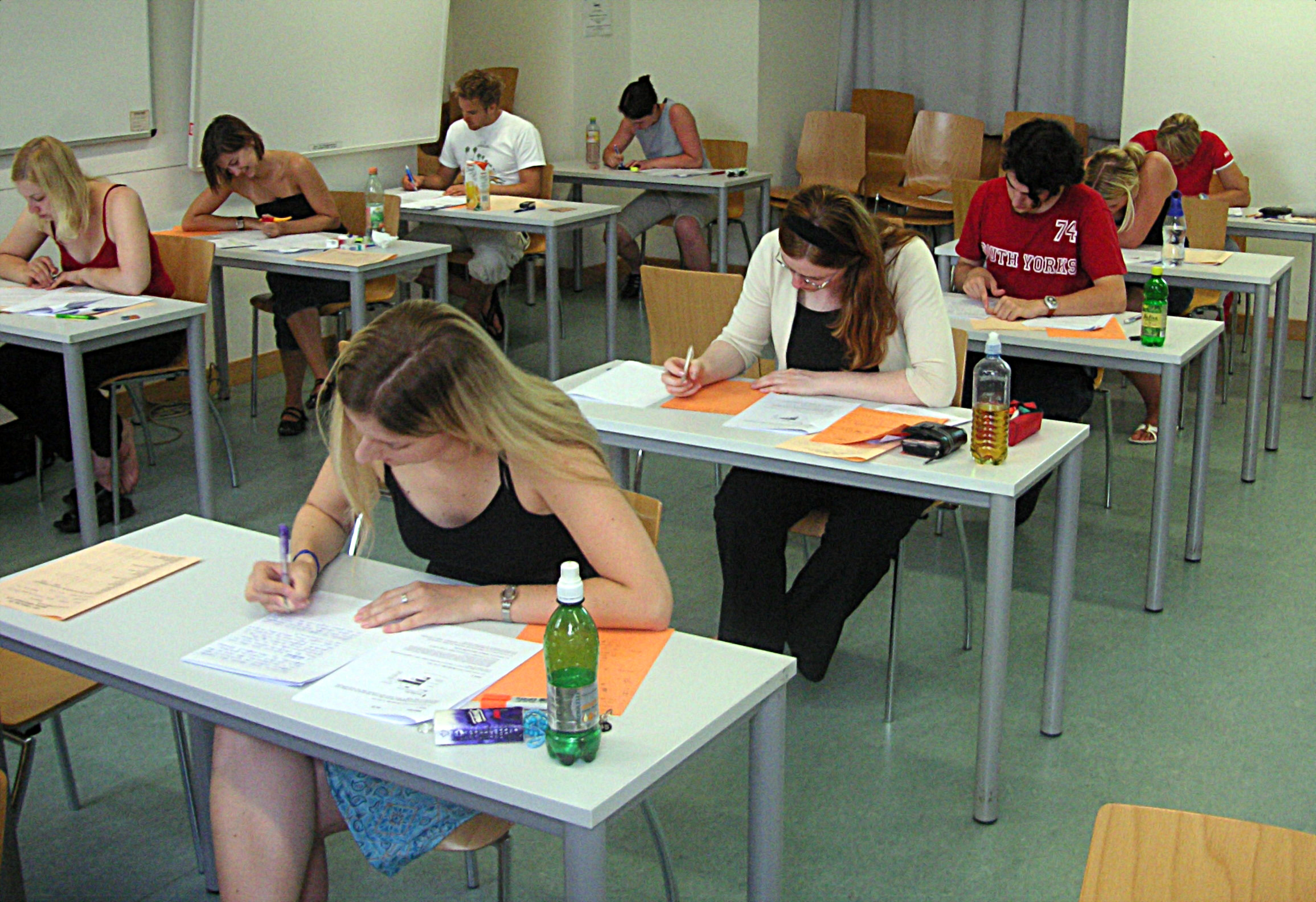
[Students sit at desks taking a test at the University of Vienna in June 2005.] Photograph: KF
Image Credits: Wikimedia Commons
A practice exam is a test you take before the test that counts. It uses the same kind of questions, often under timed conditions, and its job is to show you what you actually know rather than what you merely recognise.
This article explains why practice exams feel harder than real exams, including the desirable difficulty idea, what retrieval practice does to memory, why the real exam can feel easier, and how to tell useful struggle from practice that is simply too hard.
What makes a practice exam feel hard
A practice exam feels hard for a simple reason: it removes your safety nets. When you reread notes, the answers sit in front of you and recognition does the work. A practice paper hides the answers and asks you to produce them, which is a different and much heavier mental job.
That gap between recognising and producing is where most of the discomfort lives. You may know a topic well enough to follow a textbook explanation, yet freeze when a blank question asks you to state the same idea from scratch.
Timing adds a second layer of pressure. Practice papers are often done under exam conditions, so the clock forces quick decisions and exposes slow recall that untimed reading never reveals.
There is also the matter of feedback. In normal study, a confusing paragraph can be reread until it feels clear. In a practice exam, a wrong answer stays wrong until marking time, and that delay makes the session feel harsher than it is.
[A classroom with rows of desks where students work through written papers.] Photograph: a classroom
Image Credits: Wikimedia Commons
The desirable difficulty idea
UCLA psychologist Robert Bjork coined the term "desirable difficulty" in 1994. The idea is that some conditions make practice feel harder and slower while producing better retention and transfer days or weeks later.
The standard examples are spacing, interleaving, retrieval practice, generation, and varied practice. Retrieval practice, pulling information out of memory instead of re-reading it, is the one most practice exams rely on.
Bjork and his colleague Elizabeth Bjork later drew a sharp distinction between two kinds of memory strength. Storage strength is how durably something is encoded, while retrieval strength is how accessible it is right now.
Easy practice builds retrieval strength without efficiently building storage strength. That is why a topic can feel mastered at the end of a rereading session and vanish by the next morning.
Their 2011 chapter on the topic carries the principle in its title: "Making things hard on yourself, but in a good way." The chapter also carries a condition that popular summaries often drop.
A difficulty is only desirable if the learner has enough background knowledge to respond to it with at least partial success. Without that foundation, the same task becomes an undesirable difficulty: frustrating, unproductive, and likely to teach the student that they are bad at the subject.
Why the struggle itself helps
The effort of searching memory is not wasted motion. When you struggle to recall an answer, even unsuccessfully, the attempt itself strengthens the memory trace, and the feedback that follows lands on a brain that has just worked to find the answer.
This is the opposite of what rereading does. Rereading feels fluent because the material is present, but fluency during study is a poor predictor of recall later. The brain treats easily available information as already handled and invests less in storing it.
A 2025 study published in PNAS illustrates the point from the other direction. Bastani and colleagues found that students given unrestricted GPT-4 access during maths practice performed 17% worse on a later exam taken without AI help.
The AI removed the struggle of producing answers, so practice felt smooth while learning suffered. Students could not detect the difference, because comprehension during practice felt real.
Retrieval practice works the other way round. It feels worse during the session and pays off later, which is exactly why so few students choose it voluntarily when an easier method is available.
Why the real exam can feel easier
The real exam often feels easier for reasons that have nothing to do with its questions being simpler. First, you arrive trained. A student who has practised retrieval under time pressure has already rehearsed the exact skill the exam demands.
Second, real exams are usually better written than homemade practice papers. Official questions go through review, and their wording tends to be cleaner than a revision guide's rough approximation.
Third, adrenaline and focus change the experience. Exam-day arousal sharpens attention for many students, and the sense that this attempt counts can pull recall together in a way a low-stakes practice run does not.
There is one exception worth knowing about. Computer-adaptive exams, which adjust question difficulty to each answer, keep pushing candidates toward their maximum skill level throughout the session.
In those exams, the test never gets easier as you succeed, so the whole sitting can feel relentlessly hard even when you are performing well. That feeling is a property of the test design, not evidence of failure.
When practice is genuinely too hard
Not every hard practice session is desirable difficulty. The test is whether the struggle ends in partial success often enough to learn from.
If you score near zero on every practice paper and cannot follow the mark scheme even after reading it, the material is too far above your current level. The fix is to go back to worked examples and guided study before returning to full papers.
If you can answer roughly half the questions and understand the rest once you see the solutions, the difficulty is probably in the useful zone. That mix of success and failure is what retrieval practice needs.
A third warning sign is practice that never changes. Doing the same paper repeatedly stops testing retrieval and starts testing memory of that specific paper. Fresh questions on the same topics keep the difficulty honest.
How to make practice exams useful
Treat a practice exam as a diagnostic tool, not a prediction. Its score matters less than the list of gaps it reveals, and the review session after marking matters more than the paper itself.
Work through every wrong answer and every lucky guess. For each one, write the correct answer from memory the next day, without looking. That second retrieval is where much of the learning happens.
Space your papers out rather than stacking them. Two papers a week apart, with review in between, will teach more than two papers on consecutive days, because spacing adds its own desirable difficulty.
Finally, keep conditions honest but humane. Use a timer and closed notes, but take breaks between sections and review the paper the same day, while the struggle is still fresh in your mind.
Why do practice tests feel harder than rereading notes?
Rereading relies on recognition, which feels fluent. Practice tests demand recall, which is slower and more effortful, and that effort is what strengthens long-term memory.
Does a low practice score mean I will fail the real exam?
Not necessarily. Practice scores diagnose gaps rather than predict outcomes, and students who review their errors thoroughly often outperform their early practice scores.
Should practice exams be timed?
Yes, at least sometimes. Timed practice trains the speed of recall that real exams demand, and it reveals slow topics that untimed study hides.
How many practice exams should I take before the real one?
Enough to cover the syllabus with fresh questions and to confirm your scores are stable across different papers, rather than a fixed number. Review between papers matters more than volume.
Why do adaptive exams feel hard the whole way through?
Adaptive tests raise question difficulty after correct answers, so success never makes the test easier. Feeling challenged throughout is normal and not a sign of failing.
The bottom line
Practice exams feel harder than real exams because they strip away recognition and force genuine recall, and that effort is the mechanism that builds durable memory. The discomfort is not a sign that your revision is failing. It is often the clearest sign that it is working, provided the difficulty stays within reach and every paper is followed by careful review.
Tags: practice exams, retrieval practice, desirable difficulty, exam revision
Rive News's research desk writes evidence-based explainers on study science, drawing on published research and public sources.
Related
- Why practice tests beat rereading every time
- What desirable difficulty means for learning
- Why students blank out during tests despite studying
- Why understanding in class does not guarantee exam success
Subscribe to the Rive News newsletter for one study-science explainer each week.
Rive News publishes general educational explainers based on public sources; claims are attributed in the text.
Related stories

Why Do I Blank Out During Tests Despite Studying: Test Anxiety and Retrieval Failure
Blanking out in exams is retrieval failure, not missing knowledge. Anxiety drains working memory; rereading builds false confidence. Here

How to Study for Exams Without Burning Out
Sleep 7-8 hours, study in 25-50 minute blocks, and exercise daily. The science-backed way to study for exams without burning out, and what

Why Do I Forget What I Just Read? Science Has an Answer
You forget what you just read because of the forgetting curve, mapped by Ebbinghaus in 1885. Science explains why memory fades fast and how