
Why Do Practice Tests Beat Rereading Every Time?
By Rive News
Research desk | Rive News
Key takeaways
- Students who tested themselves recalled 61% of a passage after one week, versus 40% for rereaders, in a landmark 2006 experiment.
- Testing wins because the act of retrieving a memory strengthens it. Rereading only builds recognition fluency.
- Students misjudge this badly: 84% rank rereading among their top strategies, while only 11% use retrieval practice.
Two groups of students learned the same science passage. One group read it four times. The other read it once, then spent the remaining sessions trying to write down everything they could remember without looking. Five minutes later, the rereaders were clearly ahead: 83% recall against 71%.
One week later, the result flipped completely. The rereaders could produce only 40% of the passage. The group that had spent most of its time testing itself produced 61%. The students who studied the most remembered the least. The students who felt the best learned the worst.
This is the testing effect, one of the most replicated findings in learning science. This article explains what it is, why rereading keeps fooling us, and how to use the effect without turning study sessions into misery.
What the testing effect actually is
The testing effect is simple. Being tested on material produces stronger long-term retention than spending the same study time rereading it. The test does not have to count for a grade. It does not even have to come with feedback. The act of pulling an answer out of memory is itself the learning event.
The foundational demonstration comes from Henry Roediger and Jeffrey Karpicke. They are two psychologists at Washington University in St. Louis. They published the experiment described above in 2006. The pattern held across follow-ups. Massed rereading wins on an immediate test. Testing wins on every delayed test, at two days and at one week.
The effect scales. A 2017 meta-analysis of 217 effects by Adesope, Trevisan, and Sundararajan put the advantage of testing over restudy at an effect size of g ≈ 0.61. That is a solid medium-to-large effect. Another summary of 118 studies confirmed the effect across age groups and content areas. This is not a one-lab curiosity. It is among the best-supported claims in the psychology of learning.
It also sits at the top of the most-cited review of study techniques ever written. John Dunlosky and colleagues' 2013 review rated practice testing and distributed practice as the two high-utility strategies. Rereading, highlighting, and summarizing were rated low utility.
Why rereading feels effective when it is not
If testing wins so clearly, why do students keep rereading? Because rereading manufactures a feeling that is easy to mistake for learning.
Robert Bjork, the UCLA psychologist who coined the term "desirable difficulties," has a warning for anyone who studies this way. He says to "try to rid yourself of the idea that memory works like a tape or video recorder and that reexposing yourself to the same material over and over again will somehow write it onto your memory." Memory is not a recording device. Re-exposure does not write anything anywhere.
What re-exposure does is create fluency. By the third reading, the words glide by. The passage looks easy. The brain reads that ease as mastery. But it is only recognizing the material, not recalling it. Recognition and recall are different abilities. Most exams test the second one.
The numbers on student habits are striking. In a 2009 survey by Karpicke, Butler, and Roediger, 84% of college students ranked rereading among their strategies of choice. Only 11% reported using retrieval practice at all. Students prefer rereading, the researchers argued, because it produces a heightened sense of fluency and familiarity. Students misread that as learning. The feeling of competence is, in large part, the illusion of competence.
How retrieval actually strengthens memory
Pulling an answer from memory is effortful, and the effort is the point. Each retrieval attempt rebuilds the memory's pathways. That makes the next retrieval easier and more durable. Psychologists call the surrounding idea desirable difficulties. These are conditions that make practice feel harder while producing stronger long-term retention.
This also explains the strange timing of the testing effect. On an immediate test, the rereaders win because the material is still fresh in short-term storage. But fresh is not durable. Repeated retrieval builds the kind of memory that survives a week, a month, or a semester. Each attempt strengthens the routes the brain will use later.
There is a nuance worth knowing. Failed retrieval attempts followed by checking the answer still beat successful rereading. Getting a question wrong, then seeing the correct answer, produces stronger memory than reading the same answer twice. The error is not wasted effort. It primes the brain to absorb the correction.

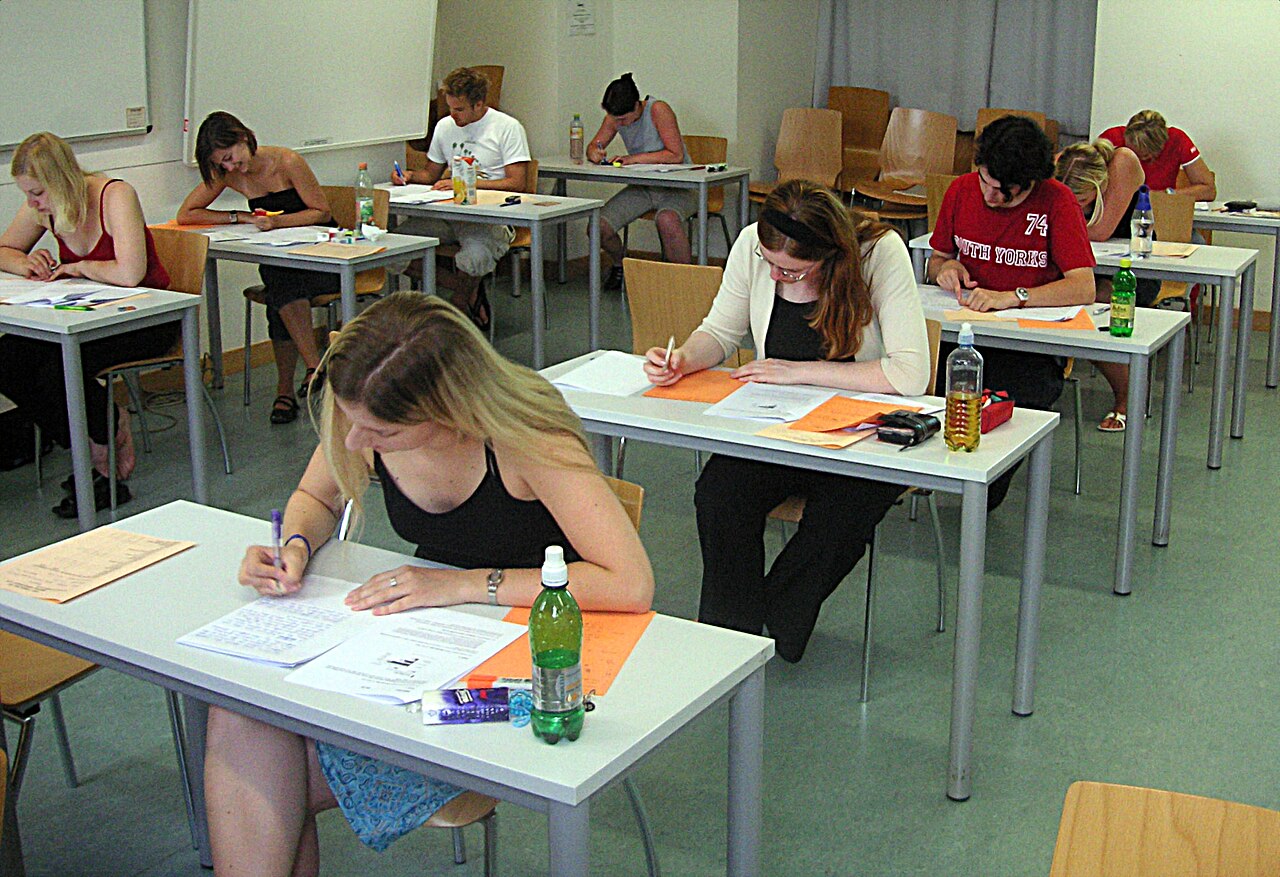
Candidates sitting for a large written examination; retrieval under test conditions is what the testing effect measures. Photograph: SSgt Sarah Brown, NATO Training Mission-Afghanistan/Wikimedia Commons
Image Credits: Wikimedia Commons (Public domain)
When practice tests do not beat rereading
The honest version of this story includes the exceptions. The testing effect is less reliable in mathematics. A 2025 meta-analysis in Educational Psychology Review found the effect not robust there (g = 0.18, with the confidence interval crossing zero). Problem-solving subjects sometimes need worked examples first, before self-testing pays off.
Retrieval practice also proves factual recall, not deep conceptual mastery. If an exam demands transfer to brand-new problems, testing alone is not enough. It needs to be paired with explanation, elaboration, and varied practice. Testing without feedback on material you cannot yet retrieve can simply confirm ignorance. The fix is to check answers and re-test, not to abandon the strategy.
How to use the testing effect in real study sessions
The method the research supports is plain. Read a passage or attend a lecture. Then close the source and write down everything you remember. Open the source, check what you missed, and note the gaps. Repeat the recall the next day, then at expanding intervals: three days, seven days, fourteen days.
Free recall beats multiple choice. Writing or saying everything you know forces generation. That strengthens memory more than recognizing the right option. Flashcards work for the same reason, provided you genuinely attempt the answer before flipping the card.
Pair testing with spacing for the strongest results. Retrieval practice is the technique. Spaced repetition is the schedule. Together they outperform either one alone. A student who self-tests a little each day will beat a student who rereads for hours the night before. That is also why all-nighters feel productive but test worse.
If procrastination keeps pushing your sessions to the last minute, the brain science behind that habit is covered in why you procrastinate on studying. For the scheduling side, how spaced repetition intervals work pairs directly with this article's method.
Frequently asked questions
Does highlighting help at all compared to practice testing?
Highlighting was rated low utility in the Dunlosky review. It can help on a first pass by marking what matters. But as a study strategy it behaves like rereading. It builds familiarity without building recall. If you highlight, convert the highlights into self-test questions afterward.
How long should I wait before testing myself?
The first test works best after a short delay, not immediately. Testing the next day is stronger than testing the same evening. Expanding intervals (1, 3, 7, 14 days) beat cramming all tests into one session. The delay is what makes retrieval effortful enough to strengthen the memory.
Is testing yourself without feedback still useful?
Yes. The original experiments found that testing without feedback still beat restudying on delayed tests. Feedback helps more, especially after failed attempts. But the retrieval attempt alone does real work. A blank-page recall session is never wasted time.
Why do my grades not improve the first week I try this?
Because testing feels worse than rereading at first. Early sessions surface gaps, which is uncomfortable but diagnostic. The payoff appears on delayed tests, exactly where rereading collapses. Give the method two to three weeks of spaced sessions before judging it.
The bottom line
Practice tests beat rereading because they train the exact skill exams demand. They teach you to pull knowledge out of memory without the source in front of you. Rereading trains recognition, which feels like learning and evaporates within days. The students in Roediger and Karpicke's experiment who felt the most confident remembered the least. Trust the discomfort of the blank page. It is the feeling of a memory being built.
---
Rive News's research desk covers learning science, fitness, and everyday how-things-work explainers, with every claim traced to a named source.
Latest in Education
- Why Do All-Nighters Feel Productive but Test Worse?
- Why Do You Procrastinate on Studying? The Brain Science
- How Spaced Repetition Intervals Work
- Why Cramming Is Ineffective Long-Term
Subscribe for one research-backed explainer every morning.
Corrections: spotted an error? Contact the research desk and we will fix it with a visible update note.
© 2026 Rive News. Facts sourced from public research; see sources in article metadata.
Related stories

Why Do I Blank Out During Tests Despite Studying: Test Anxiety and Retrieval Failure
Blanking out in exams is retrieval failure, not missing knowledge. Anxiety drains working memory; rereading builds false confidence. Here ar

How to Study for Exams Without Burning Out
Sleep 7-8 hours, study in 25-50 minute blocks, and exercise daily. The science-backed way to study for exams without burning out, and what t

Why Do I Forget What I Just Read? Science Has an Answer
You forget what you just read because of the forgetting curve, mapped by Ebbinghaus in 1885. Science explains why memory fades fast and how