
Why is cramming ineffective for long-term learning?
Key takeaways
- In 1885, Hermann Ebbinghaus showed that about half of new material is forgotten within an hour when it is never reviewed.
- Memory consolidates during sleep, so all-night study sessions trade the brain's filing system for extra reading time.
- A 2006 review of 317 experiments found that spaced study beats massed cramming for long-term retention.
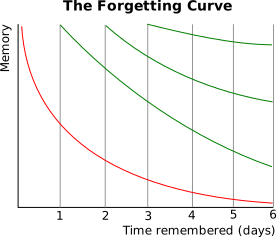
The forgetting curve: memory retention drops sharply in the first hours after learning, then levels off. Illustration: Icez/Wikimedia Commons
Image Credits: Wikimedia Commons
Cramming means studying everything in one long session, usually the night before a test. It feels productive because the material seems familiar while you are reading it.
The problem is that a feeling of familiarity is not memory. Most of what you cram fades within a day or two, leaving little behind a week later.
This article explains cramming. It covers what happens to memory in the first 24 hours, how sleep consolidates learning, why spaced practice wins, and what to study differently.
What happens to memory in the first 24 hours
In the 1880s, German psychologist Hermann Ebbinghaus ran a strange series of experiments on himself. He memorized lists of meaningless three-letter syllables, like "wid" and "zof", then tested how much he remembered at different intervals.
His results were startling. According to a review of his original data published by Structural Learning, about 58 percent was retained after 20 minutes, 44 percent after an hour, and only about 33 percent after one day. After a month, roughly 21 percent remained.
The shape of that decline matters more than the exact numbers. Forgetting is fastest right after learning, then slows down. That curve has been replicated for over 140 years with different materials and populations.
There is one important caveat. Ebbinghaus used nonsense syllables, not meaningful material like history or biology. Real course content is forgotten more slowly, but the pattern holds: the bulk of the loss happens early.
Cramming sits on the steepest part of that curve. You learn at midnight and take the test at 9 AM, which is exactly the window where memory is collapsing fastest.

Long single study sessions create a feeling of familiarity that fades fast. Photograph: English106/Wikimedia Commons
Image Credits: Wikimedia Commons
How sleep consolidates what you learn
Here is the cruel part of the all-nighter. Cramming usually steals the one thing the brain needs most to keep memories: sleep.
During sleep, the brain replays recently learned information. It moves it from the hippocampus, which handles short-term storage, to the neocortex, where longer-term memories live. This process, called memory consolidation, happens mainly during deep slow-wave sleep and REM sleep.
The evidence is direct. In a study led by Susanne Diekelmann at the University of Lübeck, reported by Medical Xpress in 2011, one group of volunteers slept briefly while another stayed awake. When tested later, the sleep group retained an average of 85 percent of learned patterns, compared with 60 percent for the group that stayed awake.
"Human memory is absolutely dynamic. Memories are not statically 'archived' in the neocortex but are subject to constant changes by various influences," Diekelmann said in the report.
Earlier work points the same way. In a 2004 experiment by Philippe Peigneux and colleagues, reported by ScienceDaily, volunteers learned to navigate a virtual town. Brain scans showed that hippocampus activity during deep sleep correlated with how much their memory improved the next day.
Studying right before bed can actually help, because the material is fresh when consolidation begins. What hurts is skipping sleep altogether. Every hour of sleep sacrificed for extra reading is an hour your brain cannot use to file away what you already read.
Why spaced practice wins
The alternative to cramming is spaced practice: spreading the same total study time across several sessions over days or weeks. The evidence for it is among the strongest in all of learning science.
The landmark review is Cepeda and colleagues' 2006 paper in Psychological Bulletin, which synthesized 317 experiments across 184 articles. Across the comparisons, spaced practice reliably beat massed practice for long-term retention. The optimal gap between sessions grew with how long the learner wanted to remember.
A practical rule from that body of research: the best spacing is roughly 10 to 30 percent of the desired retention interval. Studying for a test in a week works well with one- to two-day gaps. Studying for knowledge you want to keep for a year works with gaps of several weeks.
Other reviews rank study techniques directly. Dunlosky and colleagues' 2013 review in Psychological Science in the Public Interest evaluated ten common techniques. Practice testing and distributed practice were the only two rated as high utility.
Rereading, highlighting, and summarization, the classic cramming toolkit, were rated low.
Then there is the testing effect. In a 2006 study, Henry Roediger and Jeffrey Karpicke found that students who took a single practice test retained significantly more of a prose passage a week later than students who reread it the same number of times.
The rereaders were more confident in their memory. They were also wrong.
Cramming optimizes for the wrong target. It produces great performance tomorrow and terrible retention next month. Spacing does the reverse.
What to do instead
You do not need a complicated system. Four habits capture most of the benefit.
First, start earlier than feels necessary. Even three sessions of 30 minutes across a week beat one 90-minute cram, according to the spacing research.
Second, space with expanding intervals. Review after one day, then after three days, then after a week. Each review is harder because the memory has faded a little, and that effort is what strengthens it.
Third, test yourself instead of rereading. Close the book and write down what you remember. Flashcards and past papers count.
Passive rereading feels smooth precisely because it is not building memory.
Fourth, protect sleep the night before the exam. A full night lets consolidation finish its work. The extra two hours of cramming at 3 AM cannot compete with what your sleeping brain does with what you already learned.
Frequently asked questions
Is cramming ever better than not studying at all?
Yes, and that is why it survives. Cramming the night before can rescue tomorrow's test score because the material is still fresh on the steep part of the forgetting curve.
It just does almost nothing for what you will remember in a month. Use it as a last resort, not a strategy.
How much do we really forget after one day?
In Ebbinghaus's own syllable experiments, retention after one day was about 33 percent, meaning roughly two-thirds was gone. For meaningful course material, the loss is smaller but follows the same steep-then-flat shape. A review shortly after learning resets the curve.
Does studying right before bed actually help?
It can. Research on memory consolidation shows the brain replays fresh material during sleep, with the hippocampus handing it off to longer-term storage. Evening study followed by real sleep beats late-night study that replaces sleep.
What is the simplest study schedule that works?
Three to four sessions with gaps of a day or more, each ending with self-testing, plus a full night of sleep before the exam. This matches the spacing ratios found in Cepeda and colleagues' 2006 review without needing any app or algorithm.
The bottom line
Cramming fails long term because it fights how memory works: it skips the review that flattens the forgetting curve and skips the sleep that consolidates it. Spread your study across sessions, test yourself, and sleep before the test. Your future self will remember the difference.
Rive News is the research desk of this publication, covering what peer-reviewed science says about everyday decisions.
Related stories
- How to tell if brake pads need replacing before they fail
- How to choose hiking boots for beginners: fit, features, and break-in
- eSIM vs iSIM: what is the difference?
- Why do I get cramps in my feet but not my legs?
Subscribe to the newsletter for one research-backed explainer like this every week.
Related stories

Why Do I Blank Out During Tests Despite Studying: Test Anxiety and Retrieval Failure
Blanking out in exams is retrieval failure, not missing knowledge. Anxiety drains working memory; rereading builds false confidence. Here

How to Study for Exams Without Burning Out
Sleep 7-8 hours, study in 25-50 minute blocks, and exercise daily. The science-backed way to study for exams without burning out, and what

Why Do I Forget What I Just Read? Science Has an Answer
You forget what you just read because of the forgetting curve, mapped by Ebbinghaus in 1885. Science explains why memory fades fast and how