
Why Do All-Nighters Feel Productive but Lead to Worse Test Scores?
By Rive News
Research desk | Rive News
Key takeaways
- Sleep deprivation creates a mild euphoria that makes cramming feel effective. Memory research shows recall actually drops.
- Cramming loads short-term memory, which fades within hours. Sleep moves facts into long-term memory needed for exams.
- Students who sleep before a test consistently outperform those who stay up, even after studying less total time.

An all-nighter feels like studying with the volume turned up. The hours fly by. Pages get covered. By dawn there is a strange, buzzy confidence that the material is finally in your head.
Then the exam starts, and the facts are not there. The confidence was real. The learning was not.
Sleep researchers have studied this paradox for years. They found that pulling an all-nighter does two things at once. It changes how you feel about your studying. It changes what your brain actually does with the material. The first effect is positive. The second is not.
This article explains the feeling of productivity during all-nighters. It covers the memory systems cramming actually feeds, and what the research says works instead.
Why the all-nighter feels so productive
Sleep deprivation does not just make you tired. In the short term, it can make you feel oddly good.
A team of researchers including Seung-Schik Yoo, an associate professor at Harvard Medical School, ran a study. They deprived subjects of sleep for 36 hours, then showed them visual stimuli. The sleep-deprived participants rated neutral images more positively than rested participants did. Ordinary events triggered exaggerated emotional reactions, creating a short-lived euphoria.
That euphoria is part of the trap. When you are up at 4 a.m. highlighting notes, the same mild lift applies to your studying. The work feels meaningful. Progress feels fast. Your own brain, dulled by fatigue, is a generous judge of your effort.
There is a second reason the night feels productive: input is not learning. At 2 a.m., you can cover an impressive number of pages. Reading is easy when nobody interrupts. But covering pages is not the same as storing them. The feeling of having "done a lot" measures effort spent, not knowledge gained.
The short-term memory problem
The deeper problem is which memory system an all-nighter feeds. There are two of them, and they behave very differently.
"When we try to learn information quickly, we're only enabling short-term memory," said David Earnest, PhD. He is a professor with the Texas A&M College of Medicine who studies circadian rhythms. "Cramming doesn't allow information to assimilate from short-term to long-term memory, which is important for performing well on a project or exam."
Short-term memory is the brain's scratch pad. It holds a phone number long enough to dial it, then lets it go. An all-nighter fills that scratch pad over and over. It feels like progress because the pad is full. But exams do not test the scratch pad. They test what survived the transfer to long-term memory. That transfer is where sleep comes in.
"Sleep deprivation's effect on working memory is staggering," Earnest said. "Your brain loses efficiency with each hour of sleep deprivation." Most people need seven to eight hours of sleep a night for normal brain function, he added. A brain that misses that window performs sharply worse on learning and memory tasks.
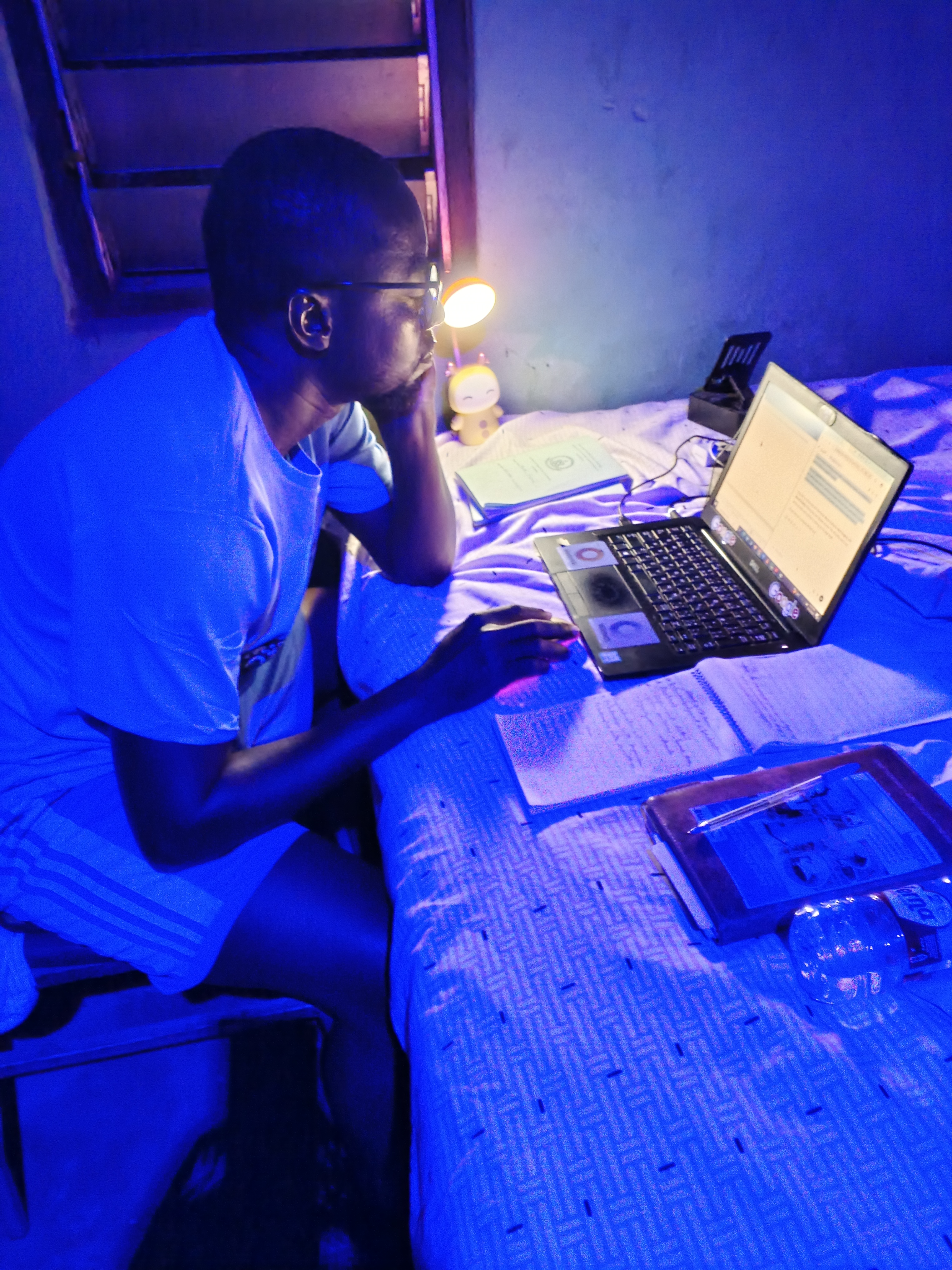
A student studying late at night, the typical scene behind an all-nighter. Photograph: Musahfm/Wikimedia Commons
Image Credits: Wikimedia Commons (CC BY-SA 4.0)
What sleep actually does for memory
The transfer of memories from their temporary holding area to more permanent storage is a sleep-dependent process. That is the summary from Robert Stickgold. He directs the Center for Sleep and Cognition at Harvard University. The Daily Bruin reported it. During sleep, the brain consolidates what was learned during the day. It strengthens the connections that make facts retrievable later.
Someone who learns material during the day and then stays awake all night will recall it poorly the next day, according to Stickgold's research. The deficit persists for years. The all-nighter does not just hurt tomorrow's exam. It undermines the learning itself.
The practical advice from sleep specialists is consistent. Dr. Philip Alapat is medical director of the Harris Health Sleep Disorders Center. He is an assistant professor at Baylor College of Medicine. He recommends studying through the semester. He recommends studying in the evening, the optimal window for alertness and concentration. And he recommends at least eight hours of sleep the night before an exam.
"Memory recall and ability to maintain concentration are much improved when an individual is rested," Alapat says. His center performs about 1,200 sleep studies a year. The pattern he sees in students matches what the lab data shows.
The evidence from the lab
The effects are not subtle. Kimberly Fenn's team at Michigan State University brought 234 people into a sleep lab at 10 p.m. Everyone practiced a sequence-based procedure. At midnight, half went home to sleep and half stayed awake. The next morning, everyone repeated the procedure.
Roughly 15 percent of the sleep-deprived group failed in the morning, compared with 1 percent of those who slept, Fenn said. The sleep-deprived participants also showed a steady increase in memory-related errors as the task went on. The finding: memory maintenance was the weak link. The sleep-deprived group struggled to pick up where they left off after interruptions.
Exams are interruptions stacked on interruptions. Each question demands that you find where you are in the material, hold a fact in mind, and apply it. That is exactly the kind of work Fenn's study showed sleep deprivation degrades.
There is also an honest counterpoint worth hearing. Robert Bjork, a psychology professor at UCLA, has told students that if they are genuinely unprepared, staying up may beat surrendering. As he put it, if you don't know the material, you won't make something out of nothing while you sleep. Sleep consolidates what is there. It cannot consolidate what was never learned.
That is the real decision an all-nighter represents. If the material was never studied, the night before is a salvage operation. Salvage is better than nothing. But if the material was studied at all, trading sleep for more repetition is a bad exchange. The hours feel productive because of fatigue-induced euphoria and the ease of rereading. Meanwhile the brain quietly loses the ability to move facts into durable storage.
What to do instead of the all-nighter
The research points to a simple playbook. Study the material in advance, even briefly. That gives sleep something to consolidate. Use the evening for a focused review session, since alertness peaks then. Then go to bed early enough to get a full night.
For a deep look at why rereading notes creates its own false confidence, see practice tests beat rereading every time. For the brain science behind putting off studying in the first place, see why you procrastinate on studying.
If the exam is tomorrow and you are behind, do a single focused pass. Then sleep at least three to four hours. A short sleep still gives the brain one cycle of consolidation. It beats a full night of highlighting that fades by morning.
The bottom line
All-nighters feel productive because fatigue lowers your judgment while rereading keeps your eyes busy. But studying is measured at the exam, not at the desk. Sleep is the step that moves facts from short-term holding into long-term memory. No amount of highlighting replaces it. The most productive thing a student can do the night before an exam is go to bed.
---
Rive News's research desk covers learning science, fitness, and everyday how-things-work explainers, with every claim traced to a named source.
Latest in Education
- Why Do Practice Tests Beat Rereading Every Time?
- Why Do You Procrastinate on Studying? The Brain Science
- Why Cramming Is Ineffective Long-Term
- What Is Active Recall and How to Use It
Subscribe for one research-backed explainer every morning.
Corrections: spotted an error? Contact the research desk and we will fix it with a visible update note.
© 2026 Rive News. Facts sourced from public research; see sources in article metadata.
Related stories

Why Do I Blank Out During Tests Despite Studying: Test Anxiety and Retrieval Failure
Blanking out in exams is retrieval failure, not missing knowledge. Anxiety drains working memory; rereading builds false confidence. Here ar

How to Study for Exams Without Burning Out
Sleep 7-8 hours, study in 25-50 minute blocks, and exercise daily. The science-backed way to study for exams without burning out, and what t

Why Do I Forget What I Just Read? Science Has an Answer
You forget what you just read because of the forgetting curve, mapped by Ebbinghaus in 1885. Science explains why memory fades fast and how