
Why Rereading Feels Productive but Fails on Exams
Key takeaways
- Rereading creates a feeling of fluency that mimics learning, but it mainly strengthens recognition, not recall.
- In a landmark 2006 study, students who self-quizzed recalled 61% of a passage after one week, versus 40% for rereaders.
- Psychologists rated rereading "low utility" in 2013; practice testing and spaced study earned the top ratings.

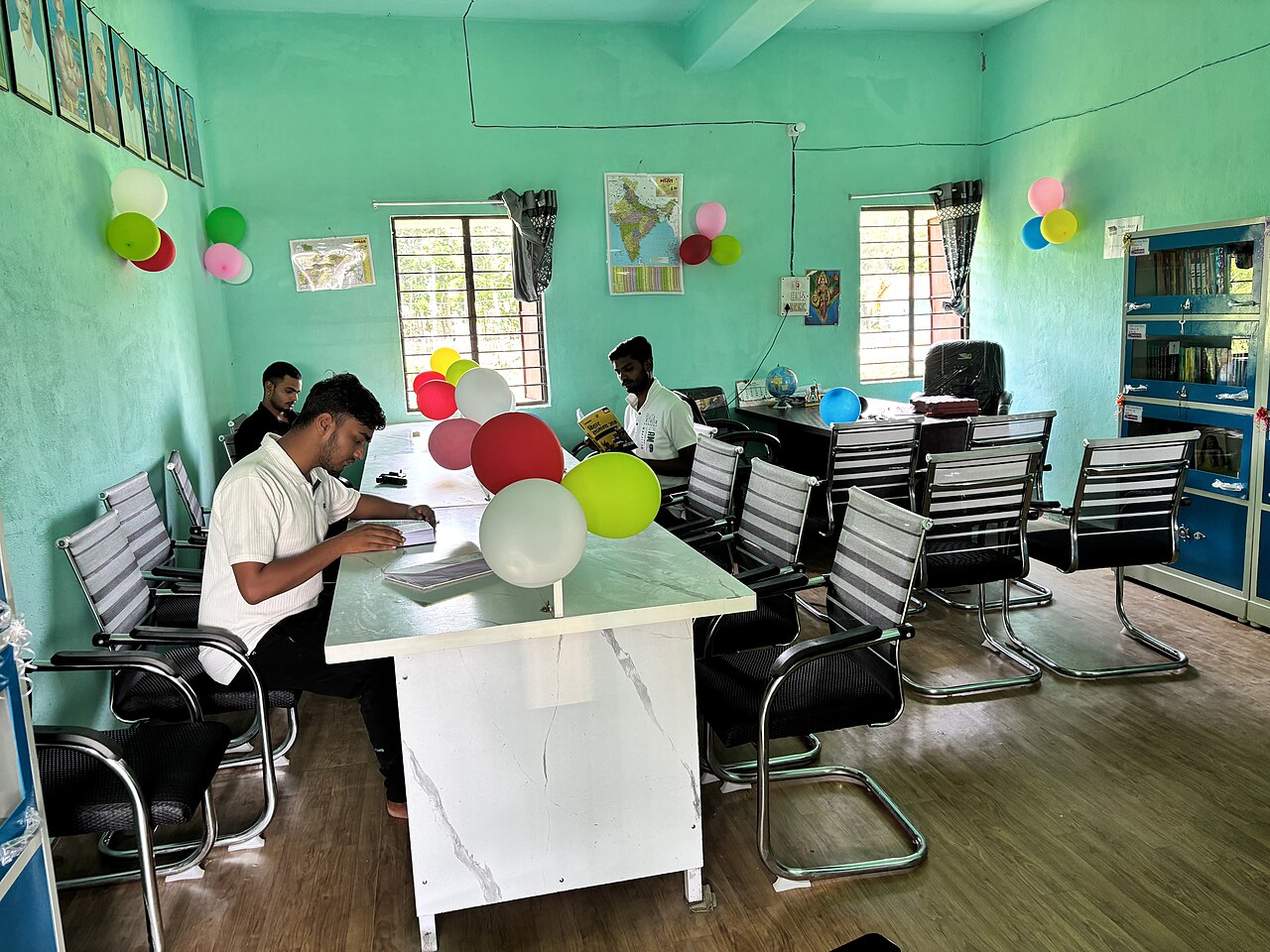
Image Credits: Wikimedia Commons / Dinesh De Alwis
Rereading is the most common study strategy on the planet. Survey after survey finds it at the top of students' lists: in one survey of 177 college students, 84% reported rereading among their go-to strategies.
It feels like work. The pages turn, the highlighter empties, and by the third pass the material flows so smoothly it feels mastered.
That smoothness is the trap. What rereading builds is fluency, the ease with which your eyes move across familiar text. Exams do not ask you to recognize sentences you have seen before.
They ask you to produce answers you cannot see. Fluency at reading the notes is a poor predictor of recalling the notes, and cognitive scientists have a name for the mismatch: the illusion of competence, or fluency illusion.
This article takes a closer look at why rereading feels productive, including the fluency illusion behind it, the 2006 experiment that exposed the gap between feeling and learning, the 2013 expert verdict that rated rereading "low utility," and the simple swap that fixes the problem.
What rereading does to your brain
Reading a chapter for the second time is easy. The first pass was full of friction: new terms, unfamiliar structure, places where you had to stop and think.
On the second pass that friction is gone. Your brain interprets the absence of friction as evidence of learning.
The problem is that the friction went away because the text became familiar, not because the ideas became retrievable. Psychologists distinguish between recognition (knowing you have seen something) and recall (producing it from memory). Rereading is a recognition workout.
An exam is a recall test. Training for one and being tested on the other is the core of the mismatch.
This is why rereading feels better the more you do it. Each pass makes the text more fluent and your predictions more confident.
The AhaSlides research roundup notes that in Karpicke's 2012 work, students rated retrieval practice as one of their least preferred strategies even though it produced the best results. Your study instincts are calibrated to comfort, not to retention.
The practical consequence shows up in the first minutes of an exam. Students who reread often report the classic failure mode: they know they studied this, the page image is almost visible in their mind, but the actual answer will not come. If you want a name for that empty-screen moment, it connects to why answers go blank during a test, a separate retrieval problem with the same root cause.
The 2006 experiment that settled the question
The decisive evidence came from Washington University in St. Louis. In 2006, Henry Roediger and Jeffrey Karpicke published "Test-Enhanced Learning" in the journal Psychological Science, and the design was brutally simple.
College students read short science passages. One group read a passage four separate times. Another group read it once, then spent the remaining sessions trying to write down everything they could remember, with no answer key and no peeking.
Five minutes after the final session, the re-readers looked like winners: 83% recall against 71% for the test-takers. If studying stopped there, rereading would have won.
One week later, the results inverted. The students who had been tested three times recalled about 61% of the material.
The students who had read it four times recalled about 40%. The group that spent less total time with the passage, and never saw it again after a single reading, beat the group that pored over it repeatedly.
Two details make the finding devastating for rereading. First, the advantage of quizzing over rereading grows as the gap before the exam lengthens: the further away the test, the more rereading fades and retrieval holds. Second, the short-term result explains exactly why students keep rereading.
On an immediate test, rereaders genuinely do better. They are optimizing for the feeling of learning in the study session, not for recall at the exam.
Roediger and Karpicke did not stop in 2006. In a 2008 paper in the journal Science, they had students learn 40 Swahili-English word pairs. Once a student could recall a word correctly, it was either kept in testing or dropped from testing. A week later, students who kept retrieving recalled about 80% of the words.
Students whose words were dropped from testing, even if they kept studying them, recalled only 33 to 36%. Extra study after learning had no measurable effect, while extra testing drove learning.
In 2011, Karpicke and Blunt, again in Science, compared retrieval practice with concept mapping, a popular elaborative technique. On a test one week later, students who practiced free recall learned more, including on questions that required inference rather than rote memory. And a 2017 meta-analysis by Adesope, Trevisan, and Sundararajan pooled 272 effect sizes from 118 articles and over 15,000 participants: practice testing beat restudying with an effect size of g = 0.51, and beat doing nothing at all at g = 0.93.
The 2013 verdict: "low utility"
In January 2013, the Association for Psychological Science published a landmark report: "Improving Students' Learning With Effective Learning Techniques," led by John Dunlosky of Kent State University. The team reviewed hundreds of studies on ten popular learning techniques and rated each from high to low utility.
The results were blunt. Practice testing (active recall) and distributed practice (spaced repetition) earned high utility.
Interleaved practice, elaborative interrogation, and self-explanation landed in the middle. And five techniques, including the two most popular ones among students, got the lowest rating: summarization, highlighting and underlining, and rereading.
The report's own wording was direct: "Based on the available evidence, we rate rereading as having low utility... although rereading is relatively economical with respect to time demands, when compared with some other learning techniques, rereading is also typically less effective.
" Dunlosky himself told reporters he was shocked that strategies students use the most, like rereading and highlighting, seemed to provide minimal benefits. His advice was simple: by just replacing rereading with delayed retrieval practice, students would benefit.
Highlighting suffered the same fate. The review rated highlighting and underlining as low utility, noting that in most situations highlighting does little to boost performance and may even hurt performance on higher-level tasks that require making inferences. If your study session is reread plus highlight, you are combining the two techniques with the weakest evidence base.
What to do instead of rereading
The fix is not to study longer. It is to change the direction of effort. Rereading puts information in; retrieval practice pulls it out.
Closing the book and writing down everything you remember builds the recall pathways the exam will use. This is the core argument behind the testing effect beating rereading, and it takes no extra time, only a change of method.
Make the swap concrete. After one reading of a chapter, close it and spend ten minutes writing a free recall: everything you remember, in your own words, no peeking.
Then open the chapter and check what you missed. The Chunks research summary emphasizes that the test does not need to be graded or formal: a flashcard, a one-minute brain dump, or a quick quiz at the start of a session all count, as long as you have to dig for the answer.
Two refinements make retrieval even stronger. First, space it out: Dunlosky's review gave distributed practice the other high-utility rating, and the advantage of quizzing over rereading grows with longer retention intervals. Second, mix topics: interleaved practice earned a moderate rating, and it forces the discrimination the exam will demand.
For students stuck in old routines, breaking bad study habits is the natural companion piece: the identity shift from "I put in the hours" to "I retrieved the material" is what makes the new method stick. And if you still read textbooks by highlighting every line, reading a textbook effectively without just highlighting covers what to replace the marker with.
The bottom-line rule is simple enough to tape to a desk: one read, then close the book and test yourself. Struggle is the signal that learning is happening, not that the method is failing.

FAQ
Is rereading completely useless?
Not completely. A first or second read is necessary to build initial familiarity, and rereading can help with difficult passages. The research verdict is about rereading as a primary study strategy: it is low utility compared with practice testing, not zero utility compared with nothing.
Why does rereading feel so effective if it is not?
Because fluency feels like knowledge. Each pass through familiar text gets smoother, and your brain mistakes processing ease for memory strength. Immediate tests reward rereaders (83% vs 71% at five minutes in the 2006 study), which reinforces the habit right before it fades.
How many practice tests do I need per chapter?
The 2006 study used three recall attempts after one reading. In practice, one solid free-recall pass per chapter, checked against the text, is enough to beat four rereads. Repeat on a spaced schedule for long-term retention.
Does highlighting help if I reread highlighted text?
The Dunlosky 2013 review found highlighting low utility in most situations, with some evidence it can hurt inference tasks by focusing attention on isolated facts instead of connections. Self-explanation or elaborative interrogation (asking "why is this true?") outperformed it.
The bottom line
Rereading feels productive because familiarity is easy to mistake for learning. The 2006 Roediger and Karpicke experiment showed the feeling is a mirage: after one week, self-quizzers recalled 61% and rereaders 40%.
The 2013 Dunlosky review confirmed it across the literature, rating rereading low utility. Swap the second and third passes for closed-book recall, space your sessions, and let the exam feel like the practice.
Latest in Education & Study
- Testing effect: why quizzing beats rereading
- Why cramming feels effective but fails the test
- How to break bad study habits
- How to read a textbook effectively, not just highlight
Want one evidence-based study tip in your inbox each week? Subscribe to the Rive News newsletter.
Related stories

Why Do I Blank Out During Tests Despite Studying: Test Anxiety and Retrieval Failure
Blanking out in exams is retrieval failure, not missing knowledge. Anxiety drains working memory; rereading builds false confidence. Here

How to Study for Exams Without Burning Out
Sleep 7-8 hours, study in 25-50 minute blocks, and exercise daily. The science-backed way to study for exams without burning out, and what

Why Do I Forget What I Just Read? Science Has an Answer
You forget what you just read because of the forgetting curve, mapped by Ebbinghaus in 1885. Science explains why memory fades fast and how