
Why you blank on answers you knew during the test
By Rive News / Research desk | Rive News / Published October 24, 2026 at 9:00 AM PKT
Key takeaways
- Blanking is usually retrieval failure under pressure: the knowledge is stored, but stress blocks access to it.
- Worry consumes working memory, the mental workspace you need to pull answers out, which is why the harder questions go first.
- Strong students are actually more vulnerable, because they rely on working memory the most.

[Students at their desks in a classroom, the setting where pressure can block recall of well-learned material.] Photograph: Pierce, C.C. (Charles C.), 1861-1946
Image Credits: Wikimedia Commons
Blanking on a test means staring at a question you could have answered yesterday and finding nothing. The answer was in your head during revision.
It may even come back to you the moment you leave the room. That pattern has a name in psychology: retrieval failure under pressure.
The knowledge is not gone. What fails is access.
Under stress, worry and self-monitoring consume the same mental workspace you need to retrieve answers, and the retrieval process stalls. This article explains the mechanism, what the research found, why it hits strong students hardest, and what actually helps.
Retrieval is a separate step from storage
Memory has phases: encoding (getting information in), storage (keeping it), and retrieval (getting it out). Studying mostly trains encoding and storage. A test demands retrieval, and retrieval is the fragile phase.
Retrieval needs working memory, the short-term mental workspace that holds information active while you work with it. Working memory is limited.
When part of it is occupied by worry ("I am running out of time," "everyone else looks calm"), less capacity remains for the actual question. The answer may be stored perfectly well, but the route to it is jammed.
This is why blanking feels so specific. You do not forget everything.
You lose the hard questions first, the ones that need the most working memory, while easy recall questions still come through. That pattern is the signature of a retrieval problem, not a learning problem.
The choking research: worry eats working memory
The clearest evidence comes from psychologist Sian Beilock and her collaborators. In research published in the Journal of Experimental Psychology: General in December 2004 and summarized by the APA Monitor in January 2005, Beilock, Thomas Carr, and colleagues tested 80 undergraduates on modular arithmetic problems.
Students answered three blocks of 24 questions, some demanding heavy working memory and some light. Before the third block, the high-pressure group was told their performance would be videotaped for math teachers to study, and paired with a partner who had supposedly improved by 20 percent, with five dollars at stake for matching it.
The high-pressure group scored worse on the high working-memory questions and reported significantly greater anxiety. On low-demand questions, pressure made no difference.
The mechanism, as Beilock later explained it to the University of Chicago Chronicle in 2007: "In essence, feelings of pressure introduce an intrusion that eats up available working memory for talented people." Worry is not just unpleasant. It is cognitively expensive, and it spends the exact resource retrieval needs.
Why strong students blank most
Here is the counterintuitive finding. People with the largest working memory capacity rely on it the most during problem solving, using demanding, step-by-step strategies.
When pressure consumes that capacity, their usual advantage disappears and they fall back on shortcuts like guessing and estimation. The Chronicle report notes that Beilock presented these findings at the 2007 annual meeting of the American Association for the Advancement of Science in San Francisco.
A 2006 follow-up by Gimmig and colleagues, published in Psychonomic Bulletin & Review (PMID 17484426), confirmed the pattern: only individuals with high working memory capacity "choked under pressure" on demanding problems. Lower-capacity individuals, who already used simpler strategies, were less affected by pressure because their approach did not depend on the resource pressure steals.
So the cruelest version of blanking, the straight-A student frozen on a question she knew cold, is exactly what the theory predicts. The better your mental machinery, the more pressure can take from you.
The anxiety multiplier
Not everyone responds to pressure the same way, and math anxiety is the big moderator. A 2011 study by Mattarella-Micke, Mateo, Kozak, Foster, and Beilock, published in the journal Emotion, measured salivary cortisol, a physiological index of arousal, around a demanding math task.
For higher working-memory individuals high in math anxiety, higher cortisol meant worse performance. But for higher working-memory individuals low in math anxiety, higher cortisol meant better performance.
The same arousal helped one group and hurt the other. Whether pressure makes you choke or thrive depends on what your brain does with the arousal: worry, or focus.
This matters for advice. Telling an anxious student to "just relax" misses the point. The goal is not less arousal but less worry: keeping the arousal while pointing it at the question instead of at yourself.
What actually helps
Write your worries down before the test. In Beilock's later work, students who spent ten minutes writing about their test anxieties before the exam performed better than controls.
Offloading the worry onto paper frees the working memory it was occupying. This is the most directly supported intervention in the literature.
Practice under test conditions. Retrieval under pressure is itself a skill.
Timed practice tests train you to retrieve with the clock running and the stakes simulated, so the real exam feels less novel. This is also why the first high-stakes test of a term is often the worst for blanking.
Build retrieval into studying, not just re-reading. Self-testing, flashcards, and explaining concepts aloud all practice the retrieval pathway directly. If you only ever re-read notes, you have trained storage without training the part that fails under pressure.
During the test, skip and return. If a question blanks you, move on.
Answering other questions builds momentum and often triggers the missing answer through association. Sitting and staring at the blank one just feeds the worry loop that caused it.
Reframe the arousal. The cortisol research suggests arousal itself is not the enemy. Interpreting a racing heart as your brain gearing up, rather than as a sign of impending failure, keeps the worry component down while the energy stays available.
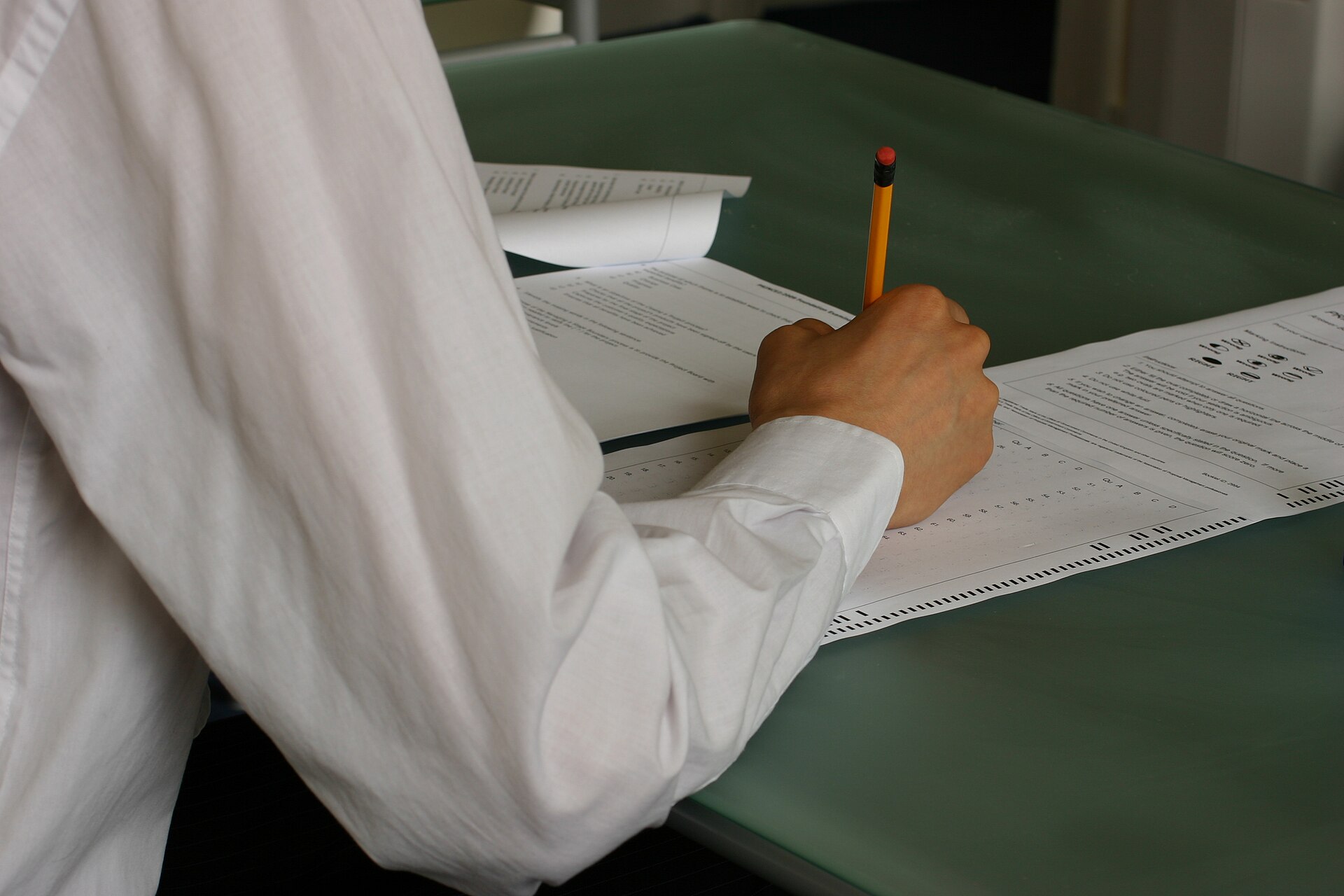
[Handwriting answers in an exam setting; timed practice under real conditions trains retrieval to hold up under pressure.] Photograph: Alison wood
Image Credits: Wikimedia Commons

[A student working through assignments; retrieval-based practice trains the pathway that pressure disrupts.] Photograph: Heidy Garcia
Image Credits: Wikimedia Commons
When blanking is something more
Occasional blanking under pressure is normal and well explained by the research. But persistent, severe test anxiety that disrupts sleep, causes panic symptoms, or tanks performance across every exam is worth discussing with a counselor or clinician. Test anxiety exists on a spectrum, and the far end responds to proper support, not just study tips.
Also distinguish blanking from not knowing. If the answer never comes back even after the test, that was a storage problem, and the fix is different: more spaced practice, better encoding, or different study methods.
The tell-tale sign of true blanking is the answer arriving in the hallway afterward. That is retrieval failure, and it is fixable.
Frequently asked questions
Why do I remember the answer right after the test ends?
Because the pressure lifted. Once the stakes and the worry clear, working memory frees up and the retrieval route unblocks. This is the classic signature of retrieval failure rather than lost knowledge.
Does blanking mean I did not study enough?
Not necessarily. If you could answer the material during revision and the answer returns after the test, your studying worked. The failure was in retrieval under pressure, which is a separate skill that timed practice specifically trains.
Are some people just bad at tests?
Susceptibility varies. Research shows people with high working memory and high anxiety are the most vulnerable to choking under pressure. But the interventions, expressive writing, simulated test conditions, retrieval practice, work across the board.
Does this apply to subjects other than math?
Yes. The working-memory mechanism applies to any test with demanding questions: essays, science problems, language exams. Math is simply where researchers have measured it most precisely.
Can blanking be cured permanently?
It can be greatly reduced. Students who combine retrieval-based studying with practice under timed conditions and pre-test worry offloading typically see large improvements. Some residual nerves are normal and, per the arousal research, can even help if they stay pointed at the task.
The bottom line
Blanking on a test is not your memory failing. It is pressure hijacking the retrieval system: worry consumes working memory, the hard questions go first, and the answers resurface the moment the stakes drop.
The research points to concrete fixes. Write down your worries before the exam, practice retrieval under timed conditions, and study by self-testing rather than re-reading.
The knowledge is already there. The job is keeping the path to it clear.
Rive News's research desk covers learning science, study methods, and education research from published studies.
Related
- Why do I blank out during tests despite studying?
- How to study for an exam in one week without cramming badly
- How to prepare for a maths exam step by step
- Why do you blank on names but remember faces?
Subscribe for one learning-science explainer every week.
Rive News publishes research-backed explainers; claims are sourced from the studies listed above.
Related stories

Why Does Cramming Not Work for Long-Term Learning? The Science
Cramming fails for long-term learning because of the spacing effect: a UC San Diego study of 1,000+ subjects found wider study gaps raised
Why Do We Forget Things Right After the Test? Memory Science Explains
Forgetting after a test follows the Ebbinghaus curve: about half of new learning fades within an hour. See why cramming fades and what

How to choose subjects for your future career
Choosing school subjects shapes your career options. Match your interests to entry requirements, test skills in demand, and keep maths