
Why Study Groups Sometimes Don't Work: 6 Science-Backed Reasons
Key takeaways
- Psychologists have studied this since 1979: people reliably put in less effort in groups than alone, a pattern confirmed across 78 studies in a 1993 meta-analysis.
- The biggest group killers are no agenda, unprepared members, oversized groups, and the false confidence that watching someone else solve a problem means you can too.
- Groups work when they are small (five or fewer), prepared, structured around testing and teaching each other, and end with individual recall.
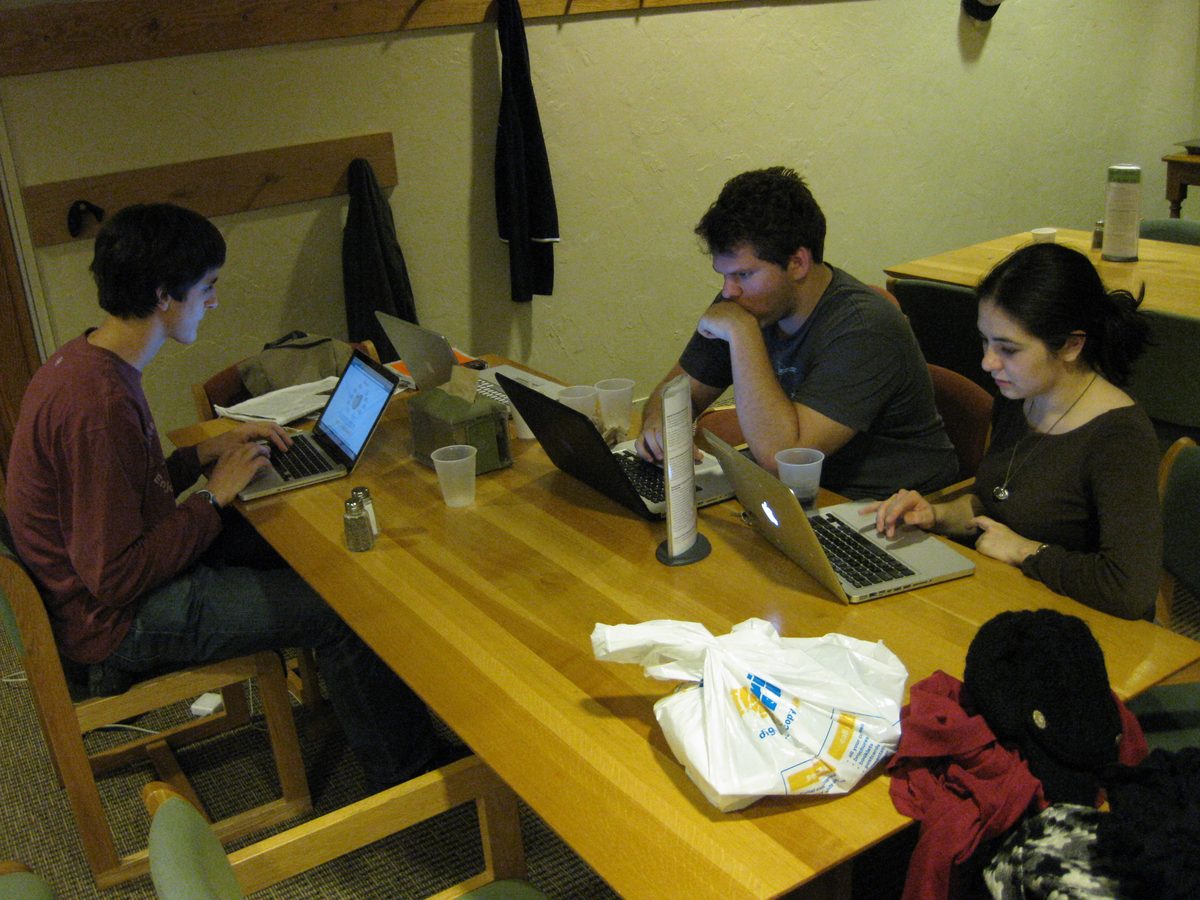
Three students share a table but work alone, which is how many study groups quietly fail. Photograph: Tbuckley89 / Wikimedia Commons
Image Credits: Wikimedia Commons
A study group is supposed to be simple: a few students meet, cover the material together, and everyone walks out sharper. Often the opposite happens. The session drifts into chit-chat, one person does all the explaining, and the rest leave feeling busy but no better prepared.
So why do study groups sometimes not work? The short answer is that groups change how our brains and motivations behave, and most sessions ignore that. A bad group rewards passivity: you can nod along, copy notes, and mistake someone else's understanding for your own.
This article explains study group failure: the psychology behind it, the most common ways groups go wrong, when groups actually help, and how to fix a broken group.
The psychology behind it
The deepest reason groups underperform is social loafing. The term describes the tendency to work less hard when working together than when working alone. It was first shown in experiments published by Latane, Williams, and Harkins in 1979 in the Journal of Personality and Social Psychology.
The effect held up under scrutiny. In 1993, Steven Karau and Kipling Williams published a meta-analysis of 78 studies on social loafing in the same journal. Their conclusion: the phenomenon is robust and holds across tasks and populations.
People slack off in groups generally, not just in one specific setup.
Karau and Williams also identified what weakens the effect. Evaluation potential mattered most: when each person's contribution could be identified and evaluated, loafing shrank. Task meaningfulness mattered too, along with expectations about co-workers and culture.
So groups fail hardest when nobody can see who is actually doing the work.
The second trap is in your head. In 2002, Yale researchers Leonid Rozenblit and Frank Keil described the illusion of explanatory depth: people believe they understand complex things far better than they do. In their experiments, participants rated their understanding of everyday objects like zippers, then tried to explain them step by step, and their confidence collapsed.
Study groups run on this illusion. You watch a classmate walk through a problem and think, "That makes sense."
It did, while someone else did it. Familiarity is not understanding, and a group can supply a whole evening of familiarity without a minute of real comprehension.
There is a related problem with free-riding. When one strong student always explains, the rest learn to wait.
The explainer benefits: teaching forces retrieval and organization. The listeners get a comfortable ride to the same exam score they would have earned alone.

Group sessions can create a warm feeling of progress even when no one is learning. Photograph: Kwameghana (Bright Kwame Ayisi) / Wikimedia Commons, CC0
Image Credits: Wikimedia Commons
The most common ways groups go wrong
Beyond the psychology, most sessions fail for practical, fixable reasons. Here are the six that show up again and again.
1. Nobody sets an agenda. Without a plan, the group defaults to whatever is easiest: re-reading notes, complaining about the professor, or "just going over chapter 5" with no endpoint. The UNC Learning Center's study groups handout recommends the opposite: a written agenda that each member contributes topics to before the session starts.
2. Members show up unprepared. A group works when everyone has done the reading or attempted the problems first.
When they have not, the session becomes a lecture by whoever did the work. UNC's handout stresses it: the best sessions happen when everyone is prepared.
3. The group is too big. Conversation quality collapses as groups grow.
UNC's Working with Study Partners guide advises limiting the group to no more than five people. Bigger groups let individuals hide, which is exactly the condition that feeds social loafing.
4. Goals do not match. One member wants to grind practice problems. Another wants to socialize. A third is cramming for a different course.
Nothing is written down or agreed, and three hours later everyone is annoyed. Mismatched goals are rarely discussed and constantly destructive.
5. Phones and tangents take over. Sessions leak time in small doses: a notification here, a side conversation there.
The UNC Learning Center suggests explicit ground rules: no phones or social media except during breaks, and a cap on the opening vent session so frustration airing does not become the whole meeting.
6. It turns competitive or judgmental. Some groups become status games, where asking a basic question feels embarrassing. UNC's advice is direct: agree upfront that all questions are accepted and nobody's skill level gets judged.

Unprepared, oversized groups tend to produce waiting rather than learning. Photograph: Kwameghana (Bright Kwame Ayisi) / Wikimedia Commons, CC0
Image Credits: Wikimedia Commons
When groups actually help
None of this means groups are useless. It means groups help under specific conditions, and research explains those too.
In 2006, Paul Kirschner, John Sweller, and Richard Clark published a widely discussed paper in Educational Psychologist on why minimal guidance during instruction fails. Their review of the evidence showed that novice learners benefit more from studying worked examples than from flailing through unguided discovery, because unguided exploration overloads working memory.
The lesson for study groups: unstructured collective "figuring it out" adds the coordination cost of a group to the mental cost of discovery. Study worked examples together instead, then close the notes and re-solve from memory.
Groups are at their best as testing and teaching machines. Taking turns explaining concepts forces retrieval, which reliably builds memory.
A partner who asks "but why does that step work?" exposes exactly the gaps the illusion of explanatory depth hides. Trying to explain, and failing, is how the illusion gets corrected.
Groups also supply accountability that solo study lacks. A fixed meeting time, a shared agenda, and peers who notice when you are absent all raise the cost of skipping. If you tend to forget what you just read after a solo session, a group that quizzes you can force the active processing that reading alone skipped.
How to fix a broken group
You do not need to quit your group. Rebuild how it runs, using the UNC Learning Center's guidance and the research above.
Shrink it or split it. Keep the working group to five people or fewer. If your current group is eight, split into two fours. Smaller groups make every contribution visible, which is the strongest known antidote to social loafing.
Appoint a facilitator. Someone has to run the point. UNC suggests either a permanent facilitator or a rotating "leader of the week" who keeps time and keeps the group on task. The job is real: watch the clock, enforce the agenda, and cut off tangents.
Require preparation. Agree on what everyone does before each session: read these pages, attempt these problems, bring these questions. Use a shared document to assign who presents what. Anyone who shows up unprepared twice in a row gets a conversation, not a third chance.
Set SMART goals and a real agenda. Decide what the session must produce: "everyone can solve three of these five problems from memory." Start each session with a quick review of the previous week, give big ideas to individual members to present, and end by testing recall instead of nodding through a recap.
Make each person accountable. End sessions with individual checks: everyone writes one problem solution without help and explains one concept out loud.
When contributions are identifiable and evaluated, the 1993 meta-analysis says effort goes up.
Cap the venting, protect the questions. Allow a few minutes at the start to air frustrations, then stop. Keep the phones away except during breaks. Protect the norm that no question is too basic: a group where people hide confusion is just a theater of learning.
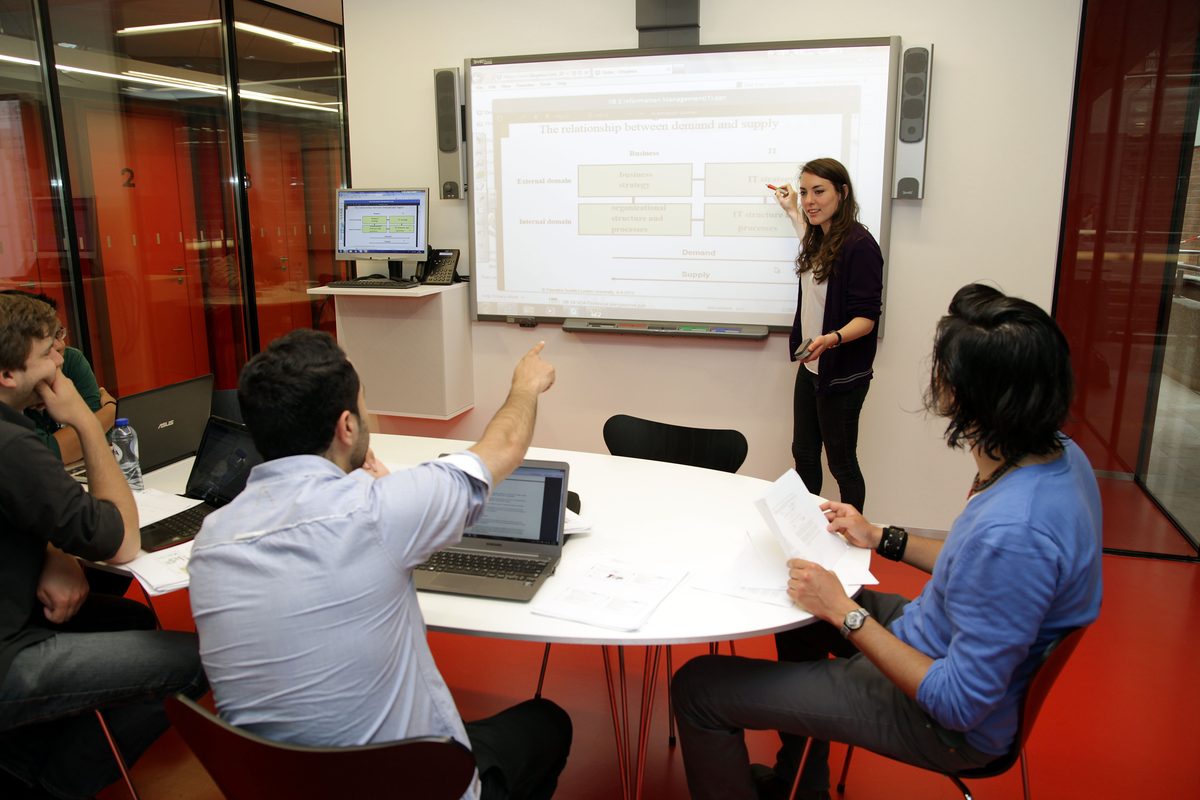
A small, prepared group with a facilitator and an agenda looks like this. Photograph: Leiden University Library / Wikimedia Commons, CC BY 3.0
Image Credits: Wikimedia Commons
One more practical note: how you spend your solo hours determines what the group can do for you. If your default study session is reading the textbook and highlighting passively, the group will just be more of that with company. Switch solo hours to retrieval and mixing up problem types the way interleaving suggests, and sessions with a timer to stay focused, like the pomodoro technique, so you arrive with material worth testing.
Frequently asked questions
Why do study groups sometimes not work even when everyone tries?
Effort is not the whole story. Groups suffer from social loafing, which a 1993 meta-analysis of 78 studies confirmed across tasks and populations, and from the illusion of explanatory depth, described by Rozenblit and Keil in 2002, where watching someone explain feels like understanding. Trying hard inside a structureless session still produces passive learning.
Are study groups effective or a waste of time?
They are effective under the right conditions. Research supports groups that are small, prepared, and built around testing and teaching each other. They are close to a waste of time when they are large, unprepared, unstructured, and dominated by one explainer.
How many people should be in a study group?
The UNC Learning Center's guide advises keeping the group to no more than five people. Smaller groups make each member's contribution visible, which directly counteracts the anonymity that fuels social loafing.
Should I join a study group right before an exam?
Yes, but only if the group does active review: testing each other, explaining concepts from memory, and working unseen problems. A pre-exam group that just re-reads notes together can burn your last study hours while producing the illusion that you are ready.
The bottom line
Study groups fail when nobody is individually accountable, because decades of psychology show people ease off in groups and mistake familiarity for understanding. They work when they are small, prepared, agenda-driven, and built around testing and teaching. If your group is not working, do not just study harder inside it: shrink it to five or fewer, assign a facilitator, set a real agenda, and end every session with everyone proving, alone, what they actually learned.
---
Author bio: Rive News is the research desk behind our education coverage, writing plain-English explainers built on cited studies and university sources.
Latest in Education
- Why We Forget What We Just Read
- How to Read a Textbook Effectively (Not Just Highlight)
- Interleaving: Studying with Examples That Mix It Up
- Does the Pomodoro Technique Actually Work?
Subscribe for one practical study-science piece every week.
Corrections: spotted an error? Email the desk and we will fix it with a dated update note.
Copyright 2026 Rive News. Research-backed explainers, written for humans.
Related stories

Why Do I Blank Out During Tests Despite Studying: Test Anxiety and Retrieval Failure
Blanking out in exams is retrieval failure, not missing knowledge. Anxiety drains working memory; rereading builds false confidence. Here

How to Study for Exams Without Burning Out
Sleep 7-8 hours, study in 25-50 minute blocks, and exercise daily. The science-backed way to study for exams without burning out, and what

Why Do I Forget What I Just Read? Science Has an Answer
You forget what you just read because of the forgetting curve, mapped by Ebbinghaus in 1885. Science explains why memory fades fast and how