
What Is the Pomodoro Technique, and Does It Work?
Key takeaways
- The Pomodoro Technique means 25 minutes of focused work, a 5-minute break, and a longer break after four rounds.
- Research links it to better focus and less mental fatigue, but a 2025 study of 94 students found no productivity advantage over self-timed breaks.
- Treat 25 minutes as a starting point to test, not a rule: the length was never based on cognitive science.
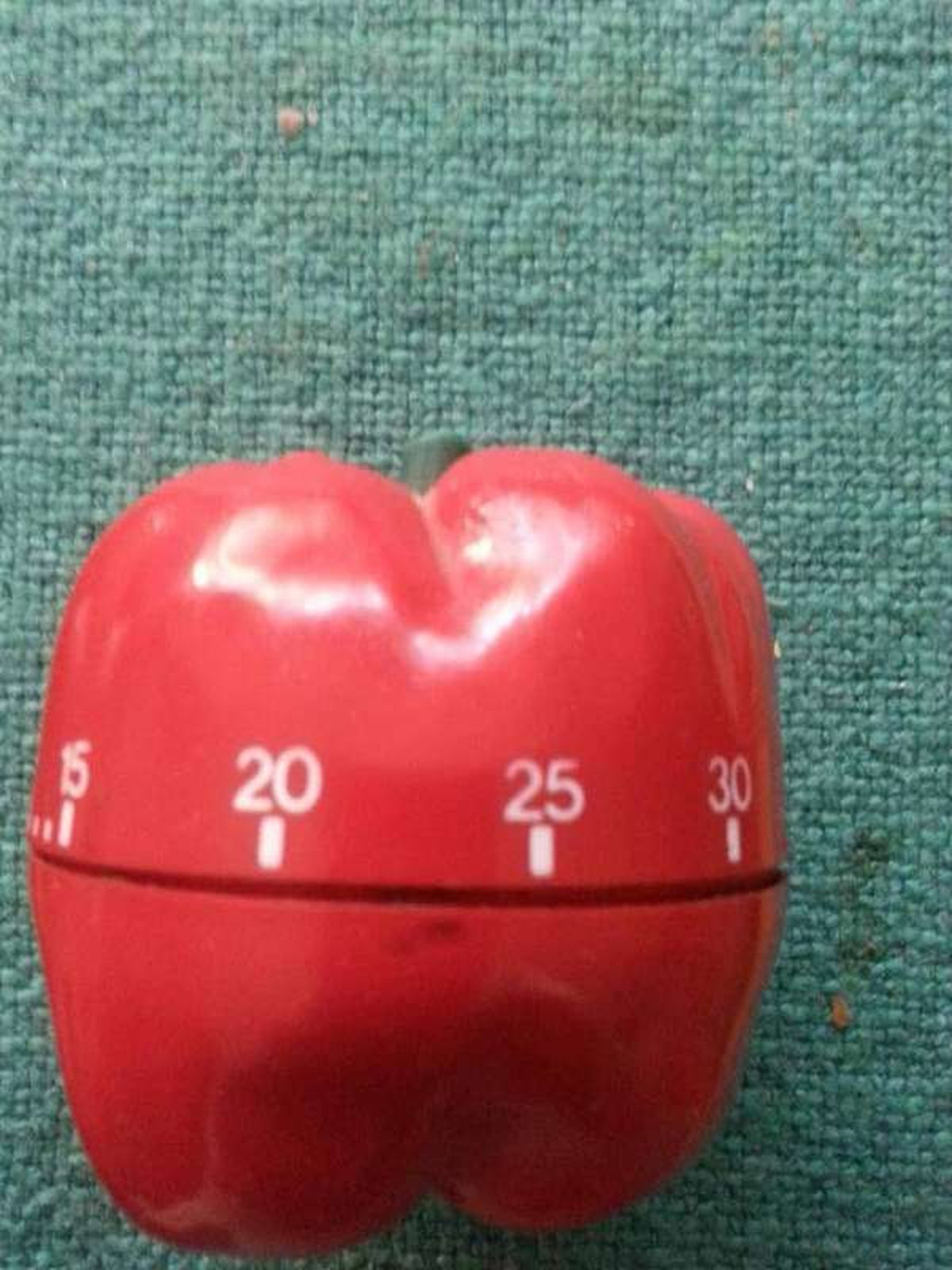
A red pepper kitchen timer, a playful cousin of the tomato-shaped timer Francesco Cirillo used as a struggling student in the late 1980s. Photograph: Noebse/Wikimedia Commons
Image Credits: Wikimedia Commons
The Pomodoro Technique is a time-management method that breaks work into short, timed chunks called pomodoros. You pick one task, work on it with full attention for 25 minutes, then take a short break before starting the next round.
It is one of the most recommended study methods on the internet, which raises the obvious question: does the research actually support it, or is it just productivity folklore? The answer is more nuanced (more mixed) than most fans admit.
This article explains what the Pomodoro Technique is, how a session actually works, what the research says about it, and when a longer session might serve you better.
What the Pomodoro Technique is
Francesco Cirillo developed the method in the late 1980s as an Italian university student who was struggling to focus while studying. He used a tomato-shaped kitchen timer borrowed from his mother's kitchen, and "pomodoro" is simply the Italian word for tomato.
Cirillo later described the idea as turning time from an enemy into an ally. Instead of facing an open-ended study session, you face one small, clearly bounded chunk. He self-published the book The Pomodoro Technique in 2006, and the method spread widely, especially among students and software developers.
Here is the part most explainers skip: the 25-minute length was not scientifically derived. According to a history of the method published by The Boring Clock, it came from Cirillo's personal testing and the practical fact that kitchen timers of that era topped out around 30 minutes. Cirillo himself has said the 25-minute chunk is not sacred and that practitioners should experiment.
How a Pomodoro session works
The classic protocol has six steps. Choose one task, set a timer for 25 minutes, and work on nothing else until it rings.
Take a 5-minute break, then repeat. After four pomodoros, take a longer break of 15 to 30 minutes, then start a new cycle.
During each work chunk, distractions get written down and postponed rather than acted on.
The break rules matter. Get up, move, look away from the screen, and avoid starting anything that will pull you in. A break spent scrolling is barely a break at all, because your attention never actually rests.
What you do inside the 25 minutes matters as much as the timer. Pair the method with active recall or practice questions rather than passive re-reading, which research on cramming shows is weak for long-term learning.

Students studying in a library: structured work chunks work best when the breaks between them are genuine rest, not more screen time. Photograph: Gary Todd/Wikimedia Commons
Image Credits: Wikimedia Commons
What the research says
The evidence is genuinely mixed, which is rare to admit in productivity writing. Start with the supportive side.
A 2025 scoping review by Ogut in BMC Medical Education examined the Pomodoro Technique in anatomy and medical education and found positive short-term effects on attention, mental effort, and task productivity. It reported links between Pomodoro use and student performance (r = 0.65), focus (r = 0.72), and time management (r = 0.60), with lower fatigue and distraction (r = -0.55). The review was careful to note that long-term effects and retention remain unexplored.
Earlier work pointed the same way. A 2023 study by Biwer and colleagues found that students taking scheduled, systematic breaks reported being more concentrated and motivated, and rated tasks as less difficult, than students who took self-regulated breaks.
Now the counterweight. A 2025 study by Smits, Wenzel, and de Bruin, published in Behavioral Sciences, compared Pomodoro, Flowtime, and self-regulated breaks in a two-hour study session with 94 university students.
It found no big differences between the groups in overall productivity, task completion, flow, fatigue, or motivation. Worse for the method's fans, fatigue rose faster and motivation dropped faster in the Pomodoro group.
A 2022 meta-analysis by Albulescu and colleagues in PLOS ONE adds context. Across 22 study samples and 2,335 participants, micro-breaks of up to 10 minutes reliably improved energy and reduced fatigue, but did not reliably improve performance overall. Breaks help you feel better; they do not automatically make you produce more.
The fair summary: the technique reliably structures your time and most users report better focus, but the controlled evidence for a productivity advantage over simply taking breaks when you need them is thin.
When 25 minutes falls short
The strongest criticism is about flow. Research on flow states linked to psychologist Mihaly Csikszentmihalyi suggests deep focus builds over 15 to 20 minutes, which means a 25-minute timer can interrupt you just as you hit your stride. For writing, programming, or hard problem sets, many practitioners extend chunks to 45 or 50 minutes.
The method also fits some tasks better than others. Flashcard review and dense reading fit neatly into 25-minute blocks. Open-ended creative work and complex essays often do not, and forcing them into short boxes can fragment your thinking.
There is also the interruption problem. The technique assumes you control your environment, which students in shared dorms and workers in open offices often do not. A method that requires unbroken quiet is a method that fails exactly where focus is hardest.
The practical answer is to treat the classic timing as a default to test. Try 25/5 for a week of similar sessions, notice whether attention holds and whether breaks actually restore you, then adjust one factor at a time. That is also the advice of the Editorialge guide to burnout-free Pomodoro use, which frames the method as a pattern to test rather than a rule to defend.

A student studying at a dorm desk: the Pomodoro method was invented by a university student, and studying remains the task it fits best. Photograph: English106/Wikimedia Commons
Image Credits: Wikimedia Commons
Frequently asked questions
Is 25 minutes the scientifically correct chunk?
No. The length came from Cirillo's testing and the 30-minute limit of 1980s kitchen timers, not from brain science. Interestingly, the 2025 BMC Medical Education review recommended a different pattern for anatomy study: six 35-minute work sessions with 10-minute breaks.
Does the Pomodoro Technique help with procrastination?
It can. A 25-minute commitment feels small enough to start, which lowers the effort of beginning a dreaded task. The timer also creates a clear finish line, so the work feels bounded rather than endless.
What should I do during the 5-minute break?
Stand up, stretch, drink water, and look at something far away. Avoid your phone and email, since mental leftover from a quick scroll carries straight into the next chunk. The break works when your mind actually disengages.
Pomodoro or Flowtime: which is better?
Flowtime lets you work until you naturally feel like stopping, then take a proportional break. The 2025 Smits study found no big difference between them in productivity or completion. If rigid timers irritate you, Flowtime keeps the spirit of structured breaks without the bell.
The bottom line
The Pomodoro Technique is a simple, well-tested way to structure study time: 25 minutes on, 5 minutes off, with a longer break every fourth round. Research supports better focus and less fatigue, but the honest evidence shows no clear productivity edge over taking breaks on your own schedule.
Start with the classic timing, pair each chunk with an active method like spaced repetition, and adjust the length to fit the task. The timer is a tool, not a law.
Tags: pomodoro technique, study methods, productivity, focus, time management
Rive News is the research desk behind this publication, covering education, study skills, and learning science with sourced, practical guidance.
Latest in Education
- How Spaced Repetition Actually Works: The Forgetting Curve and Optimal Intervals
- Why is cramming ineffective for long-term learning?
- What is active recall and how to use it for studying
- Why Do I Blank Out During Tests Despite Studying: Test Anxiety and Retrieval Failure
Subscribe for one practical study guide in your inbox every week.
Related stories

Why Do I Blank Out During Tests Despite Studying: Test Anxiety and Retrieval Failure
Blanking out in exams is retrieval failure, not missing knowledge. Anxiety drains working memory; rereading builds false confidence. Here

How to Study for Exams Without Burning Out
Sleep 7-8 hours, study in 25-50 minute blocks, and exercise daily. The science-backed way to study for exams without burning out, and what

Why Do I Forget What I Just Read? Science Has an Answer
You forget what you just read because of the forgetting curve, mapped by Ebbinghaus in 1885. Science explains why memory fades fast and how