
Credit card cash advance: how it actually works
By Rive News / Research desk | Rive News / Published October 29, 2026 at 9:00 AM PKT
Key takeaways
- A cash advance borrows cash against your card's credit limit, not against money in a bank account.
- Interest starts on day one, with no grace period, at a higher APR than ordinary purchases.
- A typical fee is 3% to 5% of the advance, and the cash limit is usually only part of the total limit.
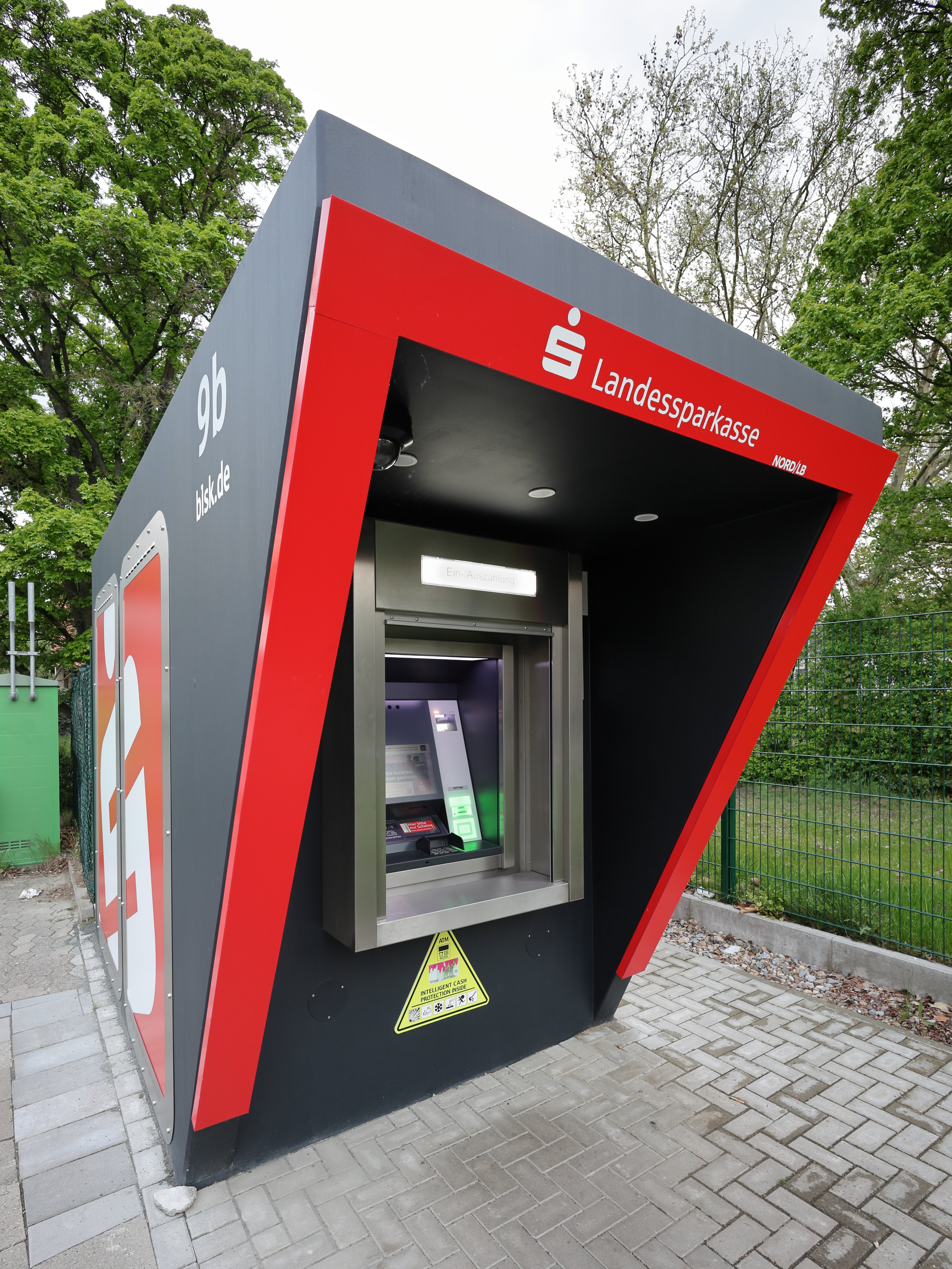
[A cash machine of the kind used for card cash withdrawals.] Photograph: Wikimedia Commons contributor
Image Credits: Wikimedia Commons
A credit card cash advance turns part of a card's credit limit into cash. The cardholder withdraws notes from an ATM, takes cash over a bank counter, or uses a convenience cheque, and the card issuer treats that cash as a loan. It is not free money, and it is not the same as spending on the card in a shop.
This article explains how a credit card cash advance actually works, including its fee, its interest rate, its separate limit, and how repayments are applied. It also covers the cheaper routes worth checking first.
This is general educational information, not financial advice.
What a cash advance is
A normal card purchase borrows money to pay a merchant. A cash advance borrows money and hands it to the cardholder as cash. Chime describes the same split: the advance comes with an upfront fee plus a higher annual percentage rate (APR) than the regular purchase APR.
The cash can come from several routes. The most familiar is an ATM withdrawal using the card and a personal identification number.
Some issuers also allow cash at a bank branch, and some treat certain transactions, such as money orders, wire transfers, cryptocurrency purchases and online gambling deposits, as cash advances. Debt.org lists money orders, wire transfers, cryptocurrency and online gambling among the transactions that can count.
That last point catches people out. A transaction can look like a purchase and still be coded as a cash advance by the issuer. Checking the card agreement for the list of cash-like transactions is the only reliable way to know in advance.
The separate cash advance limit
A cash advance does not use the full credit limit. Issuers set a separate, lower cash advance limit, usually a percentage of the total limit. Chime gives an example: a card with a $10,000 limit and a 30% cash advance limit would allow borrowing of up to $3,000 in cash.
Debt.org gives a similar picture, putting the usual cash advance limit at around 30% of the total credit limit, before fees. It works through the arithmetic for a $10,000 limit with a 5% advance fee, arriving at a maximum advance of just under $2,860, because the fee itself also counts against the limit.
Available credit matters too. If the card already carries a purchase balance, the room left for a cash advance shrinks. An ATM will simply decline a withdrawal that exceeds the remaining cash limit, and repeated attempts do not change that figure.
The fee comes first
Almost every cash advance carries an upfront transaction fee. Chime puts the typical fee at 3% to 5% of the advance amount, or $10, whichever is greater.
Debt. org reports a similar range in its comparison table, with creditor fees of 5% to 10% at the upper end for some cards.
On a $1,000 advance with a 5% fee, the fee alone is $50. That $50 is added to the balance at once, so the cardholder owes $1,050 before a cent of interest is counted. ATM operators can add their own charge on top, which Chime notes may be a few dollars per withdrawal.
The fee is easy to miss in the moment, because the ATM hands over the requested amount. The statement later shows the advance plus the fee, and the fee starts accruing interest along with the rest of the balance.
Interest starts on day one
The most expensive feature of a cash advance is the missing grace period. On ordinary purchases, a cardholder who pays the statement balance in full usually gets at least 21 days before interest starts. Chime states that cash advances have no grace period, so interest starts growing right away.
The rate is also higher. Chime cites the Discover it Cash Back card as an example, with a purchase APR of 17.49% to 26.49% and a cash advance APR of 28.49% as of August 2026. Debt.
org's comparison puts the average cash advance APR at 24.22%, against 20.09% for purchases. Individual cards vary, so the card agreement is the authority for any specific card.
Daily interest makes the cost hard to judge by eye. A 28.49% APR works out at roughly 0.078% per day.
On a $1,050 balance, that is about $0.82 of interest per day at the start. It sounds small until it runs for weeks, which is exactly what happens when only minimum payments are made.
A worked example of the cost
Chime works through a $1,000 cash advance with a 5% fee and a 29.99% APR. Paid off over six months, its table shows $50 in fees, $89.27 in interest and a $2.50 ATM fee, for total interest and fees of $141.77. The same table's two-month column appears inconsistent on its face, so the six-month column is the figure to trust here, and readers should run their own card's numbers rather than relying on any single example.
Debt. org makes the same point more simply: a $1,000 advance with a 5% fee costs $50 upfront, plus interest that accrues from day one.
The lesson of both examples is that the fee is only the visible part. The interest, running daily at a high rate with no grace period, is where the larger cost can build up.
How repayments are applied
Repayment rules decide how fast the expensive balance falls. Sunward explains that issuers separate cash advance balances from purchase balances on the statement. When a cardholder pays only the minimum, that payment typically goes toward the lower-APR purchase balance first, while the higher-APR cash advance balance keeps accruing interest.
United States law changed the picture for payments above the minimum. Under the CARD Act, any payment above the minimum must go to the highest-APR balance first.
Debt. org states the same rule: overpayments go toward the cash advance balance rather than the regular balance.
The practical consequence is clear. Paying only the minimum leaves the cash advance balance largely untouched for as long as a purchase balance remains. Paying more than the minimum attacks the cash advance balance first, which is why clearing an advance quickly matters more than clearing it eventually.
Why cash advances do not earn rewards
Most issuers do not pay rewards on cash advances. The transaction is treated as borrowing, not spending, so the points or cashback that apply to purchases do not apply here. Some issuers also exclude cash-like transactions from rewards even when they look like ordinary spending.
That exclusion removes one of the usual reasons for reaching for a card. A shopper who uses a card for a purchase gets a grace period and possibly rewards. A cardholder who takes the same amount as cash gets a fee, immediate interest, a higher rate and no rewards.
[An automated teller machine in a city street.] Photograph: Wikimedia Commons contributor
Image Credits: Wikimedia Commons
Cheaper routes to check first
A cash advance is rarely the cheapest way to raise cash, and several alternatives usually cost less. A personal loan from a bank or credit union typically carries a fixed rate and term, with interest that does not start at cash-advance rates.
Debt. org's comparison puts the average personal loan APR at 14.47%, well below its 24.22% cash advance figure, although individual offers vary with credit history.
An overdraft line on a checking account may also cost less per transaction, though charges vary by institution. Using existing savings avoids fees and interest entirely, if the money is genuinely spare. For a short, small gap, asking the biller for a payment plan can cost nothing at all.
None of these options is free of trade-offs. A personal loan takes time to arrange, and an overdraft can itself carry high charges if it is used for long. The comparison that matters is the total cost over the time the money will actually be borrowed, not just the headline rate.
When a cash advance might still make sense
There are narrow cases where an advance is the least bad option. A genuine emergency, with no other route to cash and a plan to repay within days, limits the damage from day-one interest. The fee is fixed, so a short borrowing period keeps interest small.
The danger is drift. An advance taken for an emergency and then repaid only at the minimum becomes a long, expensive loan by accident. Setting a repayment date before taking the cash, and paying more than the minimum, are the two habits that keep a short-term tool from becoming a long-term cost.
Frequently asked questions
Does a cash advance affect my credit score?
It can, mainly through credit utilisation. A cash advance raises the balance owed against the limit, and a high utilisation ratio can weigh on a score. Missing payments would damage a score further, as with any card balance.
Can I take a cash advance up to my full credit limit?
No, in most cases. Issuers set a separate cash advance limit, often around 30% of the total limit, and the fee counts against it. The available cash limit also falls if the card already carries a purchase balance.
Is there any grace period on a cash advance?
No. Interest starts from the day of the transaction, unlike purchases, where paying the statement balance in full usually gives at least 21 days interest-free.
Why did my payment not reduce my cash advance balance?
If only the minimum was paid, the payment typically goes to the lower-APR purchase balance first. Payments above the minimum must go to the highest-APR balance first, which is usually the cash advance balance.
Are ATM fees extra?
Yes, they can be. The issuer's cash advance fee is separate from any fee charged by the ATM operator or the cardholder's bank, which Chime notes may add a few dollars per withdrawal.
The bottom line
A credit card cash advance is a loan of cash against a limited slice of the credit limit, with a fee upfront, a higher APR than purchases, and interest from the first day. The combination of those three features is what makes it expensive, not any single charge on its own.
Anyone considering one should check three numbers first: the cash advance limit, the fee, and the cash advance APR, all in the card agreement. If the money cannot be repaid within days, a cheaper route is almost always worth the extra phone call. Readers weighing other card costs may also want to read how a credit card grace period works and why there is no grace period on cash advances.
Tags: credit cards, cash advance, borrowing costs
Rive News is a research desk that writes plain-English explainers from public sources, with claims checked against the documents cited.
Related
- How a credit card grace period actually works
- Why there is no grace period on cash advances
- Why paying only the minimum keeps you in debt
- What a balance transfer fee really costs
Subscribe for a weekly explainer on the money topics readers ask about most.
Rive News publishes general educational explainers. Figures and policies cited here come from the public sources listed above and can change; check the card agreement before acting.
Related stories

How your APR is divided by 365 to get daily interest
Lenders divide your APR by 365 for a daily rate, then apply it to your average daily balance. This guide walks through every step

What is the difference between APR and effective annual rate?
APR ignores compounding inside the year; the effective annual rate includes it. A 12.99% APR card really costs 13.80% a year. Worked

APY vs interest rate: what compounding does to your money
APY includes compounding; the interest rate does not. A 5% rate compounded monthly is really 5.12% APY. Here is how the math works and what