
Why Do Toddlers Wave Bye-Bye Before They Can Talk
Key takeaways
- Most babies wave bye-bye between 9 and 12 months, while first spoken words typically arrive around the first birthday or later.
- Waving needs only arm and wrist control plus imitation, which develop months before the oral-motor control speech requires.
- The CDC lists "waves bye-bye" on its 12-month checklist, defined as what at least 75% of children can do by that age.
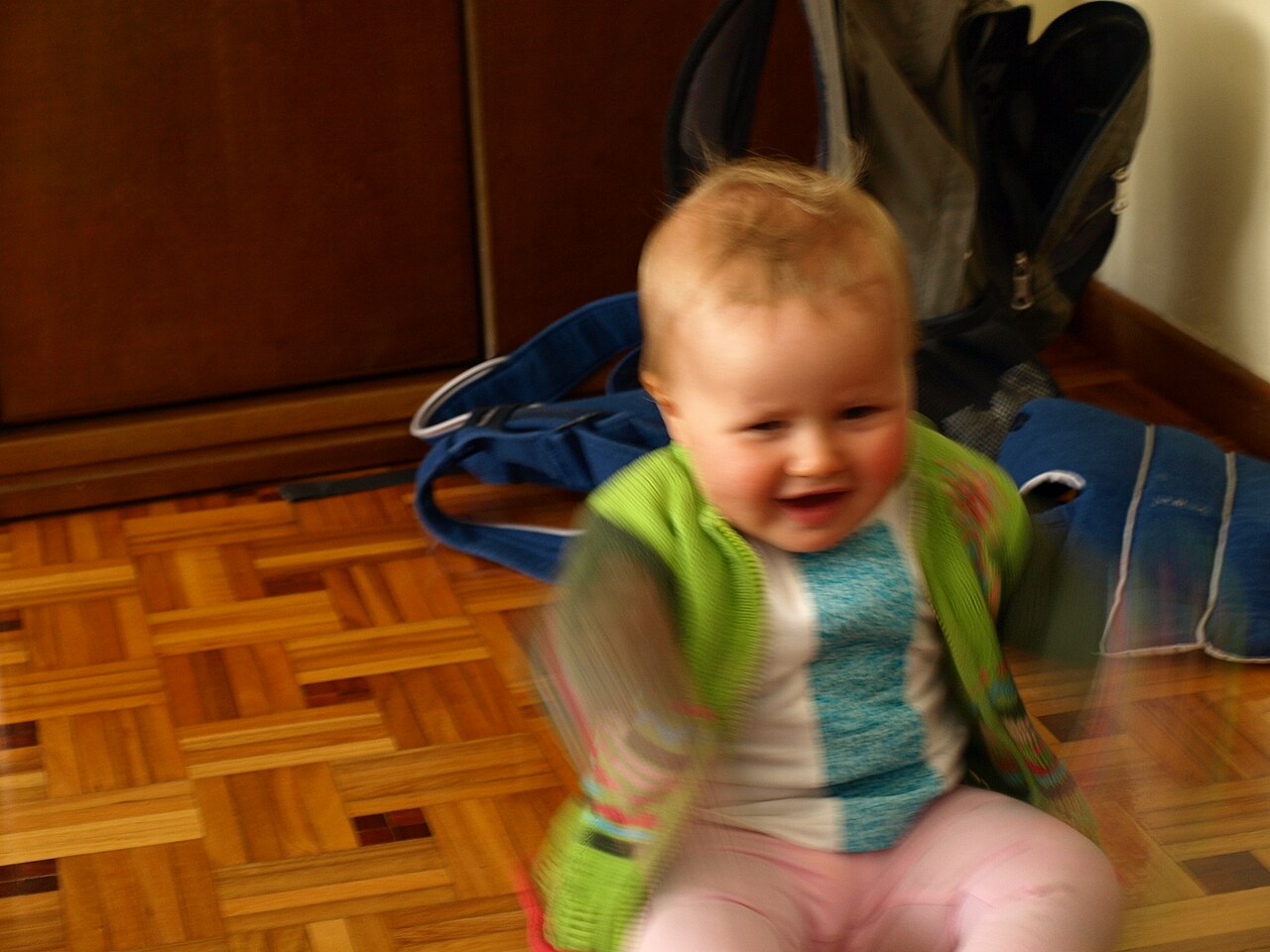
A baby waving its arms. Photograph: Wikimedia Commons
Image Credits: Wikimedia Commons
Waving bye-bye is a gesture, not a word. A baby can wave months before speaking because the two skills run on different hardware and different timelines. The arms are ready to communicate long before the mouth is.
This article explains why toddlers wave bye-bye before they can talk, including the typical waving timeline, why arm control beats mouth control, how imitation powers early gestures, what the CDC milestone checklists actually say, and when to raise a question with a paediatrician.
This article is general information, not medical advice. If you are worried about your child's development, talk to your paediatrician.
The typical waving timeline
First attempts at waving can appear as early as 7 months, often as a clumsy arm flap when a baby sees the same big gesture repeated many times a day. The more recognisable wave, with some consistency, lands in the 9 to 12 month window for most babies, according to both The Bump and Happiest Baby, which cite paediatric sources.
Around 11 months, many babies become motivated by the social side of greeting: welcoming people as they enter the room or bidding them farewell as they leave. By the first birthday, most babies can wave bye-bye on cue.
The CDC places "Waves bye-bye" on its 12-month milestone checklist, alongside understanding "no" and calling a parent "mama" or "dada. "
The range is wide, and that is normal. One study cited by Happiest Baby found that full-term babies imitated bye-bye waves anywhere from 9 to 16 months, and that very low birth weight babies lagged slightly, but all of them had mastered the milestone by 17 months.
A baby who waves at 14 months is not behind; a baby who waved at 8 months is not ahead in any way that matters. Development runs on ranges, not deadlines.
What matters most is the direction of travel. Waving usually appears alongside other social gestures: shaking the head "no" around 6 to 9 months, lifting arms to be picked up, pointing to interesting things between 7 and 12 months, and clapping around 12 to 15 months. A baby adding gestures steadily is showing a healthy communication system, even with zero spoken words.
Why arm control beats mouth control
Speech is an extraordinary motor feat. To say "bye" a baby must coordinate the lungs, vocal cords, tongue, lips and jaw with millisecond timing, all under the control of brain areas that are still maturing. Waving needs the shoulder, elbow and wrist, which mature earlier and are simpler to drive.
Catherine Wiley, MD, division chief of primary care at Connecticut Children's Medical Center, told The Bump that waving is "a really neat intersection between social, language and fine motor skills. " The fine motor part is key. By 9 months, most babies can bang two objects together, transfer toys between hands and rake food toward themselves with their fingers.
The arm and hand are under increasingly precise command. The mouth is still on babbling duty.
Babies also practise arm movements all day. Every reach, grab, bang and throw is a rep.
The mouth gets far less deliberate practice. So when a parent waves and says "bye-bye" dozens of times, the baby's most trainable equipment answers first.
There is a deeper point here that developmental scientists emphasise: gestures are not a poor substitute for speech. They are the first language.
Pointing, showing, giving and waving let a baby communicate wants, reactions and feelings months before words arrive. Florida State University's Autism Institute identified 16 social communication skills that most babies should demonstrate by 16 months, and gestures form the core of that list, according to Happiest Baby.
How imitation powers early gestures
Babies do not need to understand "bye-bye" to start waving. Early waving is imitation, pure and simple.
The baby sees the gesture, copies the motion, and gets a delighted reaction. Understanding grows with repetition and routine.
This imitative wave typically starts without meaning. A 7-month-old may flap an arm when everyone else waves at the door, with no concept of departure.
Over weeks of the same routine, the meaning accretes: keys jingle, someone moves toward the door, the word "bye-bye" sounds, and the arm goes up. By the end of the first year, many babies wave at the right moments, reading the social script.
Imitation is also why waving is so teachable. Paediatric guidance, including the CDC's own activity suggestions, recommends deliberately teaching the gesture: wave and say "bye-bye" every time someone leaves, every single time.
Repetition in context is the whole method. Clap games like pat-a-cake, which usually appear a few months later, work the same way, pairing motion with meaning until the motion carries the meaning.
Receptive language, the ability to understand words, runs ahead of expressive language throughout this period. By around 10 months, babies recognise familiar words like "bottle," "mama" and "bye-bye" even though they cannot say them. The wave is the baby's answer in the only output channel available: the hands.
What the CDC checklists actually say
In February 2022, the CDC revised its developmental milestone checklists for the first time in decades, based on a review published in the journal Pediatrics. The single most important change was the threshold: milestones are now placed at the age when at least 75% of children would be expected to show them, up from the old 50th-percentile approach.
That shift changes what a milestone means. The old checklists described the average age, which meant half of typically developing children were "late" by definition.
The new checklists describe what most children can do, so a missed milestone is a more meaningful prompt to ask questions. As the CDC's key-points page explains, the checklists are communication tools for conversations between families and professionals, not screening or diagnostic tools.
The 12-month checklist includes "Waves bye-bye," "Plays games like pat-a-cake," "Calls a parent 'mama,' 'dada,' or another special name" and "Understands 'no' (pauses briefly or stops when you say it)." Reading these together tells the real story: at one year, the CDC expects gestures, games, a word or two and comprehension. Waving is not early for its age; it is exactly on schedule.
The 2022 revision also added checklists for 15 and 30 months and removed crawling entirely, acknowledging that some babies skip it. Milestones are guides for watching development, not grades. The CDC explicitly warns against using them as diagnostic cutoffs.

Young children waving. Photograph: Wikimedia Commons
Image Credits: Wikimedia Commons
Encouraging gestures at home
The best encouragement is modelling in context. Wave every time someone arrives and leaves. Pair the motion with the word every time.
Narrate what the baby's own gestures mean: "You pointed at the dog! Yes, that is a dog. " Danelle Fisher, MD, a paediatrician quoted by The Bump, notes that on the language side, a waving baby is "telling people what they want," and naming the object or event a gesture refers to builds the bridge toward words.
Play gesture games. Pat-a-cake, peek-a-boo and "so big" (arms raised overhead) all pair big arm movements with social payoff.
Read books and point at pictures, waiting for the baby to point back. Celebrate attempts, however clumsy, because the social reward is what teaches the baby that gestures work.
Keep the pressure off. Avoid drilling the baby or comparing with other children.
Gestures flourish in relaxed, responsive interaction, not in testing. If you are working through toddler tantrums without yelling or navigating school readiness, the same principle holds: connection first, performance second.
Is it normal if my baby waves but says no words?
Yes. Waving at 9 to 12 months with first words arriving around the first birthday or later is the typical sequence. Gestures are the first communication system; speech follows.
My 14-month-old is not waving. Should I worry?
Not automatically. Studies show the normal range for imitating a bye-bye wave runs from 9 to 16 months. Keep modelling the gesture in context, and mention it at your next well-child visit so your paediatrician can look at the whole developmental picture.
Do gestures really help language development?
Yes. Research treats gestures as a precursor to spoken language. Babies who gesture more tend to build vocabulary faster, because gestures create moments where caregivers name the thing the baby is interested in.
Why does my baby wave at strangers but not at family?
The social novelty is exciting. Waving is a social gesture, and some babies perform it most eagerly for an audience. It usually evens out with time and has no hidden meaning.
Should I correct the wave if it looks wrong?
No. Early waves are clumsy by nature, from full-arm flaps to wrist flicks.
The form refines on its own over months. What matters is the intent to communicate, not the technique.
The bottom line
Toddlers wave bye-bye before they can talk because waving needs only arm control and imitation, both of which mature months before the complex oral-motor machinery of speech. Most babies wave between 9 and 12 months, the CDC expects it by 12 months, and gestures are a genuine first language, not a placeholder. Model the wave in context, narrate what gestures mean, and let the words arrive on their own schedule.
Latest in Parenting
- How to Handle Toddler Tantrums Without Yelling
- Why Your Baby Cries at the Same Time Every Evening
- Prepare Your Child for the First Day of School
- The Difference Between Time-Out and Time-In
Subscribe for one evidence-based parenting insight every week.
Related stories
Why babies cry more in the evening: the witching hour explained
The witching hour is the fussy evening stretch most newborns hit daily. Why overtiredness, cluster feeding, and overstimulation stack up
When Do Babies Start Sleeping Through the Night by Month?
Most babies sleep through the night between 3 and 6 months, with regressions at 4 and 8 to 10 months. See the month-by-month table
Why Your Baby Wakes Up the Second You Put Them Down
Newborns wake when put down as the startle reflex, light sleep, and lost warmth hit at once. It is normal and peaks early, fading