
Why is the ocean salty but lakes are not?
Key takeaways
- Rivers deliver about 4 billion tons of dissolved salts to the ocean every year, and evaporation leaves the salt behind.
- Ocean water averages 35 parts per thousand of dissolved salts, a level stable for roughly a billion years.
- Lakes stay fresh because they have outlets that flush salts away; lakes without outlets, like the Dead Sea, turn salty.
Taste seawater and you get salt. Taste lake water and you get, mostly, nothing. Both are water, both are fed by rain and rivers, so the difference is worth a closer look.
The answer is a story about delivery and trapping. Rivers constantly carry tiny amounts of dissolved minerals to the sea, and the sea has no drain.
Lakes do have drains, so their minerals keep moving. This article tells the runoff-buildup story, including where ocean salt comes from, why the salt stays in the sea, why lakes stay fresh, and the lakes that break the rule.
Where ocean salt comes from
It starts with rain. Rainwater is slightly acidic because it absorbs carbon dioxide from the air, forming weak carbonic acid. As that water seeps through soil and rock, the acid dissolves minerals, and the runoff carries the resulting ions (charged mineral particles) downhill.
Rivers are the delivery trucks. The US Geological Survey's water science materials put the yearly delivery at about 4 billion tons of dissolved salts carried into the ocean by rivers each year. Sodium and chloride, the two ions that make table salt, dominate the load, joined by magnesium, calcium, potassium, and sulfate.
The ocean got a head start, too. In Earth's early history, volcanic gases released salt-forming ions that reached the young ocean through rainfall and runoff. Hydrothermal vents on the seafloor still add mineral-rich fluids today, contributing magnesium, calcium, and potassium directly to the deep water.
Here is the part that surprises people. Each year's river delivery sounds enormous, but the ocean is enormously larger. Galen McKinley, a professor of atmospheric and oceanic sciences at the University of Wisconsin-Madison, told UW-Madison News: "Each year, runoff from the land adds only 0.00005 percent of total ocean salts.
" The salt built up over geologic time (millions and billions of years), not in any single century.
Why the salt stays in the sea
The ocean is the end of the line. Water flows downhill into it from every continent, and there is nowhere further downhill for it to go. So the water leaves by the only exit available: upward.
Evaporation lifts pure water vapor off the surface and leaves the dissolved salts behind. Every liter that evaporates makes the remaining water a tiny bit saltier. Over millions of years, that one-way process built the ocean's saltiness to its current level: about 35 parts per thousand, or 3.5% by weight.
To picture the scale, ThoughtCo offers a classic image: if you removed all the salt from the ocean and spread it over the land, it would form a layer more than 500 feet (166 meters) deep. That is the collected delivery of billions of years of rivers.
And the ocean is not getting noticeably saltier. McKinley notes there is geologic evidence that seawater saltiness has held roughly steady for at least a billion years.
Salt leaves the system too, buried in sediments, locked into evaporite deposits (layers of minerals left by dried-up water), and taken up by marine organisms. Additions and removals have balanced out over deep time.
Why lakes stay fresh
Lakes play by different plumbing. Most lakes have an outlet: a river or stream that carries water onward toward the sea. Dissolved minerals arrive with the inflow, but they leave with the outflow, so they never build up.
Turnover speed is the key number. McKinley gives a vivid comparison: a water droplet and its dissolved ions stay in Lake Superior for about 200 years, compared to roughly 100 to 200 million years in the ocean. "Even if you did have any accumulation of an ion in a lake, it would be washed out quickly," she told UW-Madison News.
Rain keeps diluting the system from above. Lakes are constantly refilled with fresh rainfall while their outlets drain the mix downstream. The minerals pass through on their way to the sea rather than settling in.
Rivers stay fresh for the same reason, only faster. River water moves too quickly and is refilled too often for dissolved salts to concentrate. The river is the conveyor belt, not the warehouse.
The lakes that break the rule
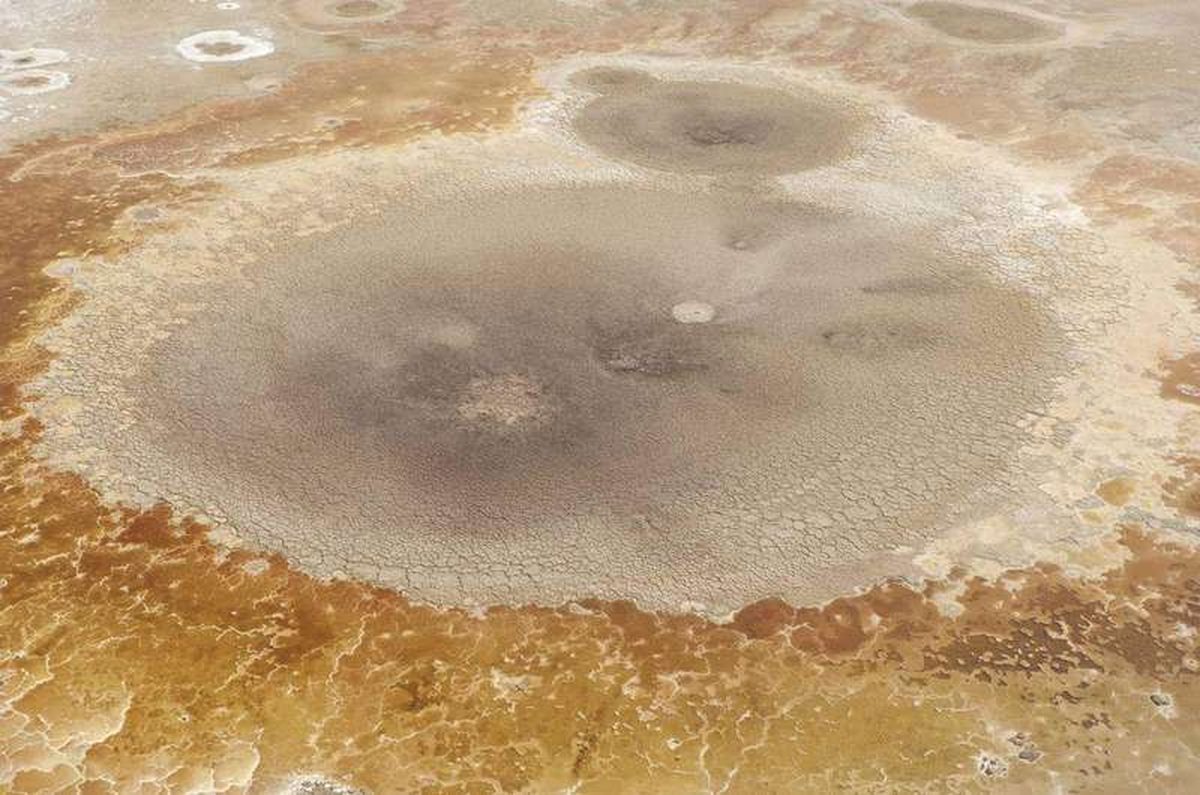
Some lakes have no outlet. Water flows in, but the only way out is evaporation, which is exactly the ocean's arrangement on a smaller scale. Geologists call these endorheic basins (closed basins with no outlet to the sea), and they turn salty the same way the sea did.
The Dead Sea is the famous example. It sits in a desert rift with high evaporation and no drainage, and its saltiness reaches about 33.7%, nearly ten times the open ocean. That is why swimmers float effortlessly in it.
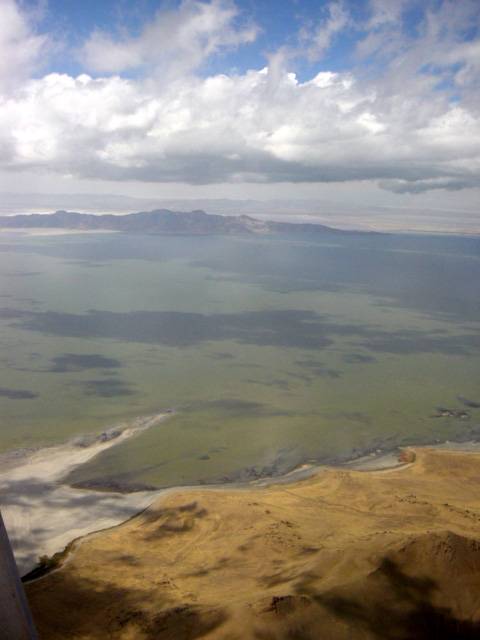
The Great Salt Lake in Utah works the same way. Its saltiness varies with water level, ranging from about 5% to 27% over recent decades. Wikipedia's salinity table splits the difference by arm: about 31.7% in the north arm and 14.2% in the south arm, both far above the ocean's 3.5%.
These lakes prove the rule by breaking it. Give any body of water an inflow of minerals, no outlet, and strong evaporation, and it will turn salty. Fresh lakes are fresh because they drain.
Frequently asked questions
Is the ocean getting saltier over time?
Not measurably. River input continues, but salt removal through sediment burial, mineral deposits, and biological uptake balances it. Geologic evidence suggests saltiness has been roughly stable for at least a billion years.
Why does the Dead Sea have so much more salt than the ocean?
It combines every concentrating factor: desert evaporation, very low rainfall, mineral-rich inflow, and no outlet. Water leaves only as vapor, so the salts build up to about 33.7%.
Can a freshwater lake turn salty?
Yes, if its outlet closes or evaporation outpaces inflow. Lake Urmia in Iran shifted from relatively fresh to highly salty within decades as its water balance changed. It is a live demonstration of the same physics.
If rivers carry salt to the sea, why aren't rivers salty?
Concentration. Rivers carry only trace amounts of dissolved minerals, and constant fresh inflow from rain dilutes them. The ocean's saltiness is the sum of those traces over billions of years, not the taste of any single river.
The bottom line
The ocean is salty because rivers have spent billions of years delivering dissolved minerals to a basin with no drain, and evaporation keeps the water while leaving the salt. Lakes stay fresh because they drain, flushing their minerals downstream before they can build up.
Every mouthful of seawater is, in a real sense, a dissolved piece of the continents. The salt in it was once mountain rock, carried grain by grain down rivers to the one place on Earth where water can leave but salt cannot.
Tags: ocean, salinity, lakes, earth science, water cycle
Rive News is the in-house research desk covering tech, health, money, home, and science with sourced explainers.
Related stories
how to transfer eSIM to a new phone
do bananas actually prevent muscle cramps
how is APR divided by 365 to get daily interest
how to prevent mold in bathroom without exhaust fan
Subscribe to the Rive News newsletter for one sourced explainer every morning.
Corrections: we correct errors promptly. Contact the research desk with the article URL and the fix.
© 2026 Rive News. All rights reserved.
Related stories

Why diamond is hard and graphite is soft when both are carbon
Diamond and graphite are both pure carbon, yet diamond is 10 on the Mohs scale and graphite is 1 to 2. The difference is not the atoms;

Why Hot Water Can Freeze Faster Than Cold: The Mpemba Effect Explained
Hot water can freeze faster than cold under specific conditions. The Mpemba effect, named for a 1963 schoolboy experiment, still divides

How Magnets Work at the Atomic Level: Spins, Domains, and Iron
Magnetism comes from electrons: their spin and orbits make each atom a tiny magnet. In iron, quantum forces align these atomic magnets into