
Why Hot Water Can Freeze Faster Than Cold: The Mpemba Effect Explained
Key takeaways
- Under specific conditions, water that starts hotter can freeze before colder water. This puzzle is called the Mpemba effect.
- Tanzanian schoolboy Erasto Mpemba noticed it with hot ice cream mix in 1963. He and physicist Denis Osborne published the finding in 1969.
- Physicists still argue over the mechanism. Convection, evaporation, and dissolved gases are proposed, and replication results remain mixed.

The Mpemba effect is the observation that, in certain specific circumstances, warmer water freezes faster than colder water. It sounds backwards. Hot water must cool through every temperature the cold water started at, so it should always lag behind. Yet under the right setup, it does not.
The effect is named for Erasto Mpemba, a Tanzanian schoolboy who stumbled onto it in 1963 while freezing ice cream mix in a cookery class. Scientists have argued about it ever since, and no single explanation has settled the debate.
This article explains what the Mpemba effect actually claims, how a teenager's ice cream experiment became a physics controversy, the leading theories for why it happens, what skeptics and replications say, and how you can try the experiment yourself.
What the Mpemba effect actually claims
The claim is narrower than it sounds. Physicist Monwhea Jeng proposed a definition used in theoretical work: there exists a set of initial parameters, and a pair of temperatures, such that given two identical bodies of water differing only in initial temperature, the hotter one freezes sooner.
The key phrase is "a set of initial parameters." Nobody claims all hot water beats all cold water. Only that some pairs of temperatures produce the surprise.
Even the word "freezing" is slippery. It can mean the moment a visible skin of ice forms on the surface, or the moment the whole volume turns solid. Studies use different definitions, which makes experiments hard to compare, as the research summaries on Wikipedia note.
New Scientist recommends starting the two containers at 35 °C (95 °F) and 5 °C (41 °F) to maximize the effect. That framing matters.
The 1963 ice cream discovery
Erasto Mpemba was a 13-year-old student in Form 3 at Magamba Secondary School in Tanganyika (now Tanzania) when he ran into the puzzle. His class was making ice cream, and freezer space was limited. While classmates boiled milk for the mixture and let it cool before freezing, Mpemba put his hot mixture straight in to save time.
When he checked later, his dessert was frozen solid while the cooled mixtures were still liquid. He asked his teachers about it and was told it was nonsense. Street ice cream vendors, though, told him they had seen the same thing, per the Skeptical Inquirer's account of the story.
The question that made a physicist curious
A few years later, Dr. Denis Osborne of the University College in Dar es Salaam visited Mpemba's school to lecture on physics. During the Q&A, Mpemba put his now-famous question to him: if you take two similar containers with equal volumes of water, one at 35 °C (95 °F) and the other at 100 °C (212 °F), and put them into a freezer, why does the one that started at 100 °C freeze first?
His classmates laughed again, but Osborne was intrigued enough to test it himself.
He confirmed the finding in his own lab.
The two published their results together in 1969 in the journal Physics Education, while Mpemba was studying at the College of African Wildlife Management.
Their setup used 70 ml samples in 100 ml beakers, placed on a sheet of polystyrene foam in a domestic refrigerator's icebox. They found that the time for freezing to start was longest with an initial temperature of 25 °C and much shorter at around 90 °C. They ruled out loss of liquid by evaporation and the effect of dissolved air as significant factors in their setup. They noted that most heat loss came from the liquid's surface.
Why hot water might freeze faster
There is no agreed mechanism, but four explanations get the most attention.
Evaporation. Hot water loses mass as steam, so there is simply less water left to freeze. Mpemba and Osborne ruled this out in their setup, but it can matter in open containers.
Convection. Hot water sets up stronger circulation currents, which carry heat to the surface faster. Osborne observed that the top of a cooling beaker stays warmer than the bottom, sustained by convection. He also found that blocking heat transfer from the top with a film of oil drastically slowed cooling.
Dissolved gases. Heating drives dissolved air out of water, and some argue this changes how freezing begins. The original 1969 paper tested boiled water and concluded the effect of dissolved air was not significant in their experiment.
Hydrogen bonds. A theory reported by Nature Chemistry in 2014 proposed that in warmer water, hydrogen bonds stretch further. That compresses the molecules' covalent bonds and produces a net cooling effect. The calculated energy changes predicted the observed differences in freezing speed. But as Nature Chemistry noted, the paper made no new predictions, so it remained unproven.
The winning entry in the Royal Society of Chemistry's 2012 competition took a multicausal view. It treated the effect as the product of several of these factors at once, with the emphasis on convection driven by the temperature gradient.
What the skeptics say
Not every lab sees it. Some studies of water have found no reproducible effect, and physicists remain divided on the effect's precise definition and underlying mechanisms, as the research literature summarized on Wikipedia states. Small differences in setup, container placement, and what counts as "frozen" can change the outcome.
That is why the debate has lasted six decades. The effect appears to be real under tightly defined conditions and elusive outside them, which is exactly the kind of result that keeps arguments alive.
The prize that drew 20,000 explanations
The puzzle is older than Mpemba. In 2012, the Royal Society of Chemistry offered a £1,000 prize for the best explanation. Its announcement traced the history back: Aristotle puzzled over it in the fourth century BCE, Roger Bacon in the 13th century, Francis Bacon in his 1620 Novum Organum (where he wrote that "slightly tepid water freezes more easily than that which is utterly cold"), and Descartes in the 17th century.
The competition drew more than 20,000 entries, per Nature Chemistry. The winner was Nikola Bregović, a research assistant at the University of Zagreb in Croatia. Mpemba himself presented the award to Bregović by video link at the Royal Society of Chemistry in London in January 2013, an event recorded in a stock photograph caption of the ceremony.
Can you test it in your kitchen?
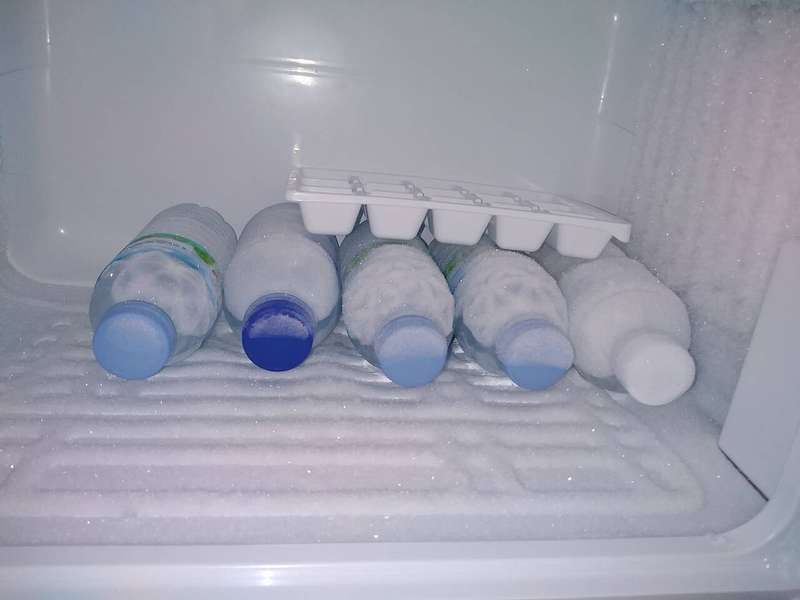
Yes, with care. Use two identical containers with equal volumes of water, one hot and one cold, on the same freezer shelf. The New Scientist pairing of 35 °C and 5 °C is a good starting point.
Decide in advance what you are measuring: the first skin of ice, or the fully frozen solid. Keep the containers uncovered or covered identically, and do not open the freezer mid-test.
One warning from the Royal Society of Chemistry's competition notice still applies: "Handling hot or boiling water should be undertaken with care or under supervision."
Frequently asked questions
Does hot water always freeze faster than cold water?
No. The effect only appears under specific conditions, with specific pairs of starting temperatures and matched containers. In most everyday situations, cold water freezes first.
Is the Mpemba effect real or a myth?
It appears to be a real phenomenon under tightly defined conditions, confirmed in the 1969 Mpemba and Osborne experiments and several later studies. But replications are mixed, and there is no consensus on the mechanism.
What is the inverse Mpemba effect?
In 2017, physicists Amit Gal and Oren Raz of the Weizmann Institute of Science in Israel found theoretical evidence for the effect and predicted an inverse version, in which a colder system heats up faster than a warmer one. Researchers led by John Bechhoefer at Simon Fraser University in Canada later demonstrated the inverse effect experimentally using optical tweezers on a colloidal particle, with results published in the Proceedings of the National Academy of Sciences.
Why do scientists still argue about it?
Because the effect is parameter dependent. The definition of "freezing" varies between studies, small setup differences change outcomes, and several mechanisms may all contribute at once.
The bottom line
The Mpemba effect says that under specific conditions, hotter water can freeze before colder water, and a 1963 ice cream experiment by a Tanzanian schoolboy put it on the scientific map. Convection, evaporation, and dissolved gases all have supporting evidence, but no single mechanism has won the argument. If you try it at home, match your containers exactly, pick the 35 °C and 5 °C pairing, and decide what counts as frozen before you start.
Tags: Mpemba effect, physics, water, freezing, experiments, science explainer
Rive News is a research desk producing verified explainers on science, money, and technology.
Related stories
- Why Credit Card Rewards Cost You Money If You Carry a Balance
- How Buy Now, Pay Later Makes Money Without Charging You Interest
- Can You Use an eSIM and a Physical SIM at the Same Time?
Subscribe to the Rive News newsletter for one clear, verified explainer every week.
Rive News follows a verification-first standard: every statistic above traces to a cited public source.
Related stories

Why diamond is hard and graphite is soft when both are carbon
Diamond and graphite are both pure carbon, yet diamond is 10 on the Mohs scale and graphite is 1 to 2. The difference is not the atoms;

How Magnets Work at the Atomic Level: Spins, Domains, and Iron
Magnetism comes from electrons: their spin and orbits make each atom a tiny magnet. In iron, quantum forces align these atomic magnets into
Why is the ocean salty but lakes are not?
Rivers deliver about 4 billion tons of salt to the sea each year, and evaporation leaves it behind. That is why oceans are salty and lakes