
Why diamond is hard and graphite is soft when both are carbon
Key takeaways
- Diamond and graphite are both made entirely of carbon atoms; they are different structural forms called allotropes.
- Diamond's atoms lock into a rigid three-dimensional tetrahedron, giving it a Mohs hardness of 10, the top of the scale.
- Graphite's atoms form flat sheets held together by weak forces, so the sheets slide, giving it a Mohs hardness of just 1 to 2.
A diamond can scratch every other natural material on Earth. A pencil, which writes with graphite, can be snapped between two fingers. Both objects are made of exactly the same atoms: carbon, and nothing else.
The trick is that properties do not come from atoms alone. They come from how atoms are arranged and bonded. Diamond and graphite are allotropes of carbon, meaning different structural forms of the same element, and their structures could hardly be more different.
This article explains the carbon-bonding contrast behind the paradox, including how diamond's structure creates extreme hardness, how graphite's structure creates softness, and the key numbers side by side.

Brilliant-cut diamonds, each carbon atom locked to four neighbors. Photograph: Mario Sarto/Wikimedia Commons
Image Credits: Wikimedia Commons
Same atoms, different arrangement
Start with the shared ingredient. Every carbon atom has four valence electrons available for bonding. In diamond, all four are used.
In graphite, only three are. That single difference in bookkeeping reshapes everything.
Chemist Miriam Rossi, a professor of chemistry at Vassar College, explains the contrast this way in Scientific American: both diamond and graphite are made entirely out of carbon, as is the more recently discovered buckminsterfullerene, a soccer-ball-shaped molecule of 60 carbon atoms. The way the carbon atoms are arranged in space is different for each, making them allotropes.
So the question is never "which atoms? " It is always "which architecture? " Diamond builds a fortress.
Graphite builds a stack of paper.
How diamond's bonding makes it the hardest natural material
In diamond, each carbon atom bonds to four neighbors arranged tetrahedrally, with a carbon-carbon-carbon bond angle of 109.5 degrees. The atoms sit just 1.544 x 10^-10 meters apart, Rossi reports, locked into a strong, rigid three-dimensional network that extends without interruption through the whole crystal.
Because every valence electron is tied up in these bonds, there is no weak direction and no loose electron. The result is a material that resists scratching, compression, and deformation from every angle. On the Mohs scale of mineral hardness, devised by German geologist Friedrich Mohs in 1812, diamond defines the top: a hardness of 10, able to scratch all other materials.
The same rigid lattice gives diamond its famous density of 3.514 grams per cubic centimeter, noticeably higher than graphite's. It also makes diamond the best conductor of heat known, carrying up to five times as much heat as copper, according to Rossi. Yet it conducts no electricity at all: with no free electrons, diamond is an electrical insulator.
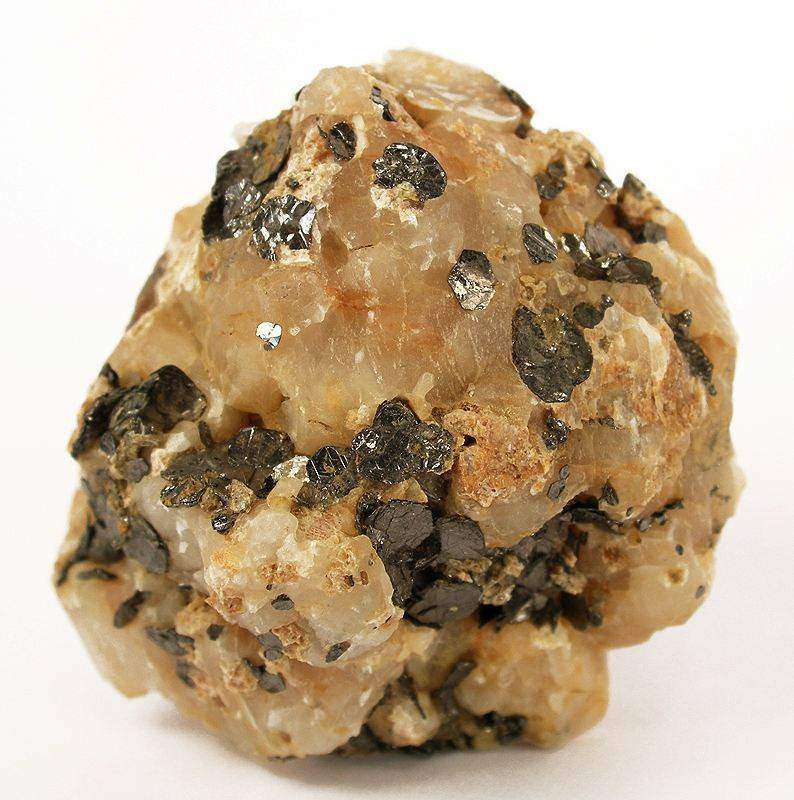
A graphite mineral specimen, soft enough to mark paper. Photograph: Robert M. Lavinsky/Wikimedia Commons
Image Credits: Wikimedia Commons
How graphite's bonding makes it soft and slippery
Graphite uses the same carbon atoms completely differently. Each atom bonds to only three neighbors, forming flat hexagonal sheets. The bond angle within a sheet is 120 degrees, and the in-plane bonds are strong.
But the sheets themselves are held together only by weak van der Waals forces. That is the whole secret of graphite's softness. The layers slide over one another with almost no resistance, which is why graphite feels greasy, stains fingers, and works as a dry lubricant in machinery.
The fourth valence electron, unused in bonding, is free to drift. Those delocalized electrons make graphite an excellent conductor of electricity, the exact opposite of diamond. Graphite's Mohs hardness sits at just 1 to 2, near talc at the bottom of the scale, and its calculated density is 2.26 grams per cubic centimeter.
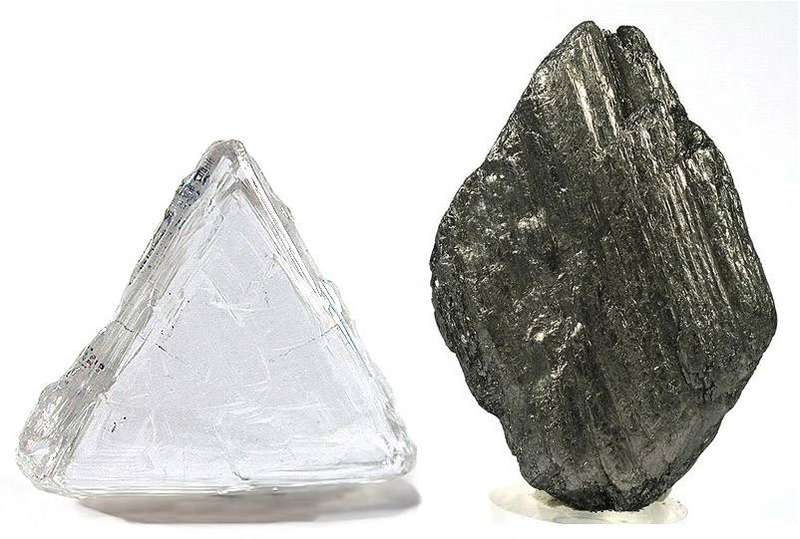
A diamond and a piece of graphite side by side: same element, opposite properties. Photograph: Robert M. Lavinsky/Wikimedia Commons
Image Credits: Wikimedia Commons
Diamond vs graphite: the numbers side by side
Put the two architectures next to each other and the paradox dissolves into a table.
| Property | Diamond | Graphite |
|---|---|---|
| Composition | 100% carbon | 100% carbon |
| Bonding | sp3, tetrahedral, 3D network | sp2, hexagonal sheets |
| Bond angle | 109.5° | 120° in-plane |
| Mohs hardness | 10 | 1 to 2 |
| Density | 3.514 g/cm³ | 2.26 g/cm³ |
| Electrical conductivity | Insulator | Conductor |
| Heat conductivity | Best known, ~5x copper | Modest |
Every row traces back to the bonding. Tetrahedral sp3 bonds in three dimensions give hardness, density, and heat conduction. Planar sp2 sheets with weak interlayer forces give softness, slipperiness, and electrical conductivity through the free fourth electron.
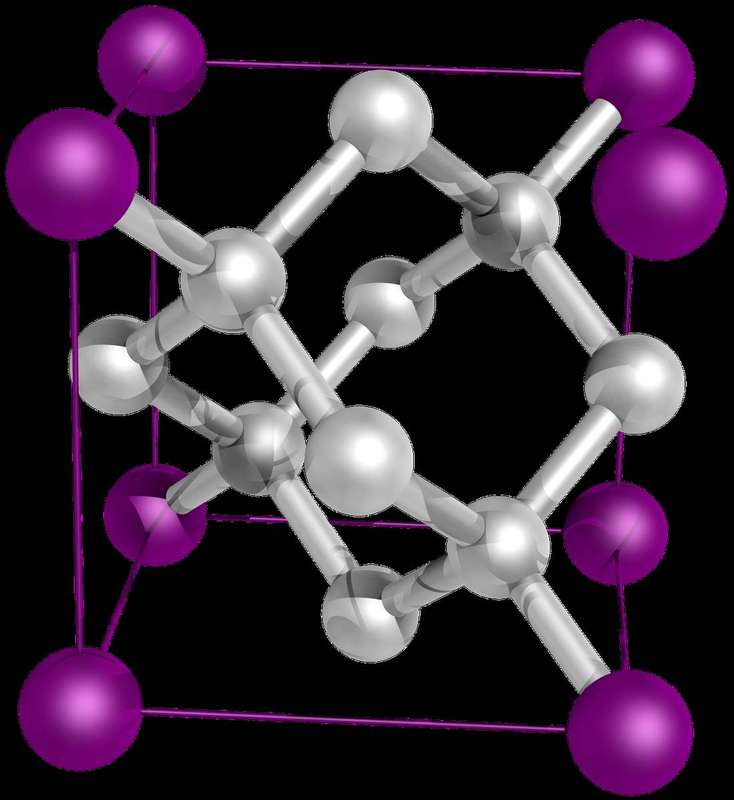
A diagram of the cubic diamond crystal lattice. Photograph: Yassine Mrabet/Wikimedia Commons
Image Credits: Wikimedia Commons
Where you meet both in everyday life
You have probably held both materials today without thinking about it. The "lead" in a pencil is graphite mixed with clay, engineered to shear off in layers as you write. Industrial graphite lubricates locks and machinery for the same reason: the sheets slide.
Diamond's hardness earns its keep far from jewelry. Cutting tools, drill bits, grinding wheels, and heat sinks in electronics all exploit the rigid lattice. Synthetic diamonds grown by high-pressure, high-temperature or chemical vapor deposition methods share the same properties as mined ones and do most of this industrial work.
Even the sparkle is structural. Diamond's high refractive index, about 2.417, bends light sharply inside the rigid lattice, producing the brilliance jewelers prize. Graphite, opaque and metallic-looking, could not be more different, and yet a chemist would find the same element in both.
Frequently asked questions
Are diamond and graphite really the same element?
Yes. Both are pure carbon, classified as allotropes: different structural forms of one element. Burn either in oxygen and you get the same product, carbon dioxide.
Why is diamond hard and graphite soft?
Diamond's carbon atoms form a rigid three-dimensional tetrahedral network with no weak direction. Graphite's atoms form flat sheets held together by weak van der Waals forces, so the sheets slide apart easily. Arrangement, not composition, decides hardness.
Does graphite conduct electricity while diamond does not?
Correct, and for the same structural reason. In graphite, each carbon's fourth valence electron is delocalized and free to move, enabling conduction. In diamond, all four valence electrons are locked in covalent bonds, making it an insulator.
Can graphite turn into diamond?
Under extreme pressure and temperature, yes. That is how natural diamonds formed in Earth's mantle and how synthetic diamonds are grown in high-pressure, high-temperature presses. The atoms rearrange from sheets into the tetrahedral network.
The bottom line
Diamond and graphite prove that what matter is made of matters less than how it is put together. Identical carbon atoms become the hardest natural material known when locked in a tetrahedral lattice, and one of the softest when stacked in slippery sheets.
The next time a pencil marks paper effortlessly, remember it is writing with the same element that cuts glass. Arrangement is everything.
Topics: chemistry, carbon, diamond, graphite, materials science
Rive News is the research desk behind the Rive News publication, covering technology and science through sourced, evergreen explainers.
Related stories
- How electric car batteries degrade over time: cycle and calendar aging explained
- Can an eSIM be hacked or cloned? The honest security answer
- APY vs interest rate: what compounding does to your money
- eSIM for multi-country travel: how regional plans actually work
Get one sourced explainer like this in your inbox every morning. Subscribe to the Rive News newsletter.
© 2026 Rive News. All rights reserved.
Related stories

Why Hot Water Can Freeze Faster Than Cold: The Mpemba Effect Explained
Hot water can freeze faster than cold under specific conditions. The Mpemba effect, named for a 1963 schoolboy experiment, still divides

How Magnets Work at the Atomic Level: Spins, Domains, and Iron
Magnetism comes from electrons: their spin and orbits make each atom a tiny magnet. In iron, quantum forces align these atomic magnets into
Why is the ocean salty but lakes are not?
Rivers deliver about 4 billion tons of salt to the sea each year, and evaporation leaves it behind. That is why oceans are salty and lakes