
How electric car batteries degrade over time: cycle and calendar aging explained
Key takeaways
- The average EV battery loses about 2.3% of its capacity per year, per Geotab's study of more than 22,700 vehicles.
- Two separate processes drive the loss: cycle aging from charging and driving, and calendar aging that happens even while the car sits parked.
- Heat, frequent high-power fast charging, and long stretches at very high or very low charge speed up degradation the most.
An electric car's battery does not die all at once. It fades, slowly and unevenly, losing a little of its ability to hold charge with every passing year.
That fade is called degradation. Engineers measure it as state of health. That is the battery's current capacity expressed as a percentage of what it held when new. When a car that once drove 300 miles on a full charge can only manage 270, its battery has degraded by roughly 10%.
This article explains how electric car batteries degrade over time: what cycle aging is, what calendar aging is, which habits speed up the loss, and what owners can do to slow it down.
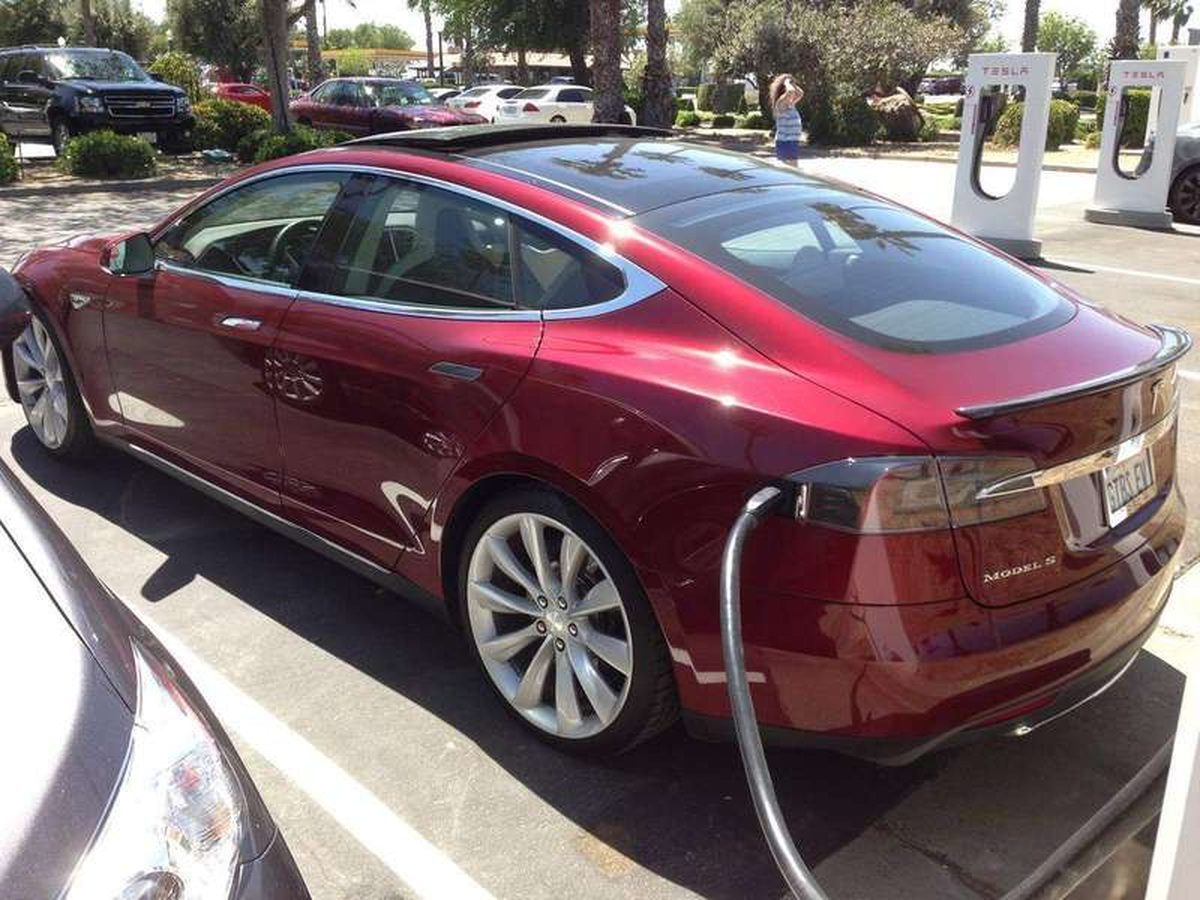
A Tesla Model S plugged in at a Supercharger station. Photograph: Jusdafax/Wikimedia Commons
Image Credits: Wikimedia Commons
What battery degradation actually means
Degradation is simply the battery's shrinking ability to store energy. The chemicals inside do not vanish. They become less available to do useful work, so the same full charge carries the car fewer miles.
The loss is permanent and one-directional. A degraded battery cannot be reconditioned back to its original capacity the way a phone can be restarted. This is why automakers warrant the outcome. Tesla, for example, guarantees at least 70% capacity retention for 8 years or up to 150,000 miles depending on the model, per InsideEVs' reporting on the company's data.
In practice, most packs age far more gracefully than the warranty floor suggests. Tesla's own fleet data shows Model 3 and Model Y Long Range vehicles retaining about 85% of capacity after 200,000 miles, while Model S and Model X hold about 88%, InsideEVs reported. Tesla says its batteries are designed to outlast 200,000 miles of driving.
Why electric car batteries degrade: cycle aging
Cycle aging is the wear that comes from using the battery. Every charge and discharge moves lithium ions back and forth between the two electrodes, and each trip takes a small toll.
The main culprit is a thin film called the SEI layer, short for solid electrolyte interphase. It forms on the anode during the battery's first charges, when the electrolyte breaks down at the electrode surface. The film is protective in principle, shielding the anode from further reaction.
But it is never perfectly stable. Each cycle, especially cycles run hot or at high current, adds new layers of decomposition products.
Every bit of film growth permanently removes lithium ions from circulation. The result is a slow, irreversible loss of capacity, as researchers describing battery aging models explained in Scienmag.
Depth of discharge matters too. Shallow cycles are gentler than deep ones. Three trips using 20% of the battery each cause less wear than one trip using 60%, even though the total energy moved is the same, per battery aging research summarized by energy-storage analysts at Altenergymag.
How calendar aging works even when parked
Here is the part most owners miss: the battery also ages when the car does nothing at all. Calendar aging is the chemical decay that proceeds with time alone, driven mainly by temperature and the battery's state of charge.
High temperatures accelerate the unwanted reactions inside the cell, including SEI growth and electrolyte decomposition. A high state of charge does the same, because at full charge the electrode potentials shift and side reactions intensify. Combine heat with a full battery and calendar aging runs fastest.
Battery University's EV aging analysis, based on research from the Technical University of Munich, tracked capacity fade over 700 days at different charge levels and temperatures. Its conclusion was blunt: the largest permanent losses happen at high charge voltage, high state of charge, and elevated temperature. None of the test cells were even charged to a phone-like 4.20 volts per cell, because the loss would have been large.
The fade is not linear. The steepest drop happens early and then slows with time.
Under gentle conditions, Battery University reports, calendar fade in storage can be kept below 10% across 15 years. Calendar aging and cycle aging are cumulative, so a driven car experiences both at once.
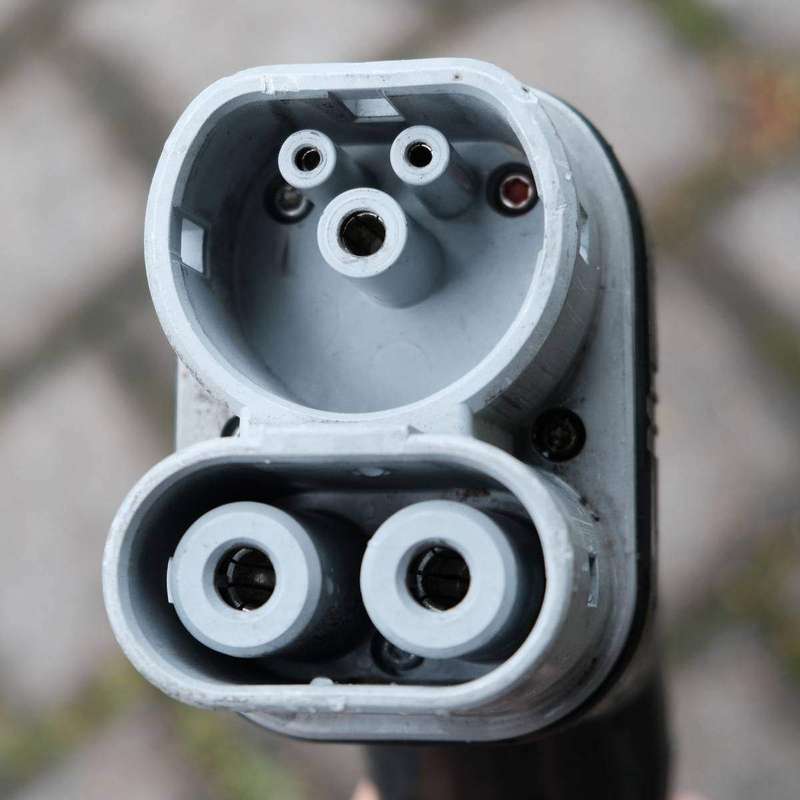
A CCS Combo 2 plug, the connector used for high-power DC fast charging in many markets. Photograph: Danilo Bargen/Wikimedia Commons
Image Credits: Wikimedia Commons
What speeds up the loss: heat, fast charging, and charge level
Real-world fleet data puts numbers on these effects. In January 2026, Geotab published an updated battery health study covering more than 22,700 electric vehicles across 21 makes and models, using years of aggregated telematics data. The headline number: an average annual degradation rate of 2.3%, up from 1.8% in the company's 2024 findings.
At that rate, the average battery is projected to retain about 81.6% of its original capacity after eight years. "EV battery health remains strong, even as vehicles are charged faster and deployed more intensively," said Charlotte Argue, Senior Manager of Sustainable Mobility at Geotab.
Charging behavior emerged as the strongest influence. Vehicles relying heavily on DC fast charging above 100 kW degraded at about 3.0% per year, roughly double the 1.5% rate of vehicles using mostly AC or lower-power charging. Geotab attributed the rise in the overall average to growing reliance on high-power public charging.
Climate mattered less than charging habits, but it still showed up. Vehicles in hotter regions degraded about 0.4 percentage points faster per year than those in mild climates. And batteries that spent more than 80% of their time parked at very high or very low charge aged faster, while occasional 100% charges followed by driving did little harm.
Chemistry adds its own wrinkles. A December 2025 study of lithium iron phosphate (LFP) batteries in MDPI's Applied Sciences journal found calendar aging strongly governed by state of charge and temperature. It warned that high-rate charging at low temperatures can trigger lithium plating, a faster and harsher form of damage.
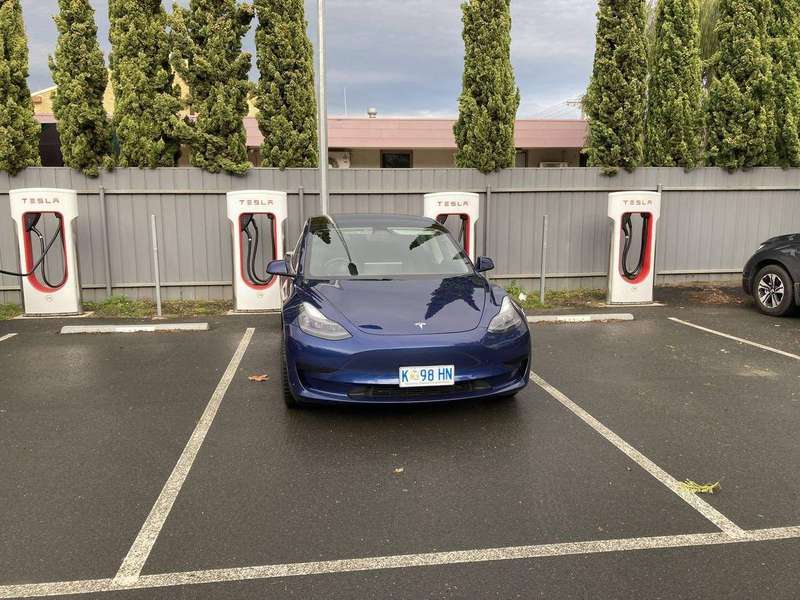
A Tesla Model 3 charging at a Supercharger in Euroa, Victoria. Photograph: Chuq/Wikimedia Commons
Image Credits: Wikimedia Commons
How to slow degradation down
No habit stops aging entirely, but the research points to a consistent playbook. Favor slower AC charging for daily use and save high-power fast charging for road trips, where the time savings actually matter.
Avoid letting the car sit for long stretches at the extremes. Geotab's data suggests the damage comes from spending most of the battery's life near full or near empty, not from the occasional top-up to 100% before a long drive. If the car will sit unused for weeks, leaving it around half charge in a cool spot is the gentlest option.
Heat deserves respect. Parking in shade or a garage during hot weather does more for the battery than most owners expect, since calendar aging accelerates with temperature whether the car moves or not. And for cold climates, preconditioning the battery while still plugged in reduces the stress of fast charging on a cold pack.
Frequently asked questions
How long do EV batteries actually last?
Longer than early skeptics predicted. Geotab's fleet data projects about 81.6% capacity after eight years at the average 2.3% annual degradation rate, and Tesla reports roughly 85 to 88% retention after 200,000 miles. Most packs should outlast the car around them.
Does fast charging ruin an EV battery?
It accelerates aging but does not ruin the pack. Geotab found heavy DC fast charging above 100 kW roughly doubles the annual degradation rate, from about 1.5% to 3.0%. Occasional fast charging on trips is fine. Depending on it daily is what costs capacity.
Is charging to 100% bad?
Occasional full charges followed by driving do little harm, per Geotab's analysis. The problem is parking at 100% (or near 0%) for long periods, which accelerates calendar aging, especially in heat.
Do EV batteries degrade if the car is not driven?
Yes, through calendar aging. Time, temperature, and state of charge drive chemical decay even at rest. Battery University's research shows the right storage conditions can hold that fade below 10% over 15 years, but a full battery baking in summer heat ages much faster.
The bottom line
Electric car batteries degrade through two parallel processes: cycle aging from charging and driving, and calendar aging from time, heat, and charge level. Fleet data says the average loss is about 2.3% per year, with fast charging and heat as the biggest accelerators.
The practical move is simple: charge slowly most days, keep the battery out of the extremes when it sits, and park cool. The battery will still fade, but it will fade on the gentle end of the curve.
Topics: electric vehicles, EV batteries, battery health, EV charging, car ownership
Rive News is the research desk behind the Rive News publication, covering technology and science through sourced, evergreen explainers.
Related stories
- Can an eSIM be hacked or cloned? The honest security answer
- APY vs interest rate: what compounding does to your money
- Why diamond is hard and graphite is soft when both are carbon
- eSIM for multi-country travel: how regional plans actually work
Get one sourced explainer like this in your inbox every morning. Subscribe to the Rive News newsletter.
© 2026 Rive News. All rights reserved.
Related stories

Why Does Tire Pressure Drop in Cold Weather?
Cold weather can cut tire pressure by 1 psi for every 10°F drop, thanks to the ideal gas law. Here is what happens inside the tire and what

Why Do Brake Rotors Warp, or Do They Actually?
Mechanics rarely see a truly warped rotor. The shudder usually comes from uneven pad deposits a few thousandths of an inch thick. Here

How to Buy a Used Car Without Getting Scammed: The Checklist
Over 450,000 cars a year have rolled-back odometers, NHTSA says. This checklist covers VIN checks, title washing, and the inspection that