
Why Does Tire Pressure Drop in Cold Weather?
Key takeaways
- Tire pressure falls about 1 psi for every 10°F drop in temperature, per AAA and NHTSA.
- The cause is the ideal gas law: colder air molecules move slower and push less on the tire walls.
- Check pressure monthly and in the morning cold, not after driving, to keep the TPMS light off.

That first cold snap of autumn does something predictable: the low tire pressure warning light pops on overnight. Drivers flood service centers convinced they have a leak.
Usually, they do not. The tire is fine; the air inside it just got colder.
Tire pressure drops in cold weather because the air inside the tire contracts as it cools. Roughly 1 psi (pound per square inch) is lost for every 10°F the temperature falls, according to both the American Automobile Association and the National Highway Traffic Safety Administration.
This article explains the drop in plain English, including what happens inside the tire, the ideal gas law behind it, how much pressure you actually lose, and what to do about it.
What is actually happening inside the tire
A tire is a sealed container of air. Tire pressure is simply the force that air molecules exert as they collide with the tire's inner walls. More collisions, or harder ones, means higher pressure.
Cold changes the molecules' behavior. As the air inside the tire cools, its molecules lose energy, move more slowly, and cluster closer together.
Slower molecules hit the tire walls less often and with less force. The result: lower pressure, with no air escaping at all.
This is a natural consequence of gas physics, not a defect. Your tire is not leaking. It is obeying the rules that all gases follow.
The ideal gas law in plain English
The rule behind all this is the ideal gas law, written as PV = nRT. In plain terms: when the volume stays constant (a tire holds its shape) and the amount of air stays the same, pressure is directly proportional to temperature.
Drop the temperature, and the pressure must drop with it. That is the whole story.
General Motors tire-lab manager David Cowger explained it this way to Phys.org: for every 10°F drop in temperature, tire air pressure decreases about 1 psi. He added that tires also slowly lose air anyway, about 0.25 to 0.5 psi per month, because air passes through rubber.
Put those two effects together and the autumn surprise makes sense. If you last checked your tires when it was 70°F and it is now 20°F, a tire set to 35 psi could be sitting at 27 or 28, Cowger noted. That is cold contraction plus months of slow seepage, all at once.
How much pressure you actually lose
Let us make it concrete. Say your tires were inflated to 35 psi at 70°F.
A cold morning at 30°F is a 40-degree drop, so you lose roughly 4 psi, landing near 31. At 20°F you lose roughly 5 psi, landing near 30.
That 4 to 8 psi swing is enough to matter.
Most tire pressure monitoring systems trigger when pressure falls about 25 percent below the recommended level. That is the US federal standard for these systems (FMVSS 138), which requires the warning at that threshold.
A tire at 35 psi triggers its warning around 26 to 27 psi. After a sharp cold snap, or after months without a check, you can easily land there.
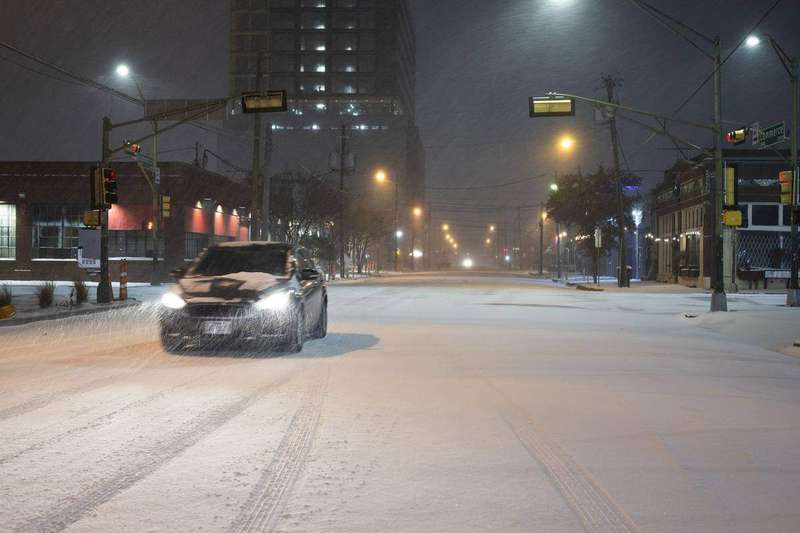
This is why the warning light appears overnight rather than while driving. Tires warm up as you drive, and pressure rises a little with that heat. Park the car in the cold overnight, and the morning reading is the honest one.
Why underinflated tires are worth taking seriously
Low pressure is not just a dashboard annoyance. Cowger told Phys.org that underinflated tires wear out prematurely, handle worse, reduce fuel economy, and can overheat, which in extreme cases leads to a blowout.
The effects compound in winter. Softer tires flex more, which builds heat and wears the shoulders of the tread.
Handling gets sloppy exactly when roads are slickest. And fuel economy drops because the engine works harder to roll a flattened tire.
None of this means you should panic when the light comes on. It means you should treat the light as maintenance information, not an emergency, and fix it the same day.
What to do about it
First, find your car's recommended pressure. It is on the placard on the driver's side door edge or center pillar, not on the tire itself (the tire sidewall shows the maximum, which is not the target).
Second, check pressure when the tires are cold, ideally in the morning before driving, or at least three hours after the car has been parked. Use a reliable gauge, since gas-station gauges take a beating and drift.
Third, inflate to the recommended number and recheck monthly through winter, plus before any long trip. NHTSA recommends monthly checks as a baseline, and cold months deserve the attention most. If the TPMS light stays on after you inflate to the correct pressure, then have the tire inspected: at that point a slow leak or a faulty sensor is genuinely possible.
One more tip: park in a garage if you have one. A vehicle kept in an unheated garage loses less pressure than one left outside, simply because the starting temperature is higher.
Frequently asked questions
Is it normal for the TPMS light to come on in cold weather?
Yes. A sharp temperature drop can pull tire pressure down several psi overnight, enough to cross the warning threshold. Inflate to the recommended pressure and the light should go off.
Does the pressure come back when it warms up?
It rises somewhat, since warmer air molecules push harder. But it rarely returns fully to where you want it, especially if the tires were already slowly losing air through the rubber. Check and top up rather than waiting.
Should I overinflate tires in winter to compensate?
No. Inflate to the vehicle manufacturer's recommended pressure when cold. Overinflation reduces the tire's contact patch and hurts grip, which is the opposite of what you want on winter roads.
Do nitrogen-filled tires avoid this?
Nitrogen-filled tires still follow the same gas law: pressure drops as temperature drops. Nitrogen seeps through rubber slightly slower than oxygen, but the cold-weather effect remains. You still need to check pressure.
The bottom line
Cold air makes tire pressure drop about 1 psi for every 10°F, and that is physics, not a leak. Check your pressure cold, inflate to the door-placard number, and repeat monthly through winter. It takes five minutes and keeps your tires, your fuel bill, and your handling where they should be.
---
Rive News is the research desk behind these guides, covering work, learning, and everyday decisions with sourced, practical explainers.
Related stories
- What to Do If You Get Lost Hiking: Step by Step
- Is eSIM Safer Than a Physical SIM Card?
- How to Study for Exams Without Burning Out
Subscribe for one practical guide in your inbox every morning.
Corrections: spot an error? Contact the desk and we will fix it with a timestamped update, never a silent edit.
Related stories

Why Do Brake Rotors Warp, or Do They Actually?
Mechanics rarely see a truly warped rotor. The shudder usually comes from uneven pad deposits a few thousandths of an inch thick. Here

How to Buy a Used Car Without Getting Scammed: The Checklist
Over 450,000 cars a year have rolled-back odometers, NHTSA says. This checklist covers VIN checks, title washing, and the inspection that
Why Does My Car Pull to One Side When Braking?
A car that pulls when you brake has a brake force imbalance, usually a sticking caliper or collapsed hose. Learn the causes, the heat test