
How Do Scientists Measure the Age of the Universe?
Key takeaways
- Scientists arrive at 13.8 billion years by measuring the universe's ingredients today and rewinding its expansion history back to the beginning.
- The cosmic microwave background, a snapshot of the universe at 380,000 years old, is the single most precise piece of evidence.
- Three independent methods agree on the age, which is why cosmologists trust it despite an open debate over the exact expansion rate.
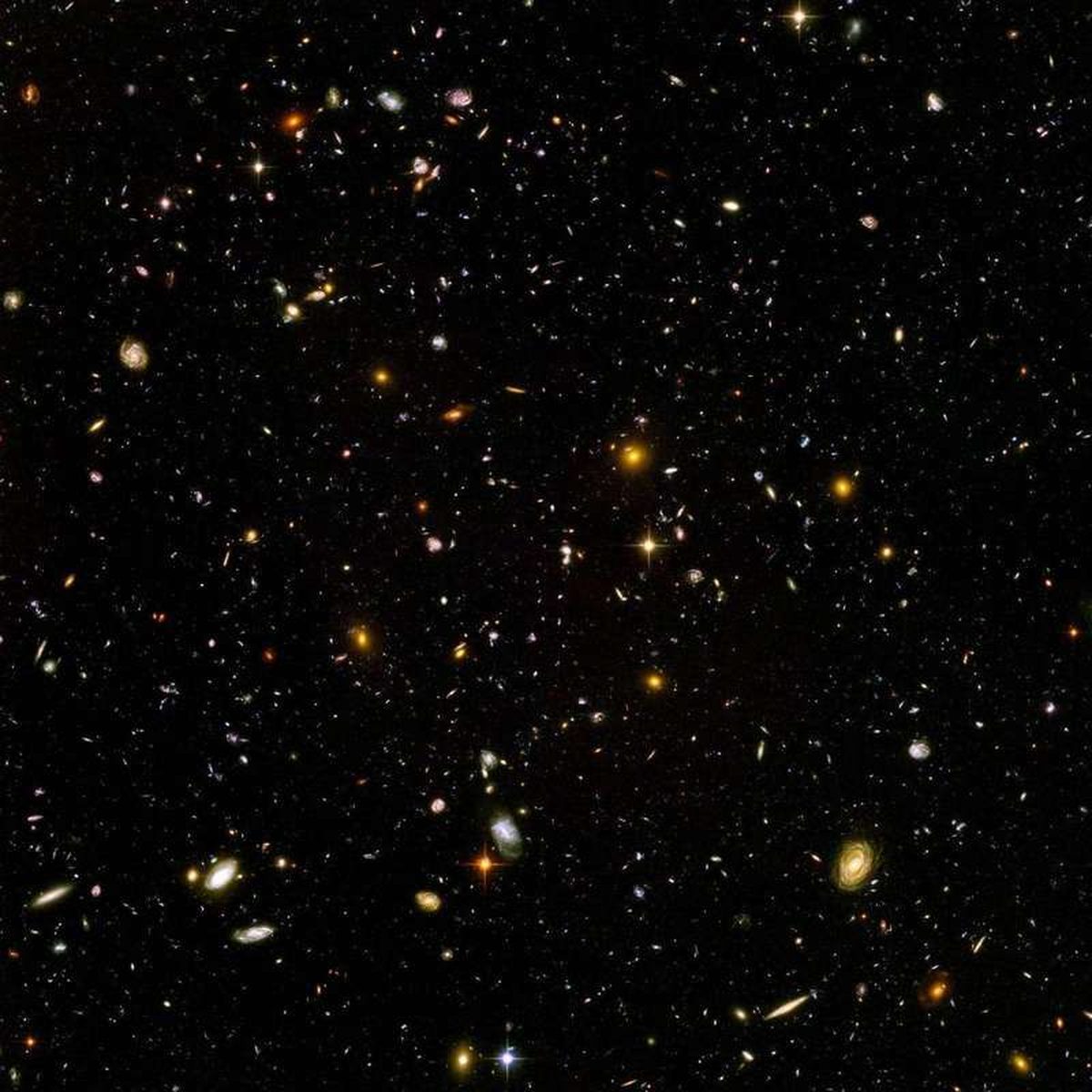
The Hubble Ultra Deep Field: thousands of galaxies in a patch of sky smaller than a grain of sand held at arm's length. Looking far away is looking back in time. Photograph: NASA and the European Space Agency/Wikimedia Commons
Image Credits: Wikimedia Commons
The universe is 13.8 billion years old. That number sounds impossibly precise for something no one was around to witness. Nobody found a cosmic birth certificate.
What scientists actually did is more like detective accounting. They measured what the universe contains, clocked how fast space is expanding, and ran the expansion backward in time. This article explains how scientists measure the age of the universe, including the three measurement methods, the role of the cosmic microwave background, and why different approaches mostly agree.
The three ways scientists pin down cosmic age
There is no single experiment that spits out the age of the universe. Instead, cosmologists rely on three independent lines of evidence, and the fact that they agree is the real story.
The first line is distant stars and galaxies. By measuring how fast faraway galaxies are moving away and how their light has been stretched (redshifted) by expansion, astronomers map the expansion history across cosmic time.
The second is the large-scale structure of the universe. Galaxies are not scattered randomly; they cluster in patterns shaped by ancient sound waves called baryon acoustic oscillations. Those frozen ripples act as a cosmic ruler, letting scientists measure distances and expansion at different eras.
The third is the cosmic microwave background, or CMB. This is the afterglow of the Big Bang itself, and it carries the most precise information of all. Physicist Ethan Siegel, writing for Big Think, notes that the best age estimate comes most precisely from Planck's CMB data, plus supernova measurements and galaxy surveys, yielding 13.81 billion years with an uncertainty of just 120 million years.
Any one method alone would leave too much wiggle room. As Siegel puts it, each constraint offers a range of possibilities, and only their overlap tells us where we live. The agreement between all three is what turned 13.8 billion from a guess into a measurement.
The cosmic microwave background: a baby photo of the universe
For its first 380,000 years, the universe was a hot, cloudy soup of particles and radiation. Light could not travel freely because it kept colliding with charged particles.
Then the universe cooled enough for electrons and protons to join into neutral atoms. Photons (light particles) were suddenly free to travel, and the light released at that moment has been traveling ever since.
Stretched by 13.8 billion years of expansion, it now arrives as faint microwaves coming from every direction. That is the cosmic microwave background.
The CMB is a snapshot of the universe at 380,000 years old. Its tiny temperature wiggles, one part in 100,000, are the seeds of every galaxy that exists today. Regions slightly denser than average became galaxy clusters; slightly emptier ones became cosmic voids (empty regions).
Three generations of satellites have mapped this glow with increasing sharpness. NASA's COBE launched in 1989 and proved the wiggles existed; two of its lead scientists earned the 2006 Nobel Prize in Physics.
NASA's WMAP, launched in 2001, sharpened the picture. Then came Planck, a European Space Agency mission launched in 2009, which imaged the sky at more than 2.5 times WMAP's resolution and produced the sharpest all-sky CMB map ever made, according to NASA's Jet Propulsion Laboratory.
From expansion rate to a 13.8-billion-year age
Here is the core logic. If you know what the universe is made of and how fast it is expanding now, you can calculate how the expansion behaved in the past, then rewind to the moment everything was packed together. That rewind gives you the age.
Planck's 2013 results, announced at a NASA news conference on March 21, 2013, recalculated the universe's recipe from its first 15 and a half months of observations. The universe turned out to be 13.82 billion years old, about 100 million years older than WMAP had suggested, because it is expanding slightly more slowly than thought.
The ingredient list matters as much as the expansion rate. According to Planck, the universe today is about 68.3 percent dark energy, 26.8 percent dark matter, and 4.9 percent normal matter, the stuff of stars, planets, and people. Big Think's accounting adds roughly 0.1 percent neutrinos and 0.01 percent radiation.
Each ingredient pushes the expansion differently. Normal and dark matter slow it down through gravity. Dark energy speeds it up.
Plug the measured recipe and the measured expansion rate, 67 kilometers per second per megaparsec, into the equations of general relativity (Einstein's theory of gravity), and the clock reads 13.8 billion years. The stated uncertainty of 120 million years means cosmologists are confident in the age to about 99.1 percent accuracy.
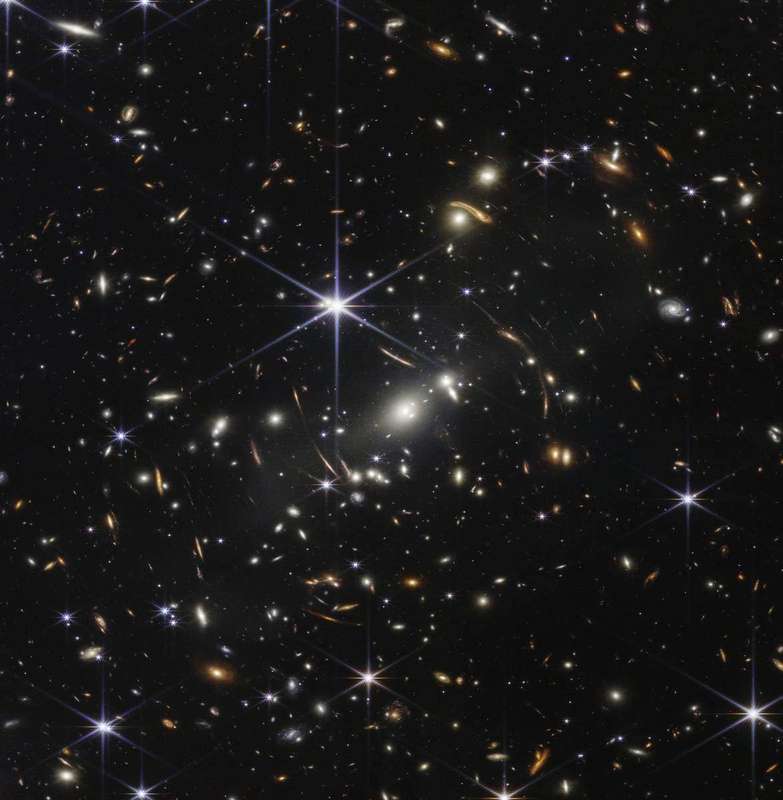
Webb's First Deep Field, released as the deepest infrared image of the universe at the time. Its ancient galaxies are independent confirmation of a universe billions of years old. Photograph: NASA, ESA, CSA, and STScI/Wikimedia Commons
Image Credits: Wikimedia Commons
Why scientists are confident, and what is still debated
Confidence comes from agreement. The CMB, galaxy clustering, and supernova distances each probe the expansion history differently, yet they land on the same age. It is hard for three independent methods to be wrong in exactly the same way.
That said, cosmology has a live argument called the Hubble tension. Measurements of the expansion rate from the early universe, via the CMB, give about 67 kilometers per second per megaparsec.
Measurements from the late universe, using the cosmic distance ladder of stars and supernovae, give about 74, roughly 9 percent higher. Siegel flags this as a genuine open question.
A faster expansion rate would imply a somewhat younger universe, but the tension does not break the 13.8-billion-year picture. It suggests there may be something new in the physics, perhaps an unknown ingredient or a wrinkle in our models, rather than a wildly different age. Resolving it is one of the biggest open problems in cosmology.
Frequently asked questions
Why 13.8 billion years and not some other number?
The number falls out of the measured expansion rate and the measured ingredients of the universe. Change what is in the universe or how fast it expands, and the rewind gives a different age. The Planck satellite measured both with enough precision to pin the answer to within 120 million years.
Could the universe actually be older than 13.8 billion years?
Independent checks say no. The oldest star clusters we can date are younger than 13.8 billion years, consistent with the cosmic age. If the universe were much older, we would expect to find stars older than the universe itself, which we do not.
What exactly is the cosmic microwave background?
It is the light released 380,000 years after the Big Bang, when the universe first became transparent. Expansion has stretched it from visible light into microwaves. It arrives from every direction in the sky and carries a detailed imprint of the infant universe.
How accurate is the 13.8-billion-year figure?
The formal uncertainty is about 120 million years, or roughly 99 percent accuracy. The bigger caveat is the Hubble tension: different ways of measuring the expansion rate disagree by about 9 percent, which may point to new physics but has not overturned the age estimate.
The bottom line
Scientists do not measure the universe's age with a clock. They measure its ingredients, its expansion rate, and its oldest light, then run the film backward. Three independent methods agree on 13.8 billion years, and the cosmic microwave background gives the sharpest reading of all.
The number is not the end of the story. The Hubble tension means the expansion rate itself is still under debate, and resolving it may reveal new physics. If you want to follow along, the Planck collaboration's published results and NASA's deep field images are the best places to start.
Tags: cosmology, universe, cosmic microwave background, Planck satellite, astronomy
Rive News is the research desk behind this explainer series, covering health, science, and everyday questions with sourced reporting.
Subscribe for one evidence-based explainer in your inbox every morning.
Related stories

Why diamond is hard and graphite is soft when both are carbon
Diamond and graphite are both pure carbon, yet diamond is 10 on the Mohs scale and graphite is 1 to 2. The difference is not the atoms;

Why Hot Water Can Freeze Faster Than Cold: The Mpemba Effect Explained
Hot water can freeze faster than cold under specific conditions. The Mpemba effect, named for a 1963 schoolboy experiment, still divides

How Magnets Work at the Atomic Level: Spins, Domains, and Iron
Magnetism comes from electrons: their spin and orbits make each atom a tiny magnet. In iron, quantum forces align these atomic magnets into