
How to Prepare for a Behavioral Interview Step by Step
Key takeaways
- A behavioral interview asks about real past situations, so the winning move is preparing stories, not memorizing lines.
- The STAR method (Situation, Task, Action, Result) keeps each answer under two minutes and easy to score.
- Interviewers at structured companies often score each answer right away, so specific numbers and clear actions matter more than polish.
A behavioral interview is the part of the hiring process where you are asked about things you have actually done. Instead of "How would you handle a difficult client?", you hear "Tell me about a time you handled a difficult client." The interviewer wants a real story with a real outcome.
The logic is simple: what you did in the past is the most reliable signal of what you will do next. Harvard researcher Iris Bohnet's interview guidance makes the case for structured interviews, in which every candidate gets the same questions in the same order and each answer is scored immediately. That scoring habit is exactly why preparation pays off: the interviewer is not grading your charm, they are grading your evidence.
This article explains behavioral interview preparation: what interviewers look for, how the STAR method works, a step-by-step preparation plan, and the mistakes to avoid.

A candidate sits across from an interviewer during a hiring conversation, the setting where behavioral questions usually land. Photograph: bpsusf / Wikimedia Commons.
Image Credits: Wikimedia Commons
What interviewers look for in a behavioral interview
Interviewers are listening for evidence of specific skills, not personality alone. Common themes include teamwork under pressure, ownership of mistakes, conflict resolution, and meeting deadlines. The Muse's behavioral interview guide organizes 33 common questions into themes like teamwork, time management, and communication. That gives you a map of what interviewers keep probing for.
Most large employers run behavioral rounds as structured interviews. That means the interviewer asks every candidate the same set of questions in the same order, which allows clearer comparisons between candidates. This structure is documented in Bohnet's Harvard scholar-page guidance on removing bias from interviews.
The same guidance recommends that interviewers score each answer immediately after it is given. Waiting until the end of the interview lets vivid or recent answers crowd out earlier, quieter, high-quality ones.
For you, this means the first 90 seconds of each answer carry disproportionate weight. Lead with substance, not warm-up.
Research also supports why the format works. A meta-analysis by Schmidt and Hunter (1998), summarized by GuerrillaDEI, found that structured interviews predict job performance with a validity coefficient of 0.51, compared with 0.38 for unstructured conversations.
Companies invest in this format because it hires better people. Your preparation should match that seriousness.
How the STAR method works
The STAR method is the standard structure for behavioral answers, and Indeed's behavioral interview guide breaks it into four parts. It turns a sprawling memory into a story an interviewer can follow and score in real time.
S: Situation. Set the context in one or two sentences. When and where did this happen, and what was at stake? According to Indeed's guide, this is where you give the listener enough background to understand the story, such as joining a project mid-stream or facing a deadline during a company merger.
T: Task. State your specific role and goal. What were you personally responsible for? This separates your contribution from the team's. Indeed's guide frames it as explaining what you needed to achieve on behalf of your employer.
A: Action. Describe exactly what you did. This is the longest part of the answer. Use "I" instead of "we," name the steps you took, and keep the focus on your own decisions. Keep each full story to about one to two minutes so it stays sharp.
R: Result. Share the outcome, with numbers where possible. Did revenue rise, did the deadline hold, did the customer stay? Quantify it: "cut response time by 30 percent" lands harder than "improved things." Then add one line on what you learned.
There are variants. The Muse's interview guide cites the CARE method: Context, Action, Result, Evolution, where Evolution is the explicit lesson learned.
It is the same idea with a slightly different label. STAR remains the one most interviewers expect by name, so learn it first.
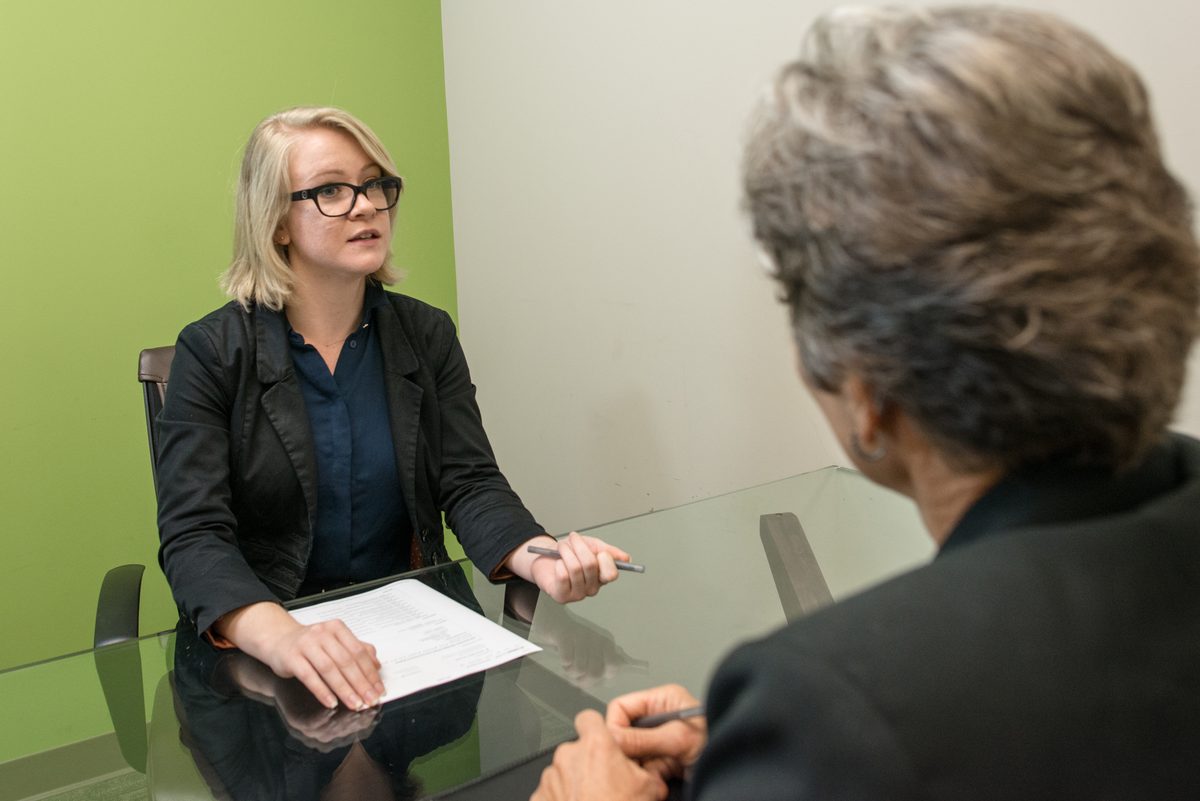
A candidate answers behavioral questions in an interview setting. Photograph: amtec_photos / Wikimedia Commons.
Image Credits: Wikimedia Commons
A step-by-step plan to prepare for a behavioral interview
Preparation works best as a sequence. Follow these steps over the week before your interview, spending 30 to 45 minutes a day.
- Study the role and the company. Read the job posting line by line and list the skills it repeats, then research the company's stated values. Amazon, for example, publishes 16 leadership principles on amazon.jobs, including Customer Obsession, Ownership, and the two newest: Strive to be Earth's Best Employer and Success and Scale Bring Broad Responsibility.
- Collect 6 to 8 story candidates. Brainstorm real moments from work, school, volunteering, or freelance projects: a conflict you resolved, a deadline you saved, a mistake you fixed, a time you led without a title. Our guide to explaining career changes in interviews shows how non-traditional experience, from classrooms to volunteering, counts as evidence too.
- Map each story to a theme. Match your stories to the question themes The Muse lists, such as teamwork, time management, communication, and motivation. One strong story can flex across several questions, like a project rescue covering teamwork, leadership, and deadlines.
- Write each story in STAR, then add numbers. Draft bullet points for Situation, Task, Action, and Result, then harden the Result with specifics like dates, team sizes, percentages, or dollar amounts. If numbers are confidential, describe the scale instead, such as "a client account worth roughly a quarter of team revenue."
- Practice out loud, with a timer. Read your stories aloud, not in your head, and time each one: the designgurus FAANG guide recommends about one to two minutes per story. Ask a friend to interrupt with follow-ups, since real interviewers probe with "What did you do next?"
- Prepare your questions and your logistics. Behavioral rounds almost always end with "What questions do you have for me?", so bring two or three about the team and the work. Confirm the time, the link or address, and a quiet room the night before. Since ghosting after interviews is a documented candidate complaint, ask the recruiter for the decision timeline before you leave.
Behavioral interview mistakes to avoid
The most common failure is rambling. Candidates who skip the Task and jump from Situation to a ten-minute Action lose the interviewer's scoring thread. The STAR structure exists to prevent exactly this, so trust it.
Another mistake is answering with hypotheticals. "I would talk to the team" is not an answer to "Tell me about a time." If you genuinely have no matching story, say so briefly and offer the closest real example. An honest near-miss beats an invented scenario.
Avoid taking credit for other people's work. Interviewers probe ownership with follow-ups like "What exactly did you do?", and team-only answers collapse under them. Keep "I" for your actions and "we" for the team's context.
Do not badmouth former employers, even when describing conflicts. Frame disagreements around goals and data, not personalities. Recruiters scan for red flags the same way in interviews as they do on resumes, and negativity is one of them.
Finally, do not skip preparing questions for the interviewer. Having none signals low interest. Two thoughtful questions take five minutes to prepare and cost you nothing.

Interviewees waiting ahead of a hiring interview. Photograph: N509FZ / Wikimedia Commons.
Image Credits: Wikimedia Commons
Frequently asked questions
What is the STAR method in a behavioral interview?
The STAR method is a four-part structure for answering behavioral questions: Situation, Task, Action, Result. You set the context, state your role, describe what you personally did, and share the outcome with numbers where possible. Indeed's interview guide presents it as the primary way to give a complete, easy-to-follow response.
How long should a behavioral interview answer be?
Aim for about one to two minutes per story. That is long enough to cover all four STAR parts and short enough to hold the interviewer's attention. Time yourself while practicing, since stories that feel short in your head often run long out loud.
How many stories should I prepare for a behavioral interview?
Prepare 6 to 8 strong stories, each usable for more than one question. Map them to common themes like teamwork, conflict, leadership, failure, and deadlines so every likely question has a matching story. Quality beats quantity: one detailed story with real numbers outperforms three vague ones.
How do I prepare for a behavioral interview with no work experience?
Use classroom projects, volunteering, part-time jobs, internships, and personal projects as story material. Interviewers assess the skills in the story, not the employer's name on it. A semester project where you resolved a team dispute shows the same teamwork skill as a corporate example.
What should I not say in a behavioral interview?
Do not answer with hypotheticals, do not claim team results as solo achievements, and do not criticize former employers. Avoid absolute statements like "I never make mistakes," which invite disbelief. Stick to real stories, own your part honestly, and frame conflicts around goals and data.
The bottom line
Behavioral interviews reward preparation, not improvisation. Build a bank of 6 to 8 real stories, shape each one with the STAR method, and practice them out loud until they land in under two minutes.
Your next step: pick one story today, write it in STAR bullets, and time yourself telling it. If it clears two minutes with numbers intact, your system works.
Tags: behavioral interview, job interview, STAR method, interview preparation, job search
Rive News is a research desk covering practical career and jobs explainers. We verify facts against primary sources and do not invent statistics or quotes.
Latest in Career
- How to answer "Why should we hire you" in an interview
- What to do when companies ghost candidates after interviews
- How to ask for a raise with data and market rates
- What recruiters look for in the first 6 seconds of your resume
Subscribe for weekly career explainers grounded in real research.
Corrections: if you spot an error, contact us and we will correct it promptly with a note.
Copyright 2026 Rive News. All rights reserved.
Related stories

How to Ask for a Raise With Data, Not Emotions
Ask for a raise with market data and documented results, not emotions. Research your rate from BLS wage tables, build an evidence file, run

How to Explain a Career Gap on Your Resume Honestly
A career gap is not a red flag if you explain it honestly: give a reason, show what you did, and point forward. Recruiters reveal the exact

How to Switch Careers at 30 With No Experience in the Field
A career change at 30 means repackaging a decade of transferable skills, not starting over. Map your skills, earn one certification,