
Why background noise helps some people focus better
By Rive News / Research desk | Rive News / Published October 29, 2026 at 9:00 AM PKT
Key takeaways
- Background noise helps some people focus mainly by masking sudden sounds and by raising low arousal toward an optimal level.
- Moderate noise, around 70 decibels, improved creative performance in a 2012 study, while 85 decibels hurt it.
- People without attention difficulties often perform slightly worse with added noise, so the effect is personal, not universal.

People work on laptops in a busy coffee shop, where moderate background noise can help creative thinking. Photograph: Wikimedia Commons
Image Credits: Wikimedia Commons
What background noise does to attention
Background noise is steady, low-information sound that fills a room while you work. It can be a fan, rain, café chatter, or electronically generated white noise.
It does not add information to your task. It changes the conditions around the task, and that change matters for two separate reasons.
This article explains how background noise masks distractions, how it can lift arousal toward a useful level, why the effect differs from person to person, and how to test it on your own work.
How masking quiets sudden distractions
Your brain is built to notice change. A door slamming in a silent room grabs attention because it stands out sharply against quiet.
Steady background sound raises the floor that other sounds must clear. A conversation two desks away becomes harder to follow, so it stops pulling your attention away.
Speech is the worst offender here. Intelligible words compete directly with reading and writing, because language processing uses some of the same mental resources.
White noise, which spreads energy evenly across audible frequencies, is a strong masker. Pink noise, which is softer at high frequencies and sounds more like rain, masks less sharply but feels easier to listen to for long sessions.
The arousal idea: noise as stimulation
Masking is only half the story. The other half is arousal, the general level of alertness in your nervous system.
Some people start a study session under-aroused: drowsy, restless, or drifting. For them, added stimulation can push alertness toward the level where focus works best.
This idea comes from the stochastic resonance model proposed by Göran Söderlund, Sverker Sikström, and Andrew Smart in 2007. In their model, a little extra neural stimulation helps weak signals get detected, which improves attention in people whose baseline arousal sits below the optimum.
The same added stimulation hurts people who are already at their optimum. Push past the sweet spot and the noise becomes one more thing competing for attention.
That split explains the most consistent finding in this field. Noise helps some people and hinders others, and the dividing line is often how easily they focus in silence.
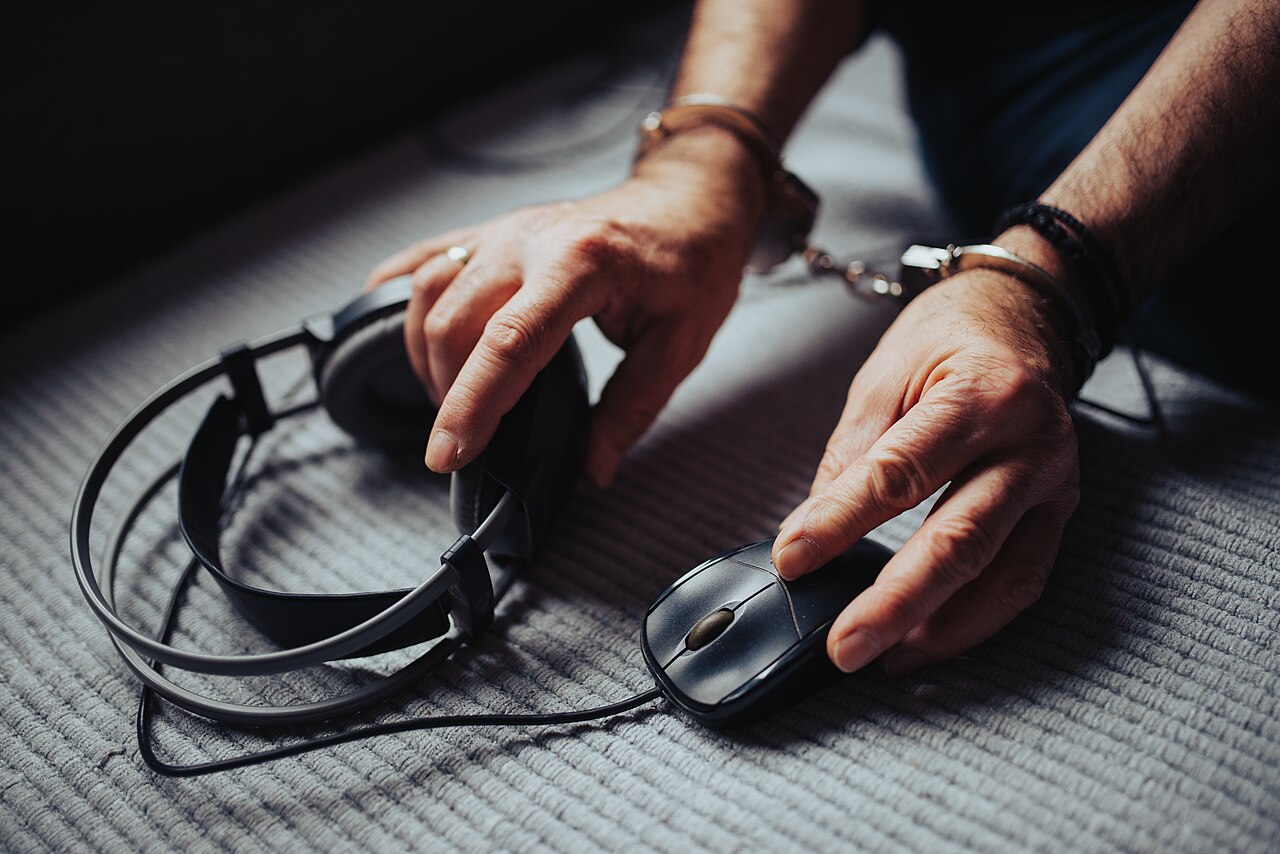
Headphones lying near a mouse can signal a boundary, and they help most when they block intelligible speech. Photograph: Wikimedia Commons
Image Credits: Wikimedia Commons
What the research actually found
A 2012 study by Ravi Mehta, Rui Zhu, and Amar Cheema, published in the Journal of Consumer Research, tested three noise levels across five experiments. Moderate noise at 70 decibels improved creative task performance compared with quiet 50 decibels.
High noise at 85 decibels did the opposite. It reduced information processing and hurt creativity, according to the study's abstract.
Mehta described the pattern as an inverted U. He said, in a summary of the work, "It turns out that around 70 decibels is the sweet spot."
A separate line of research looked at white and pink noise and attention difficulties. A meta-analysis led by Joel Nigg, professor of psychiatry at Oregon Health and Science University, pooled 13 studies on the topic.
The analysis found small but consistent improvements in task performance for people with ADHD or elevated attention problems when white or pink noise played in the background. For people without attention difficulties, the same noise made performance slightly worse, as reported by Flinders University's Better U blog in 2025.
Earlier work points the same way. Söderlund and colleagues found in 2010 that children with attention difficulties improved episodic memory under 78 decibel white noise, while typically developing children showed slight decreases.
Why silence works better for some people
If you focus easily in a quiet room, background noise adds little and costs something. Your brain must still filter it, even when it is steady.
Complex tasks suffer first. Reading dense material, solving multi-step problems, and writing all draw heavily on working memory, leaving little spare capacity.
Lyrics are a special case. Songs with words you can follow act like overheard speech, and they tend to hurt reading and writing more than instrumental sound does.
Task type matters too. Creative brainstorming, where loose associations help, benefits more from moderate noise than careful proofreading does.

A library reading room offers the quiet that memory and reading work need most. Photograph: Wikimedia Commons
Image Credits: Wikimedia Commons
Choosing a sound that fits the task
Start with the job, not the playlist. For reading and writing in a noisy room, white or pink noise at a low, steady volume is the practical choice.
For creative work, café-style chatter around 70 decibels matches the level that helped in Mehta's experiments. A busy coffee shop produces roughly that level naturally.
For long sessions, brown noise or rain sounds feel less tiring than bright white noise. The lower-frequency emphasis is gentler on the ears over hours.
Keep the volume modest. The goal is to lift the sound floor just above the distractions, not to drown the room out. If you must raise your voice to be heard over it, it is too loud.
Test one sound for a full week on the same kind of task. Compare it with silence on the same task the following week, and judge by completed work rather than by how focused you felt.
Common mistakes with study noise
One common mistake is switching sounds every few minutes. Each change is itself a distraction, and it breaks the steady floor that masking depends on.
Another is using noise to cover a room that is too loud already. If nearby speech is still intelligible, add distance or ear protection first, and use noise only for what remains.
A third is leaving noise running during breaks. Breaks work better in quiet, because the brain needs the contrast to reset before the next work block.
Finally, avoid treating noise as a cure for poor sleep or chronic distraction. If focus problems persist for weeks, they deserve a closer look than a playlist.
Frequently asked questions
Does white noise help everyone study?
No. Research consistently shows it helps people with attention difficulties most, while people who already focus well in silence often do slightly worse with it.
Is brown noise better than white noise for studying?
Brown noise is softer and less fatiguing over long sessions, but white noise masks sharp sounds more strongly. The better choice depends on whether masking or comfort matters more for your task.
What volume should background noise be?
Moderate, around the level of a busy café, roughly 70 decibels, is the level linked to benefits in research. Keep it low enough that normal conversation nearby is still possible.
Can background noise replace a quiet room?
It can reduce the damage from a noisy room, but it cannot fully recreate silence. If a quiet space is available for demanding work, it remains the safer choice.
Why do lyrics distract more than instrumental music?
Lyrics are language, and language competes with reading and writing for the same mental resources. Instrumental sound carries no words, so it interferes less.
The bottom line
Background noise helps some people focus because it does two jobs at once: it masks sudden distractions, and it lifts low arousal toward the level where attention works best.
The evidence points to a moderate level, near 70 decibels, and to a clear personal split. People who struggle to focus in silence tend to gain, while strong concentrators tend to lose a little.
Treat it as an experiment, not a rule. Try one steady sound at a modest volume on one kind of task, compare it honestly with silence, and keep whichever produces more finished work.
Tags: background noise, focus, studying, concentration, white noise
Rive News's research desk covers how people learn, study, and work, drawing on published research and documented findings.
Related
- How background noise affects concentration and focus
- Why study playlists help some people and distract others
- How to stay focused while studying at home
- Why study breaks improve focus and memory retention
Subscribe to Rive News for one research-backed study explainer each week.
Rive News publishes general educational information based on cited public sources; facts are checked against those sources before publication.
Related stories

Why Do I Blank Out During Tests Despite Studying: Test Anxiety and Retrieval Failure
Blanking out in exams is retrieval failure, not missing knowledge. Anxiety drains working memory; rereading builds false confidence. Here

How to Study for Exams Without Burning Out
Sleep 7-8 hours, study in 25-50 minute blocks, and exercise daily. The science-backed way to study for exams without burning out, and what

Why Do I Forget What I Just Read? Science Has an Answer
You forget what you just read because of the forgetting curve, mapped by Ebbinghaus in 1885. Science explains why memory fades fast and how