
How to take notes that you will actually remember
Key takeaways
- Notes fail when they are written to be reread; memory comes from retrieval, the act of pulling answers out of your head.
- The Cornell method builds retrieval into the page: a cue column for self-testing and a summary written from memory.
- Handwriting beats word-for-word typing for conceptual understanding, and short spaced reviews beat marathon rereading sessions.
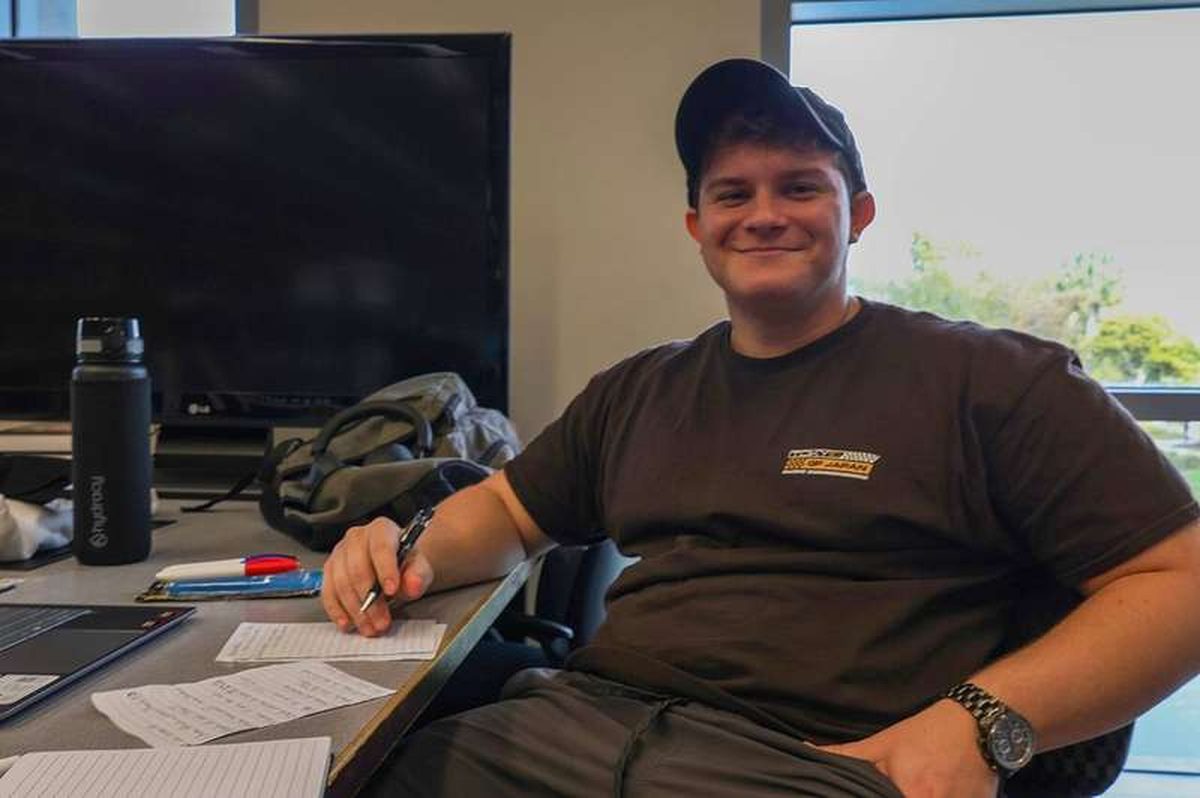
A student writing notes by hand at a desk. The slower pace of handwriting forces you to process ideas instead of copying them. Photograph: Heidy Garcia/Wikimedia Commons
Image Credits: Wikimedia Commons
Most notes are beautiful, organized, color-coded, and completely useless when the exam arrives. That is not a memory problem. It is a system problem.
The typical note-taking habit, write everything down during class and reread it the night before the test, is built around the weakest study strategy science knows.
Notes stick when writing them forces your brain to think, and when reviewing them forces you to recall. Everything below follows that one principle. The methods have research behind them, and the research points in the same direction.
This article explains how to take notes you will actually remember, including why rereading fails, how the Cornell method works, what handwriting does to memory, and how to turn every page of notes into a self-test.
Why most notes fail: the rereading trap
Rereading feels productive because it feels easy. You look at a page, the words make sense, and your brain mistakes recognition for knowledge. Then the test asks you to produce the answer from nothing, and the gap shows up.
The science is blunt about highlighting and rereading. TimesLife's roundup of note-taking research notes that highlighting, while it feels productive, ranks among the weakest studying strategies. The problem is the same as rereading: marking text is not thinking about it.
Notes have two jobs, and most students use only one. The first job is encoding, the mental processing that happens while you write. The second is storage, the notes as a record you can review later.
Research on note-taking going back decades separates these two jobs. The steady finding is that reviewers outperform non-reviewers, because review exercises both jobs.
The catch is that rereading is the laziest possible form of review. It exercises almost nothing.
This is why our guide to why you forget what you just read focuses on the same culprit: passive re-exposure.
The fix for notes is the same as the fix for reading. Make the review active.
The Cornell method: recall built into the page
The Cornell method was created by Cornell professor Walter Pauk, and its layout exists for one reason: to turn review into recall. Divide each page into three zones.
A wide right column holds your notes during class. A narrow left column holds cue questions, written after the session. A strip at the bottom holds a short summary, written from memory.
The actual method is a sequence, not a layout. MyStudyLife breaks it into five Rs, and the layout just supports them. Record happens in class: phrases, not sentences, with a line skipped between ideas so there is room to add later.
Everything after that is where the learning is.
Reduce comes within a day. Go back and write questions in the left column, real questions, not labels.
"Why did the 1973 oil shock raise prices so fast?" is a cue. "Oil shock" is not.
The cue has to demand an answer.
Recite is the step everyone skips, and it is the one with the research behind it. Cover the notes column with your hand or a sheet of paper. Look only at the cues, and answer each one out loud, in your own words.
Then uncover and check. Pulling an answer out of your head is retrieval practice (testing yourself by recalling answers), and study after study finds it does far more for long-term memory than rereading the same notes twice.
Reflect means asking what the material connects to. How does this relate to last week? Where does it disagree with something else?
Write those thoughts down. Review is ten minutes a week on every page you have made: cover, recite, check.
TimesLife cites a 2013 study in the Journal of Experimental Psychology finding that students who made their own retrieval cues during note-taking scored much higher on delayed recall than those who simply re-read marked text. The cue column is the engine. Without it, Cornell is just a divided page.
Write by hand when you can
The laptop is a faster recorder and a worse learner. In three studies published in Psychological Science in 2014, Pam Mueller of Princeton and Daniel Oppenheimer of UCLA had college students take notes on 15-minute talks either by hand or on laptops.
As Education Week's Sarah D. Sparks reported, the results were the same whether students were tested right away or a week later. Those who summed up and reframed concepts in their own words remembered more than those who copied the lecture word for word.
The typing itself is the cause. Laptop users in the studies copied lectures nearly word for word, while the slower pace of handwriting forced summarizing. The paper's abstract states it directly: laptop note-takers' habit of copying lectures word for word rather than processing information and reframing it in their own words hurts learning.
The researchers even tested the obvious fix. They told some laptop users clearly not to copy word for word. It failed completely; the habit was too strong.
Typing invites mindless copying, while pen and paper prompt reframing, with or without the asterisks and arrows.
That does not mean laptops are banned forever. If you must type, type like a hand-writer: deliberately put things in your own words, leave gaps, and never copy sentences whole.
But when understanding matters most, the research says reach for the pen. This pairs well with active recall, the study technique built on the same recall principle.
Turn your notes into a self-test
The Cornell recite step is one version of a general rule: every review session should be a quiz, not a read-through. You can add this onto any notes you already have, in any format.
The fastest version is the blank-page test. Read a section of your notes, close them, and write down everything you can remember on a blank page.
Then reopen and fill the gaps in a different color. The gaps are your study list; the things you got right are already handled.
The second version is the question conversion. Take any set of straight notes and turn the key points into questions in the margin, Cornell-style. You only need to do this once per page, and from then on the page is a deck of flashcards.
Our explainer on how spaced repetition intervals work shows how to schedule these self-tests for maximum effect.
The third version is the teach-back. Explain the concept out loud as if teaching someone who missed the class.
Wherever you stumble is where your understanding is thin, and that thin spot is exactly what to review. This works because explaining forces you to organize the material, which is thinking work that rereading never does.
One warning from the research: do not let note quantity fool you. The Mueller and Oppenheimer studies found that taking more notes can help, but only when the notes involve thinking. Pages of word-for-word copy are a storage win and a learning failure.
Review in short spaced sessions, not marathons
The final piece is timing. Cramming the night before works for tomorrow's test and disappears by next month, because memory locks in with spaced recall. Ten minutes of Cornell-style cover-and-recite each week, across eight weeks, is roughly a full study session you never had to schedule.
Make the habit tiny and regular. After each class, spend five minutes writing cue questions while the lecture is fresh.
That same evening, do one recite pass. Weekly, cycle through the stack.
Each pass gets faster because there is less you have forgotten, which is the whole point.
Burnout kills this system faster than laziness does. If exam season is near, read our guide to avoiding burnout while studying for exams before you add hours. Consistent small sessions beat heroic ones every time.
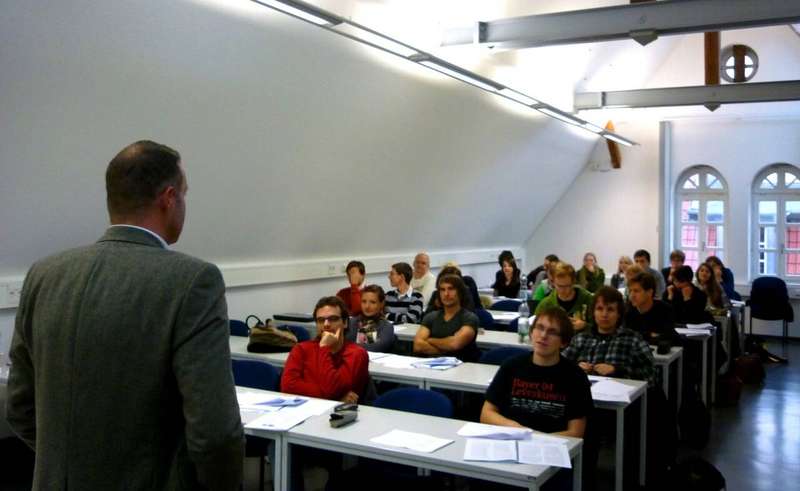
Students in a university lecture hall. The notes that matter most are the ones taken during the lecture, then turned into questions within a day. Photograph: George Serdechny/Wikimedia Commons
Image Credits: Wikimedia Commons
Frequently asked questions
Is the Cornell method actually better than regular notes?
The layout alone is not magic; the recall steps are. Mometrix notes that Cornell University specifically recommends using the cue column to quiz yourself rather than rereading, and research on retrieval practice (testing yourself by recalling answers) consistently supports self-testing over restudy. Use the full five-step sequence, or you are just drawing lines on paper.
Should I take notes on a laptop or by hand?
By hand, when understanding is the goal. The 2014 Mueller and Oppenheimer studies found hand-writers did better on conceptual questions than laptop users in all three experiments. If you type, force yourself to put things in your own words instead of copying, though the researchers found most students cannot keep that up.
How soon after class should I review my notes?
Within a day for the cue-writing step, according to the Cornell method's sequence. Memory of the lecture is freshest then, and writing questions while you still remember the context produces better cues. Even a five-minute pass the same evening makes the weekly review much easier.
Do I need special templates or apps for Cornell notes?
No. Any paper works: draw a vertical line about a third of the way from the left edge and a horizontal line near the bottom. The method is the five-step sequence, and as MyStudyLife puts it, Pauk described a sequence and the layout exists to support it.
The bottom line
Notes you remember are notes that made you work. Write cues, not just content.
Answer from memory, not from the page. Review in small weekly sessions, not in one panicked night.
Start with the next lecture: hand-write phrases in the right column, write real questions in the left within a day, and recite with the column covered. That single habit outperforms every highlighter you own.
Rive News is the research desk behind the Rive News production run, writing practical explainers across gardening, careers, education, and more.
Latest in education
- How to avoid burnout while studying for exams
- Why you forget what you just read
- How spaced repetition intervals work
- What active recall is and how to use it
Get one practical explainer in your inbox every morning. Subscribe to the Rive News newsletter.
Corrections: spotted an error in this article? Email the research desk and we will verify and fix it promptly.
Related stories

Why Do I Blank Out During Tests Despite Studying: Test Anxiety and Retrieval Failure
Blanking out in exams is retrieval failure, not missing knowledge. Anxiety drains working memory; rereading builds false confidence. Here

How to Study for Exams Without Burning Out
Sleep 7-8 hours, study in 25-50 minute blocks, and exercise daily. The science-backed way to study for exams without burning out, and what

Why Do I Forget What I Just Read? Science Has an Answer
You forget what you just read because of the forgetting curve, mapped by Ebbinghaus in 1885. Science explains why memory fades fast and how