
Why Does Downhill Running Destroy Your Quads? The Science
Key takeaways
- Downhill running forces the quadriceps to lengthen under load with every step, an eccentric contraction that causes more micro-damage than uphill running.
- One study found quad strength dropped immediately after downhill running and stayed low for 24 hours, with soreness peaking between 24 and 72 hours.
- The damage is trainable: repeated downhill sessions trigger a protective adaptation that can last up to 9 months.
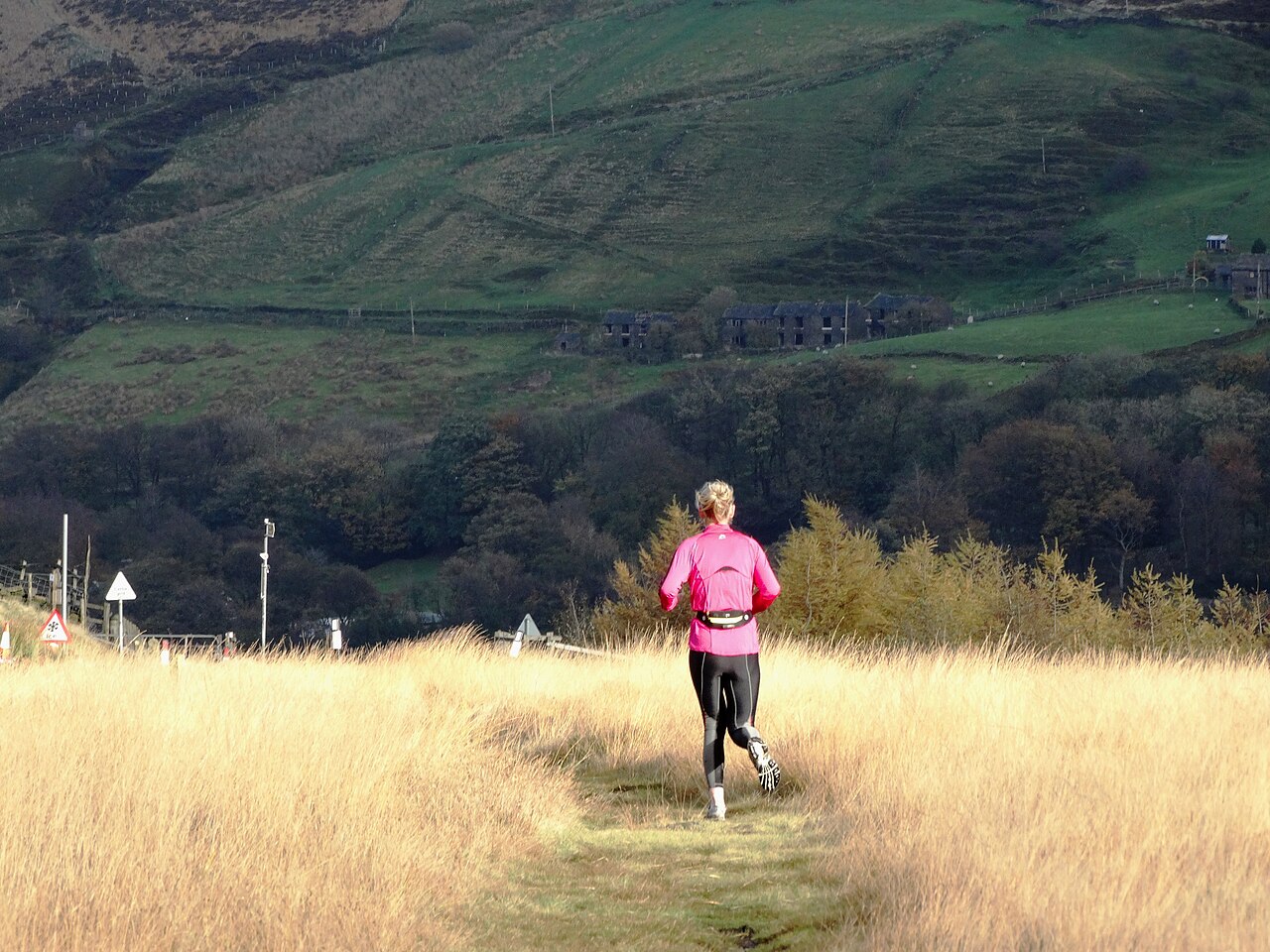
A fell runner on a downhill trail. Every footstrike forces the quads to brake the body's momentum. Photograph: Neil Theasby
Image Credits: Wikimedia Commons / Neil Theasby, Jay Pea, Robin McConnell
Eccentric contraction is the technical name for a muscle lengthening while it stays under tension. It is what your quadriceps do hundreds of times on a long descent, and it is the most damaging type of muscle action in running.
Runners often feel fine at the bottom of the hill and wrecked two days later. That delay is normal, measurable, and well studied. The soreness has a name, delayed onset muscle soreness, and a clear mechanical cause.
This article explains why downhill running destroys your quads, including what the quads do on a descent, what the damage looks like inside the muscle, why soreness peaks two days later, how the repeated bout effect protects you, and how to descend with less damage.
What your quads actually do on a descent
On flat ground, your quads mostly extend the knee to push you forward. On a downhill, gravity accelerates you with every step, and something has to slow you down. That something is your quadriceps, acting as brakes.
Each footstrike lands with the knee bent and the body's mass moving downward and forward. The quad must produce high force while lengthening to absorb that impact and keep you from collapsing. Roger Eston's classic 1995 review describes this as controlled lengthening under tension, and notes that the highest tensions in the leg extensors occur while the muscles are lengthening just after foot contact.
The numbers explain why downhills hurt more than climbs. During downhill running, the eccentric work of the anti-gravity muscles, the knee extensors, the shin muscles, and the hip extensors, is sharply accentuated compared with level running at the same speed. Your quads can produce more force eccentrically than concentrically, which means they absorb more load per step than they ever generate going uphill.
Stride mechanics make it worse for heel strikers and overstriders. A foot landing far ahead of the body creates a longer braking lever, forcing the quad to absorb more energy per step. Shorter, quicker steps under the hips cut that braking force noticeably.
What the damage looks like inside the muscle
Eccentric loading does not just tire the quads. It causes exercise-induced muscle damage: microscopic tears in muscle fibers, disruption of the contractile proteins, swelling, and leakage of enzymes such as creatine kinase into the blood.
A Brazilian study published in SciELO measured this precisely. Seventeen physically active men ran downhill in 6 sets of 5 minutes at a minus 3 degree gradient and 70 percent of maximal aerobic speed. Their knee-extensor peak torque dropped immediately after the session and stayed depressed for 24 hours, with the change statistically significant at p less than 0.011.
A 2024 study in the European Journal of Applied Physiology used a tougher protocol, 30 minutes at a minus 20 percent gradient, and found moderate drops in maximal voluntary contraction that needed 4 full days to recover. Creatine kinase concentration, quadriceps swelling, and soreness all rose significantly and resolved over the same 4-day window.
The late phase of force production suffers most. The researchers found that the ability to produce force quickly in the 100 to 200 millisecond window after contraction starts was impaired for 3 days, while the earliest phase was unaffected. For trail runners, that means the muscle's responsiveness, not just its raw strength, takes days to return.
None of this is the same as an injury. It is the predictable cost of eccentric work, and it resolves on its own with rest. The distinction matters: soreness and injury feel different and need different responses.
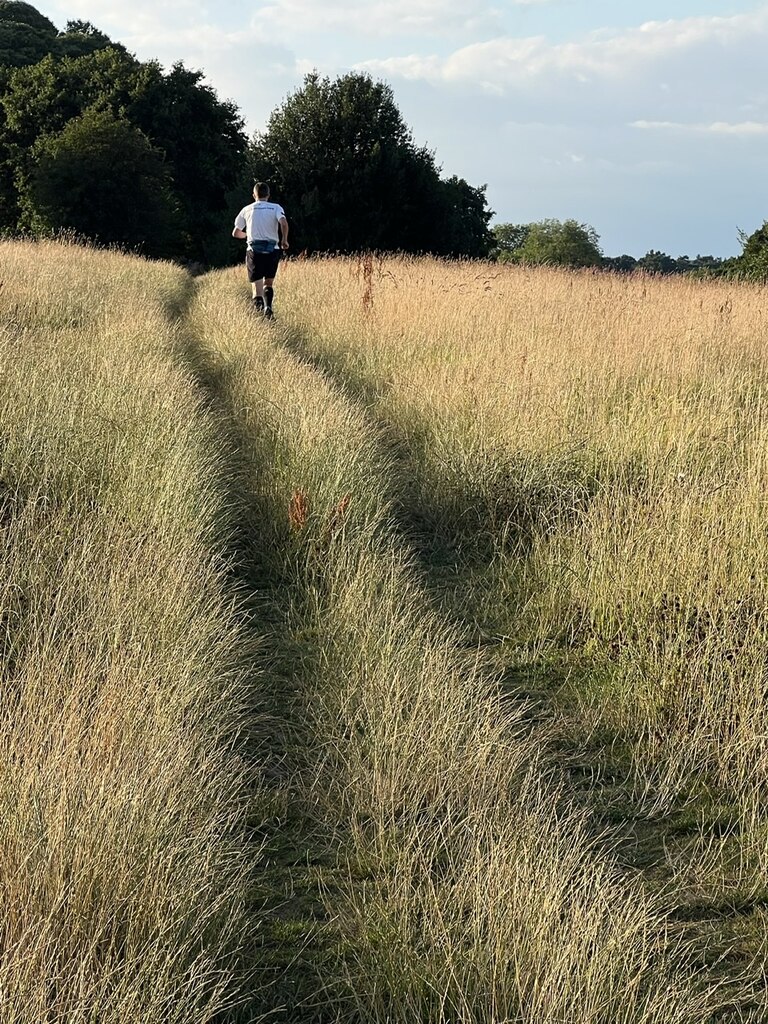
Trail running loads the quads eccentrically far more than road running on the flat. Photograph: Jay Pea
Why the soreness peaks two days later
Delayed onset muscle soreness, or DOMS, is the familiar stiffness that arrives a day or two after unfamiliar exercise. In the SciELO downhill study, quad soreness scores rose significantly between 24 and 72 hours after the run, peaking well after the runners had gone home.
The delay has a chemical explanation. The initial micro-damage triggers an inflammatory response: immune cells enter the damaged fibers, fluid accumulates, and sensitizing chemicals bathe the nerve endings. That inflammatory cascade takes roughly a day to build, which is why you feel fine at dinner and broken at breakfast two days later.
Swelling contributes directly. Fluid buildup inside the muscle compartment raises pressure on pain receptors, and the stiffness you feel going down stairs is partly mechanical. It is no coincidence that going downstairs hurts knees more than going up: both involve loaded knee flexion under eccentric control.
Creatine kinase in the blood confirms the timeline. Levels rise over 24 to 48 hours as damaged fibers leak their contents, then clear over several days. In the 2024 study, CK, swelling, and soreness all normalized by day 4, a useful benchmark for planning your next hard session.
Light movement helps more than total rest. Walking, easy spinning, or gentle uphill hiking increases blood flow without adding eccentric load, which is why a recovery jog often feels better than the couch.
The repeated bout effect: your quads adapt
Here is the good news. One bout of downhill running protects against the next one. Exercise scientists call this the repeated bout effect, and it is one of the most reliable adaptations in physiology.
After a single eccentric session, the next identical session causes less strength loss, less swelling, less soreness, and smaller spikes in blood markers of damage. The protection appears within days and, remarkably, can persist for months. A review in PMC notes the effect lasting up to 6 months for soreness and inflammation markers and up to 9 months for maximal isometric force and creatine kinase.
The mechanisms are still debated. Stronger connective tissue, better recruitment patterns that spread load across more fibers, and a blunted inflammatory response all play a role. What matters for runners is the practical result: downhill fitness is a real, trainable quality.
A 2024 study from Liverpool John Moores University tested the dose. Twelve untrained adults completed repeated downhill running sessions, and after 10 sessions their perceived quadriceps soreness following a standard downhill bout was significantly reduced. Five sessions were not enough to move the needle on every marker, which suggests adaptation needs consistent exposure over weeks, not a single heroic descent.
This is why experienced trail runners bounce down mountains that destroy beginners. Their quads are not stronger in the gym sense. They are specifically armored against eccentric damage.
How to descend with less damage
Train the descent, not just the climb. Add one short downhill session per week, starting with 10 to 15 minutes of easy descending, and build duration before intensity. Your quads need the specific stimulus to adapt.
Shorten your stride on downhills. Landing with the foot under the hips instead of ahead of the body cuts braking forces dramatically. Think quick, light steps rather than long bounding strides.
Keep a slight forward lean from the ankles, not a backward sit. Leaning back behind your feet increases braking with every step and pounds the quads harder. A tall posture with a gentle forward tilt lets gravity assist rather than fight you.
Strengthen the quads eccentrically off the trail. Slow step-downs, Bulgarian split squats with a 3-second lowering phase, and Nordic-style knee extensions all mimic the lengthening-under-load pattern. Two sessions a week for 6 weeks builds meaningful protection.
Respect the 4-day window after a big descent. The research shows strength and soreness need up to 4 days to normalize after a hard downhill bout. Scheduling intervals or a race inside that window invites poor performance and injury.
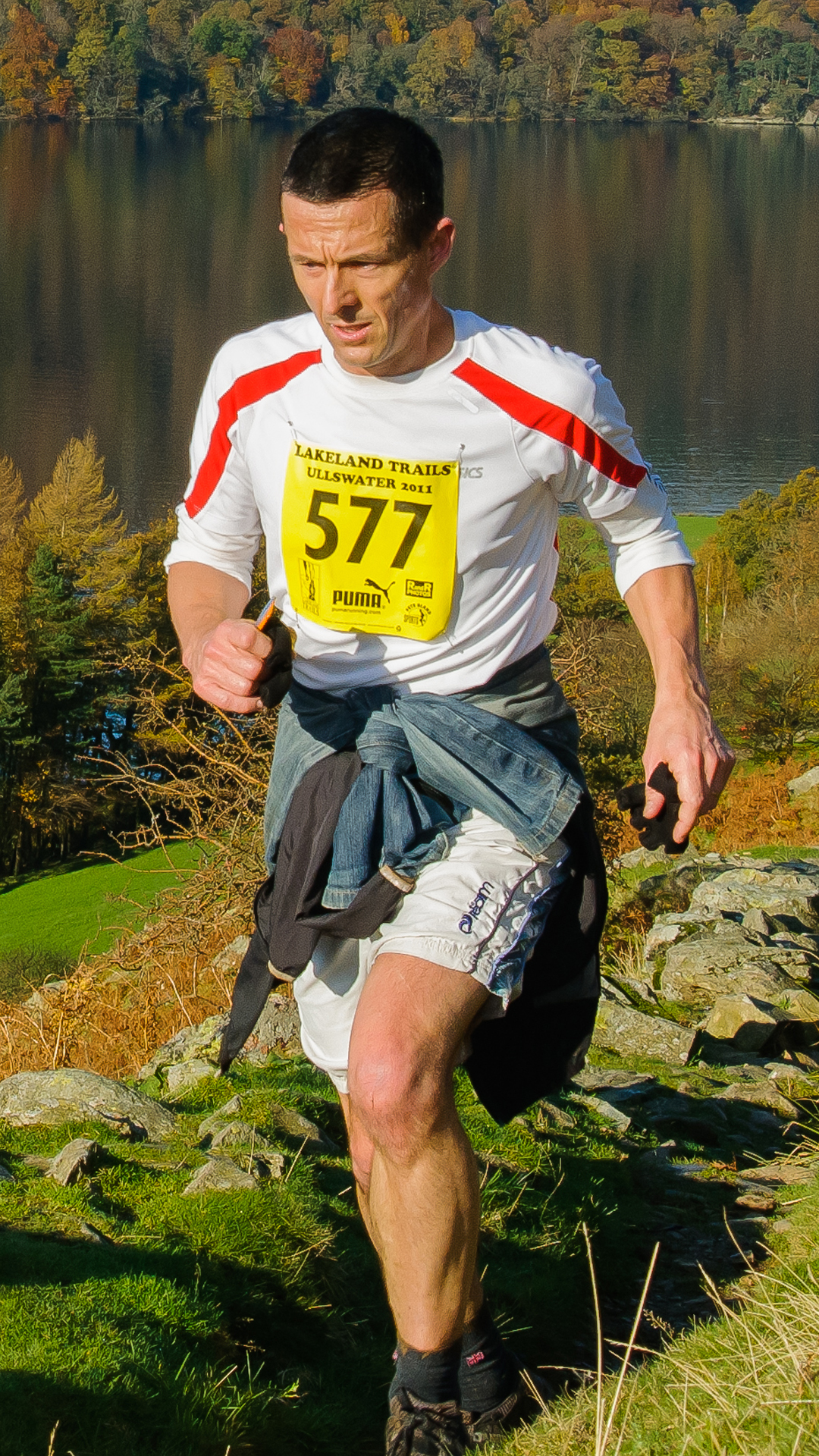
Trail racers on a hilly course. Downhill-specific training separates comfortable descenders from destroyed quads. Photograph: Robin McConnell
Frequently asked questions
Why do my quads hurt more after downhill than uphill running?
Uphill running uses concentric contractions, where the muscle shortens to produce force. Downhill running uses eccentric contractions, where the muscle lengthens under load to brake your momentum. Eccentric actions generate higher tension per fiber and cause more micro-damage, hence more soreness.
How long should I wait before running hard again after a long descent?
Research suggests up to 4 days for full recovery of strength, swelling, and soreness after a demanding downhill session. Easy recovery movement is fine within a day or two, but schedule hard workouts or races outside that window.
Will downhill running damage my knees?
Quad soreness is muscular, not joint damage. Knee pain is a separate issue with different causes, and knees hurting during squats but not running usually points to loading patterns rather than the descent itself. Sharp or localized knee pain deserves professional assessment.
Can beginners train for downhills safely?
Yes, with gradual exposure. Start with short, easy descents once a week and add time before adding steepness. The repeated bout effect means even modest regular exposure builds protection within weeks.
The bottom line
Downhill running destroys your quads because every step forces them to brake your body weight while lengthening, the most damaging contraction type in running. Strength can dip for 24 hours and soreness peaks between 24 and 72 hours, with full recovery taking up to 4 days after a hard session.
The fix is exposure, not avoidance. Regular downhill sessions trigger the repeated bout effect, armoring the quads for up to 9 months. Train descents deliberately, shorten your stride, respect the recovery window, and the same hill that once wrecked you for a week becomes just another part of the run.
Latest in Fitness
- Why going downstairs hurts your knees more than going up
- Muscle soreness vs. injury: how to tell
- Why knees hurt squatting but not running
- Why you get dizzy after working out
Get one practical fitness explainer in your inbox each week. Subscribe to the Rive News newsletter.
Related stories
How long does it really take to build noticeable muscle?
Strength gains start in week one, but visible muscle takes 8-12 weeks for most beginners. What the Oklahoma CT-scan study measured,
Why you feel dizzy after a workout: the 5 common causes
Post-workout dizziness usually comes from a blood pressure dip, dehydration, or low blood sugar. The numbers behind each cause, and when
Why Do Knees Hurt When Squatting but Not Running?
Knees hurt when squatting but not running because deep bends multiply force on the kneecap. Learn the mechanics, common causes, fixes,