
How do fitness trackers estimate calorie burn and how accurate is it
By Rive News
Research desk | Rive News
Key takeaways
- Fitness trackers do not measure calories; they predict them from motion, heart rate, and your age, weight, and sex.
- In a 2017 Stanford study of 60 people, the best of seven devices missed calorie burn by 27 percent and the worst by 93 percent.
- Heart rate readings are far more reliable, with errors under 5 percent, so use calories as a trend, not a budget.
A fitness tracker never watches a calorie leave your body. It watches your wrist move, watches your pulse rise and fall, and then runs those signals through a private formula built from your age, weight, height, and sex. The calorie number on your screen is a prediction, not a measurement.
This article explains how fitness trackers arrive at that number, including the sensors they use, how the math works, what validation studies have found, and how to use the number wisely.
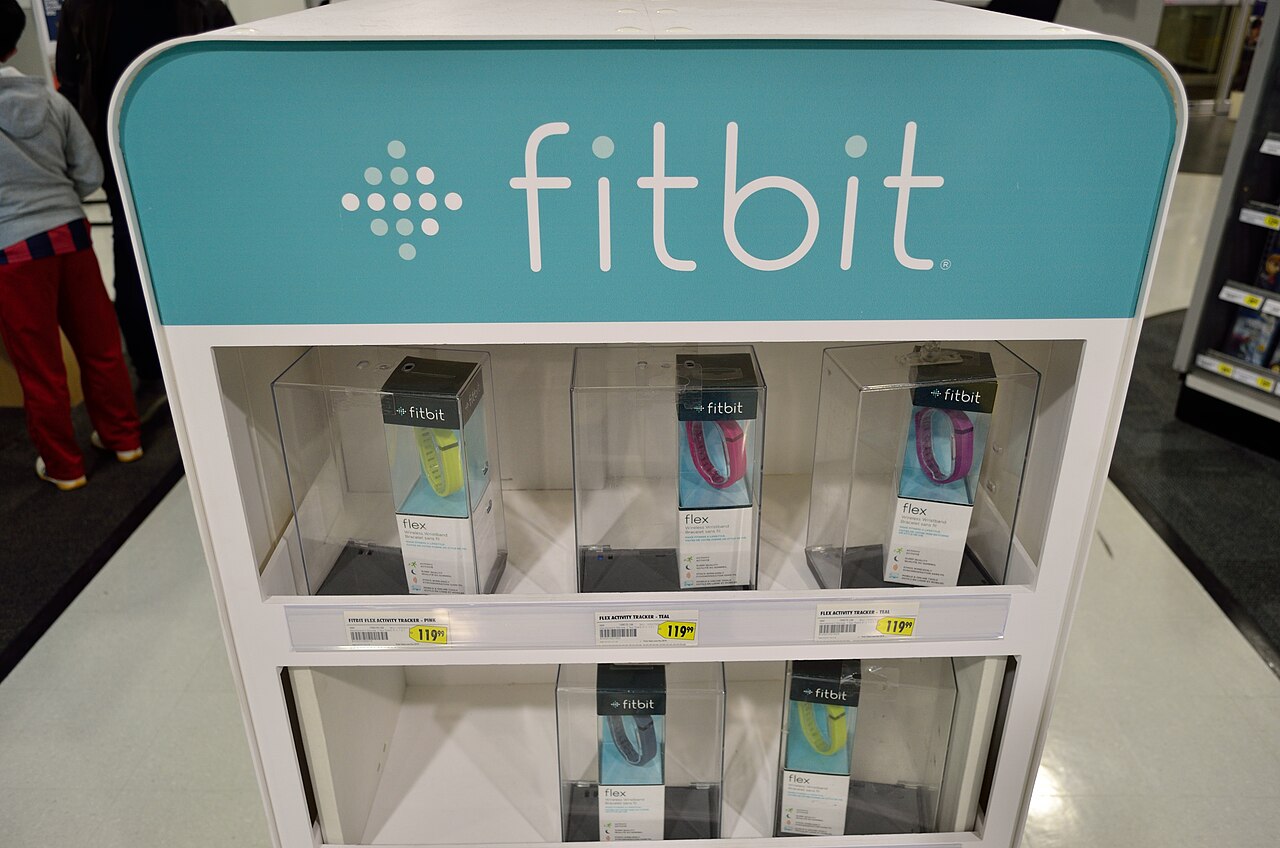
A Fitbit retail display. Millions of wearers make daily food and training decisions from the calorie numbers these devices produce. Photograph: Raysonho/Wikimedia Commons
Image Credits: Wikimedia Commons (CC0)
How fitness trackers measure your movement and heart rate
Two sensors do most of the work. The accelerometer (a motion sensor) detects motion: the swing of a wrist on a walk, the faster cadence of a run. From that rhythm the device estimates steps, distance, and activity intensity.
The second sensor is the optical heart rate monitor. It shines green light into your skin and measures the reflected light as blood volume changes with each pulse. Heart rate is the more useful signal during workouts where the wrist barely moves, like cycling or yoga.
Both data streams then feed into the device's algorithm alongside your personal stats. Companies are not required to publish their formulas or verify their calorie counts against any independent standard, according to an analysis by BuzzManchester of how tracker algorithms reach the market.
How the calorie number is actually calculated
The math has two halves. First comes your basal metabolic rate (BMR), the energy your body uses at rest to keep you alive. Trackers estimate BMR from your age, weight, height, and sex.
Second comes activity energy. This is where heart rate and movement matter: higher intensity means a higher assumed oxygen demand, which converts to calories. Garmin, for example, splits this into Active Calories (movement above baseline) and Total Calories (BMR plus active), using your biometric profile, VO2 max estimate (a measure of fitness), and motion data, as described in Lifestack's breakdown of Garmin's method.
Here is the catch. The lab gold standard for energy expenditure is indirect calorimetry, which measures the oxygen you breathe in and the carbon dioxide you breathe out.
A wrist device measures neither. It is translating arm swings and a pulse into a guess about your whole body's fuel use.
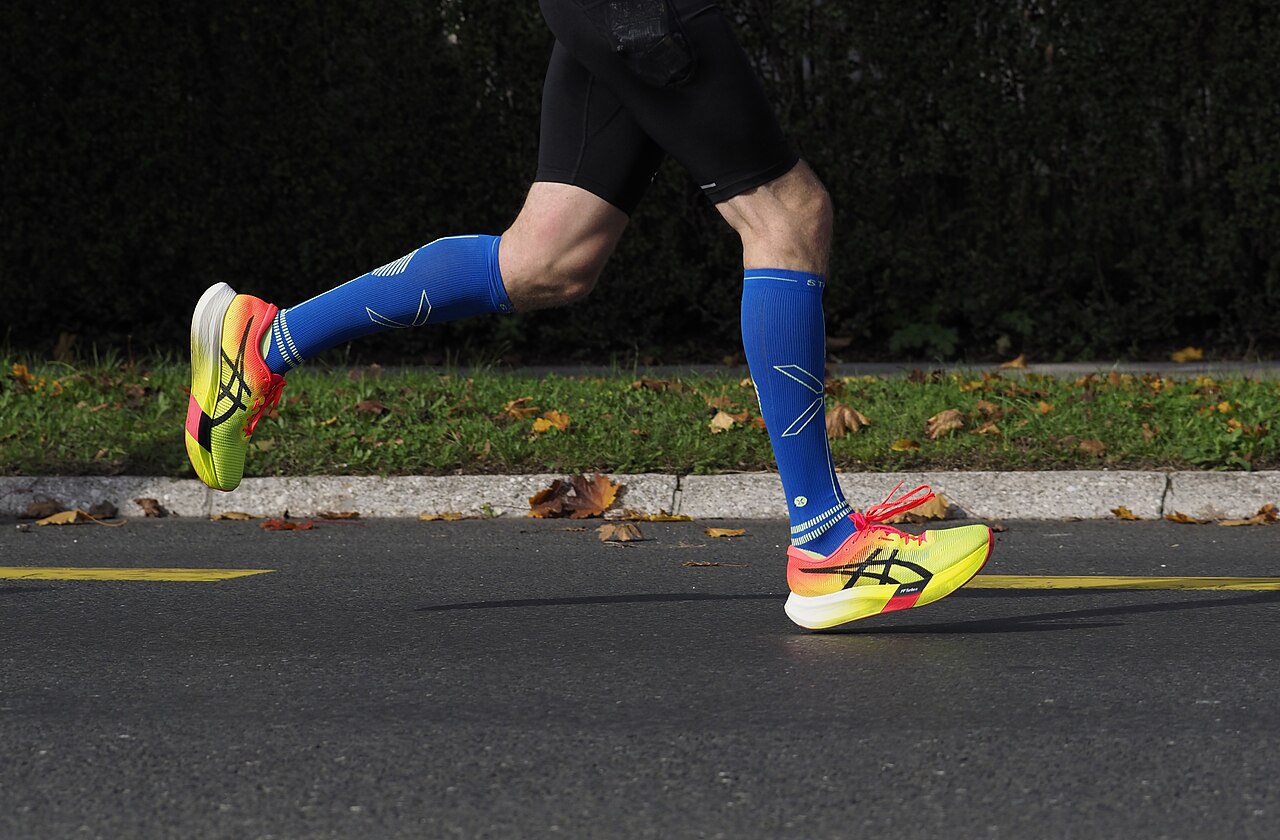
Running pace and heart rate correlate well, which is one reason trackers estimate calories best during steady runs. Photograph: PetarM/Wikimedia Commons
Image Credits: Wikimedia Commons (CC BY-SA 4.0)
What the validation studies found
The most cited test is the 2017 Stanford evaluation. Sixty volunteers, including 31 women, wore seven devices (Apple Watch, Basis Peak, Fitbit Surge, Microsoft Band, Mio Alpha 2, PulseOn, and Samsung Gear S2) while walking, running, and cycling, measured against medical-grade ECG and indirect calorimetry.
Six of the seven measured heart rate with an error rate under 5 percent. For energy expenditure, none of the seven was accurate: the best device was off by an average of 27 percent and the worst by 93 percent, as reported by Medical News Today.
A detailed validation summary on kcalm.app puts the same study's medians at 27.4 percent error for the best device and 92.6 percent for the worst, with heart rate medians of 2.0 and 6.8 percent. In concrete terms, a workout your watch scores at 500 kcal could plausibly have cost you 360 or 640 kcal, and the wrist alone gives you no way of knowing which.
Newer studies confirm the pattern. A 2026 systematic review of 47 studies, cited by BusinessUpturn, found recent devices err by roughly 10 to 40 percent against indirect calorimetry. A 2019 Japanese study compared 12 devices against a metabolic chamber and then 15 days of doubly labelled water, the isotope technique used to calibrate national dietary guidelines, and found errors ranging from 19.4 to 100.2 percent.
In September 2026, researchers reported on four smartwatches tested against metabolic analyzers and found calorie errors strongly linked to body fat percentage, ranging from 50 percent to more than 100 percent, according to the NY Post. Study author Jason Kostrna said the algorithms were trained mostly on leaner people. "If your goal is to lose weight, I would be conservative about using that number to determine how much to eat or to evaluate the success of a workout," he wrote for The Conversation.
Why heart rate is accurate but calories are not
The split between the two measurements comes down to what is being measured directly. Heart rate is a signal the sensor reads from your skin. Energy expenditure is a conclusion the software draws from that signal.
Heart rate correlates with effort, but the correlation shifts with fitness level, temperature, stress, caffeine, and whether your arms are moving. Two people at the same heart rate can burn different amounts of energy. The algorithm smooths over all of that with population averages.
That is why trackers are best at steady-state running and walking, where heart rate tracks effort closely, and weakest at strength training and interval work, where heart rate lags behind actual effort. A companion article on sore muscles after workouts explains what that effort does to your body, and why the damage markers your tracker cannot see matter for recovery too.

Treadmill sessions give trackers clean, rhythmic data, which is why estimates look most plausible during steady cardio. Photograph: Shixart1985/Wikimedia Commons
Image Credits: Wikimedia Commons (CC BY 2.0)
How to use your tracker's calorie number wisely
Do not treat the number as a food budget. If your watch says 600 kcal, eating 600 extra kcal could overshoot by hundreds. Studies repeatedly show errors large enough to erase a calorie deficit, which is one reason some people do not lose weight despite exercising.
Instead, use the number as a relative gauge. Is today higher than your average Tuesday? Did that harder route cost more than the easy one?
For trend tracking, consistency matters more than absolute accuracy, and this is where devices are genuinely useful. The NY Post's coverage of the 2026 study noted the same devices tracked heart rate, distance, and pace reliably.
A few habits improve the estimate. Keep your profile stats current, especially weight. Wear the band snug during workouts, an inch or two above the wrist bone, so the optical sensor stays in contact.
Log the correct workout type rather than leaving the device to guess. And if you are comparing week to week, keep the same device: different brands use different algorithms, so their errors point in different directions.
Are fitness trackers accurate for heart rate?
Yes, generally. The Stanford study found six of seven devices within 5 percent of a medical-grade ECG. Skin tone and body mass index affected results somewhat, but heart rate remains the most trustworthy metric your tracker reports.
Which fitness tracker is most accurate for calories?
No device in the Stanford test kept its calorie error under 20 percent in any single activity, according to the kcalm.app validation summary. Newer reviews put top devices at 10 to 40 percent error. No consumer brand has a clearly proven accuracy lead that holds across studies.
Should I eat back the calories my tracker says I burned?
Be cautious. With errors of 27 to 93 percent in the landmark study, eating back the full number can easily erase your deficit. If you use the number at all, treat half of it as a conservative ceiling.
Can I make my tracker more accurate?
Somewhat. Update your weight, wear the band tightly during exercise, select the right workout mode, and keep the firmware updated. But the underlying method is estimation, and no setting turns a prediction into a measurement.
The bottom line
Fitness trackers estimate calories by combining motion, heart rate, and your body stats in a proprietary formula. The estimate is useful for comparing days and workouts, but validation studies from 2017 to 2026 put the error anywhere from 10 to over 90 percent.
Trust the heart rate reading, treat the calorie number as a rough trend, and make food decisions from a separate, more careful method. If you want to understand what your training is actually doing, how sleep affects muscle recovery is a better place to start than the calorie count.
---
Rive News is the research desk of this publication, covering the science behind everyday questions with sourced, verifiable reporting.
Latest in fitness
- How repeated training fades soreness over time
- Why lactic acid is blamed for soreness but clears in an hour
- How sleep affects muscle recovery, scientifically
Subscribe for one research-backed explainer every morning.
Corrections: if you spot an error, contact the research desk and we will correct it promptly. Published October 12, 2026. Copyright Rive News 2026.
Related stories

How long does it really take to build noticeable muscle?
Strength gains start in week one, but visible muscle takes 8-12 weeks for most beginners. What the Oklahoma CT-scan study measured, and the

Why you feel dizzy after a workout: the 5 common causes
Post-workout dizziness usually comes from a blood pressure dip, dehydration, or low blood sugar. The numbers behind each cause, and when to

Why Do Knees Hurt When Squatting but Not Running?
Knees hurt when squatting but not running because deep bends multiply force on the kneecap. Learn the mechanics, common causes, fixes, and w