
What is the muscle pump and does it mean growth
By Rive News / Research desk | Rive News / Published October 25, 2026 at 9:00 AM PKT
Key takeaways
- The pump is a temporary swelling of a working muscle from blood flow and fluid shifts, not new muscle tissue.
- A 2025 review by Van Every and colleagues finds that mechanical tension, not the pump, drives muscle growth.
- The cell-swelling theory behind the pump came largely from liver cells, which lack the scaffolding that constrains real muscle fibers.

A woman lifts dumbbells in a gym, the kind of set that produces a strong pump. Photograph: Shixart1985
Image Credits: Wikimedia Commons
The pump is the tight, swollen feeling in a muscle during and just after a hard set. Your sleeves feel tighter. Your arms look bigger in the mirror.
For decades, gym lore treated that feeling as a sign of growth in progress. The logic felt obvious: the muscle is bigger, so it must be growing.
The research now points the other way. This article explains what the muscle pump is and whether it means growth, including the blood and fluid mechanics behind the swell, the cell-swelling theory and its weak foundation, and what actually builds muscle instead.
This article is for general information only and is not medical advice; talk to a clinician about any symptoms.
What the pump actually is
When a muscle works hard, blood flow to it rises sharply. Working muscle needs oxygen and fuel, and it produces waste products that must be cleared. Blood floods in faster than it can drain out, especially during sets with short rest periods and continuous tension.
Fluid shifts into the spaces around and inside muscle cells, and the muscle swells visibly.
Metabolites build up at the same time. Lactate and hydrogen ions accumulate as the muscle burns glucose for energy faster than oxygen can keep up. These byproducts draw fluid with them and contribute to the burning sensation that lifters call the burn.
Veins stand out because blood is pooled near the surface under pressure. None of this is new tissue. It is the same muscle, temporarily holding more blood and fluid.
The pump fades fast. Within minutes to an hour after training, blood flow normalizes, fluid drains away, and the muscle returns to its normal size. Real growth, by contrast, takes weeks.
It comes from adding new contractile proteins, actin and myosin, inside muscle fibers. That process is called myofibrillar hypertrophy, and it cannot happen in the course of a single workout. A pump that vanishes before dinner was never growth.
Where the pump-growth theory came from
The idea that the pump builds muscle has a respectable origin. In 2010, Brad Schoenfeld proposed a framework of three factors influencing muscle hypertrophy: mechanical tension, muscle damage, and metabolic stress. The pump sat inside the metabolic stress factor.
The reasoning was that cell swelling acts as a threat signal: the cell senses its own expansion, turns up protein synthesis, and turns down protein breakdown. Since growth is protein synthesis minus protein breakdown, anything tilting that balance looked like a growth lever.
Early evidence for the mechanism came from cell studies, and that is where the trouble starts. A 2025 narrative review by Derrick Van Every and colleagues, published in the Journal of Sport and Health Science, examined every proposed pathway connecting the pump to hypertrophy. Its verdict, as reported by Massage & Fitness Magazine, was blunt: the current evidence does not support cell swelling, metabolites, or acute hormone spikes as factors promoting muscle growth.
The review's sharpest point concerns the cell type behind the theory. The cell-swelling research that launched the pump theory was conducted primarily on hepatocytes, or liver cells. Liver cells lack the extracellular matrix lattice that surrounds and constrains muscle fibers.
What happens inside a liver cell when fluid pressure builds is not necessarily what happens inside a muscle cell, which is held in a stiff scaffold of connective tissue. The mechanism was borrowed from a different organ and assumed to transfer.
What the direct tests found
The review also examined human experiments designed to isolate the pump's effect, and the results were unhelpful to the theory. One line of evidence comes from blood flow restriction training, which traps blood in the working muscle and produces a far bigger pump than normal lifting. When blood flow restriction was added to heavy lifting, hypertrophy did not increase compared with heavy lifting alone.
Same training volume, more pump, no additional growth, as summarized by FitChef's coverage of the review.
Metabolites fared no better as a direct cause. A 2020 study infused sodium lactate into 16 participants while they performed one-legged resistance exercise. Blood lactate concentration ran about 130 percent higher than normal, yet muscle pH, anabolic hormone signaling, and muscle protein synthesis rates did not change.
If metabolites drove growth directly, a near-doubling of lactate should have moved something. It moved nothing.
There are correlational findings that point the other way, and honesty requires naming them. One study found greater acute muscle swelling after a single session of leg extension over six weeks, with cellular swelling explaining about 25 percent of the variance in muscle growth. Another reported a significant positive correlation between swelling and hypertrophy, but it was published only as an abstract and used a protocol of 100 repetitions per set, which limits how far it applies to normal training.
Van Every and colleagues note both studies and judge them insufficient against the failed direct tests. Correlation between swelling and growth is expected, because hard training produces both. That does not make swelling the cause.
The review also notes a measurement problem. The pump as lifters experience it is subjective, and it does not accurately indicate the degree of actual cell swelling. Two lifters can report very different pumps from the same workout.
A signal that cannot be measured reliably makes a poor training target.
So what actually builds muscle?
Mechanical tension is the primary driver, according to Van Every and colleagues. Mechanical tension is the force generated by muscle fibers during active contraction or passive stretch. That force is converted into chemical signals inside the cell through a process called mechanotransduction.
Sensors in the cell membrane and surrounding matrix detect the load and switch on pathways, including mTOR, that drive the building of new contractile proteins.
Stuart Phillips of McMaster University, who co-authored the review, told Massage & Fitness Magazine that hypertrophy can be generated across a broad spectrum of loads, roughly from 30 percent to more than 85 percent of one-repetition maximum, provided sets are taken close to failure. That range is liberating for program design. A lifter who dislikes heavy singles can train mostly in the 8 to 15 repetition range and still grow well.
A lifter with sore joints can use lighter loads for higher repetitions, as long as effort is high and sets approach failure.
Volume and effort over time matter more than any single session's feeling. Progressive overload, gradually increasing the load, repetitions, or sets over weeks, keeps mechanical tension rising as the muscle adapts. Sleep, protein intake, and consistency set the ceiling on how much of that stimulus becomes tissue.
None of these factors announces itself with a tight sleeve in the mirror, which may be why the pump stole their credit for so long.
That does not make the pump useless. It makes it a byproduct, not a target. A strong pump usually means you trained with enough volume and effort to disturb the muscle, and many lifters enjoy chasing it.
Blood flow also delivers oxygen, amino acids, and glucose to working muscle while clearing waste, which supports performance within the session. The honest framing is that the pump accompanies productive training. It does not cause the growth that follows it.
How to use the pump without being fooled by it
Treat the pump as feedback, not as a score. A session that produced no pump can still build muscle, especially heavy low-repetition training with long rests, which generates high tension with little metabolite buildup. A session with an enormous pump can still be junk, especially light weights moved for dozens of repetitions with no progression over time.
Judge a program by its logbook, not its mirror. If the weight on the bar, the repetitions at a given weight, or the total hard sets are rising over weeks, the program is working. If nothing is rising but every session ends with a great pump, the program is entertainment, not training.
Photos taken under the same lighting, weeks apart, tell the truth that a post-workout mirror cannot.
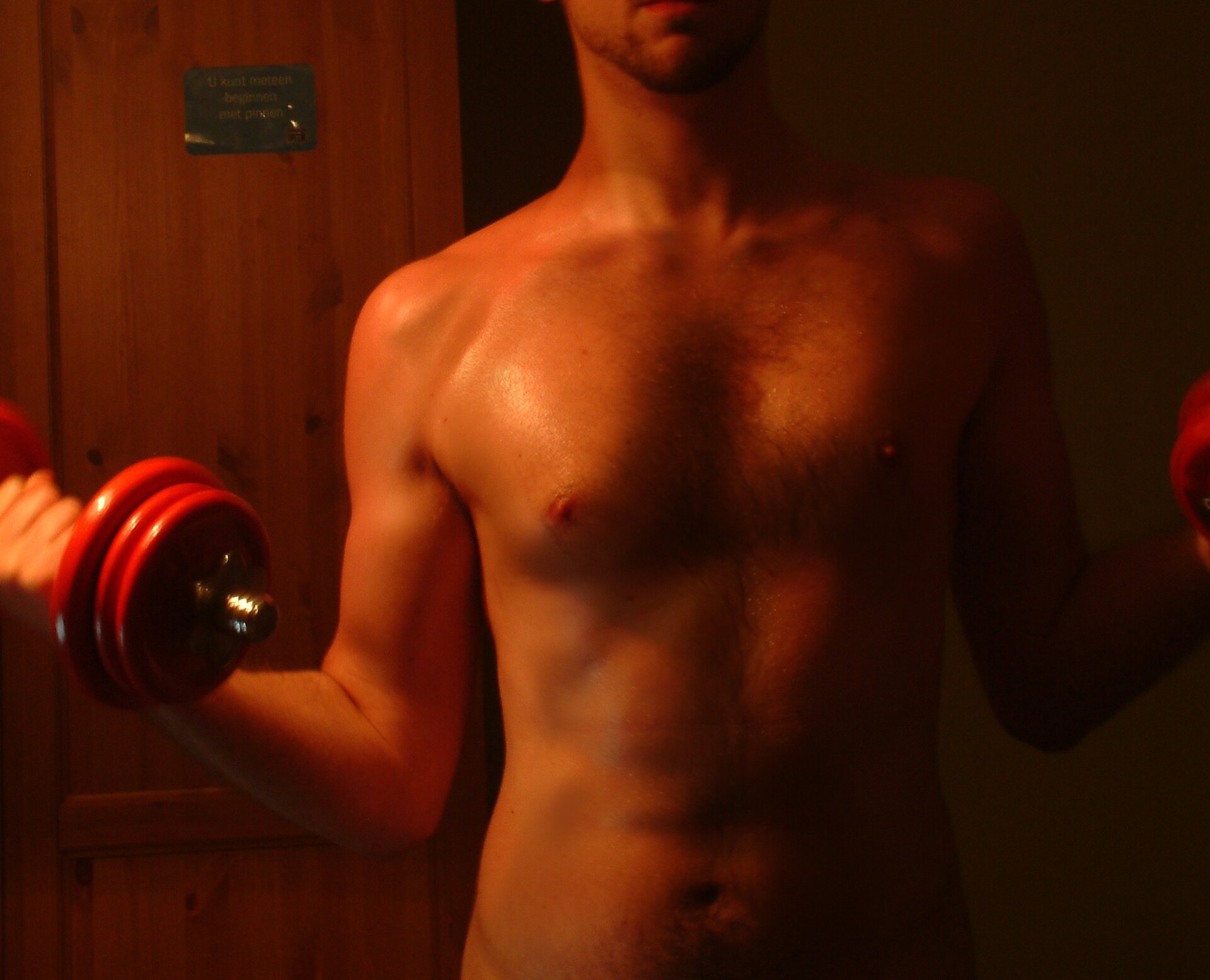
A set of weightlifting dumbbells. Photograph: McVaio
Image Credits: Wikimedia Commons
One more distinction helps. The temporary size from a pump is sometimes confused with sarcoplasmic hypertrophy, the expansion of the non-contractile contents of a muscle fiber, such as fluids and glycogen. Van Every and colleagues argue that sarcoplasmic hypertrophy is not a separate form of growth but a remodeling that occurs alongside the addition of contractile proteins.
Glycogen binds several grams of water per gram stored, which can inflate muscle size without adding force-producing tissue. A fuller muscle is not automatically a stronger one.
Does a bigger pump mean a better workout?
Not necessarily. Pump size tracks blood flow, metabolite buildup, and rest periods more than it tracks tension. Heavy sets with long rests build muscle with little pump.
Light sets with short rests build a huge pump with less tension. Judge the workout by effort and progression, not by swelling.
Can you train specifically for the pump?
Yes, with moderate weights, higher repetitions, short rests, and continuous tension. That style is fine as part of a program. It becomes a problem only when pump training replaces progressive overload entirely, because the pump alone has little evidence as a growth driver.
Why do sprinters not have huge muscles if metabolites build muscle?
Sprinting and high-intensity interval training produce metabolite concentrations equal to or greater than resistance training, yet neither produces meaningful hypertrophy. If metabolites drove growth, sprinters would be among the most muscular athletes alive. The comparison is one of the review's cleanest arguments against the metabolite theory.
Is blood flow restriction training useless then?
No. Blood flow restriction lets lifters achieve a hypertrophic stimulus at low loads that protect healing tissues, which helps post-surgical patients and older adults with painful joints. The mechanism, Phillips notes, is still mechanical tension on recruited fibers, not metabolites as such.
The bottom line
The muscle pump is real physiology: blood and fluid temporarily swelling a working muscle. It is not growth, and the best current evidence says it does not cause growth either. The cell-swelling theory rested on liver cells, and direct human tests, from blood flow restriction to lactate infusion, have failed to show a pump-driven growth effect.
Mechanical tension, applied with enough effort and volume over time and progressed week by week, is what builds muscle. Chase the pump if you enjoy it, but judge your training by the logbook.
Tags: muscle pump, hypertrophy, strength training
Rive News's research desk covers practical explainers across cars, work, study, fitness, and home, drawing on public sources and industry guidance.
Related
- Why you look more muscular right after a workout
- How progressive overload builds muscle, explained
- Mind-muscle connection explained
- Why veins pop out during exercise
Subscribe for one practical explainer each week, drawn from real sources and written in plain language.
Rive News publishes explainers based on public sources. Corrections are noted on the article when verified.
Related stories
How long does it really take to build noticeable muscle?
Strength gains start in week one, but visible muscle takes 8-12 weeks for most beginners. What the Oklahoma CT-scan study measured,

Why you feel dizzy after a workout: the 5 common causes
Post-workout dizziness usually comes from a blood pressure dip, dehydration, or low blood sugar. The numbers behind each cause, and when
Why Do Knees Hurt When Squatting but Not Running?
Knees hurt when squatting but not running because deep bends multiply force on the kneecap. Learn the mechanics, common causes, fixes,