
How does progressive overload actually trigger growth
By Rive News / Research desk | Rive News / Published October 25, 2026 at 9:00 AM PKT
Key takeaways
- Progressive overload works by raising mechanical tension, the force muscle fibers feel against resistance.
- Tension switches on the mTOR pathway, which drives muscle protein synthesis and fiber growth.
- Soreness and the pump are side effects, not the growth signal itself.

[A woman doing a squat workout with a barbell in a gym. Photograph: Nenad Stojkovic]
Image Credits: Wikimedia Commons
Progressive overload is the most repeated advice in strength training: gradually lift more weight, do more reps, or add more sets over time. The advice is sound, but most versions of it skip the interesting part, which is what happens inside the muscle when the load goes up.
The short version is that muscles do not grow because they are damaged or because they burn. They grow because mechanical tension tells them to. This article explains how progressive overload actually triggers growth, including what mechanical tension is, how it switches on growth signaling, and how to apply overload without chasing soreness.
This article is for general information only and is not medical advice; talk to a clinician about any symptoms.
What progressive overload really changes
Progressive overload means increasing the demand on a muscle beyond what it has already adapted to. The increase can take several forms: more weight on the bar, more repetitions with the same weight, more sets, a slower lowering phase, or shorter rest between sets. All of them count, because all of them raise the total challenge the muscle must meet.
The key point is that the muscle does not sense "more weight" as a number. It senses force.
When you add 2.5 kilograms to a squat, the fibers must produce more force to move the load through the same range of motion. That force, experienced inside the fiber, is mechanical tension.
A muscle that faces the same tension week after week has no reason to change. It already handles that demand comfortably. Growth is the body's answer to a demand it cannot yet meet easily, which is why the load must keep creeping upward as the muscle adapts.
Mechanical tension: the signal that matters
Mechanical tension is the force muscles create when they contract against resistance. It comes in two forms.
Active tension arises as fibers contract to lift or lower a load. Passive tension arises as fibers stretch while still resisting that load, such as at the bottom of a squat or a Romanian deadlift.
Both forms send signals, and exercises that combine them tend to be the most effective builders. A full range of motion matters here: a half squat loads the muscle through only part of its length, while a deep squat stretches it under load at the bottom and contracts it hard at the top.
Freeletics' hypertrophy guide states the current consensus plainly: of the three candidate mechanisms, mechanical tension, metabolic stress, and muscle damage, tension appears to be the most important driver. The burn of a hard set and the soreness the next day are real, but they are supporting actors, not the lead.
From tension to growth: the mTOR pathway
Inside each muscle fiber sit mechanosensors, structures that detect physical stress. When tension rises during a hard set, especially in the final reps when fatigue forces more fibers to join the effort, these sensors activate a signaling chain known as the mTOR pathway.
The mTOR pathway switches on muscle protein synthesis, the process of building new contractile protein from amino acids.
Actin and myosin, the two proteins that actually pull against each other to create contraction, are the main products. Over days and weeks, synthesis outpaces breakdown, and the fiber gets thicker and stronger. That thickening is hypertrophy.
Bodybuilding Wizard's overload guide lays out the chain in order: progressive overload raises mechanical tension, tension recruits more and larger motor units, recruited fibers activate protein synthesis, and repeated synthesis over weeks produces measurable hypertrophy. No step in that chain mentions soreness, which is why a workout can build muscle without leaving you hobbling the next day.
Motor-unit recruitment deserves a note of its own. Muscles activate small, low-force motor units first and call in larger, high-force ones only as demand rises.
Easy sets never reach the largest fast-twitch fibers, which have the greatest growth potential. Hard sets near failure do, which is why effort matters as much as load: a light weight lifted lazily recruits little, while the same weight lifted to near failure recruits much more.
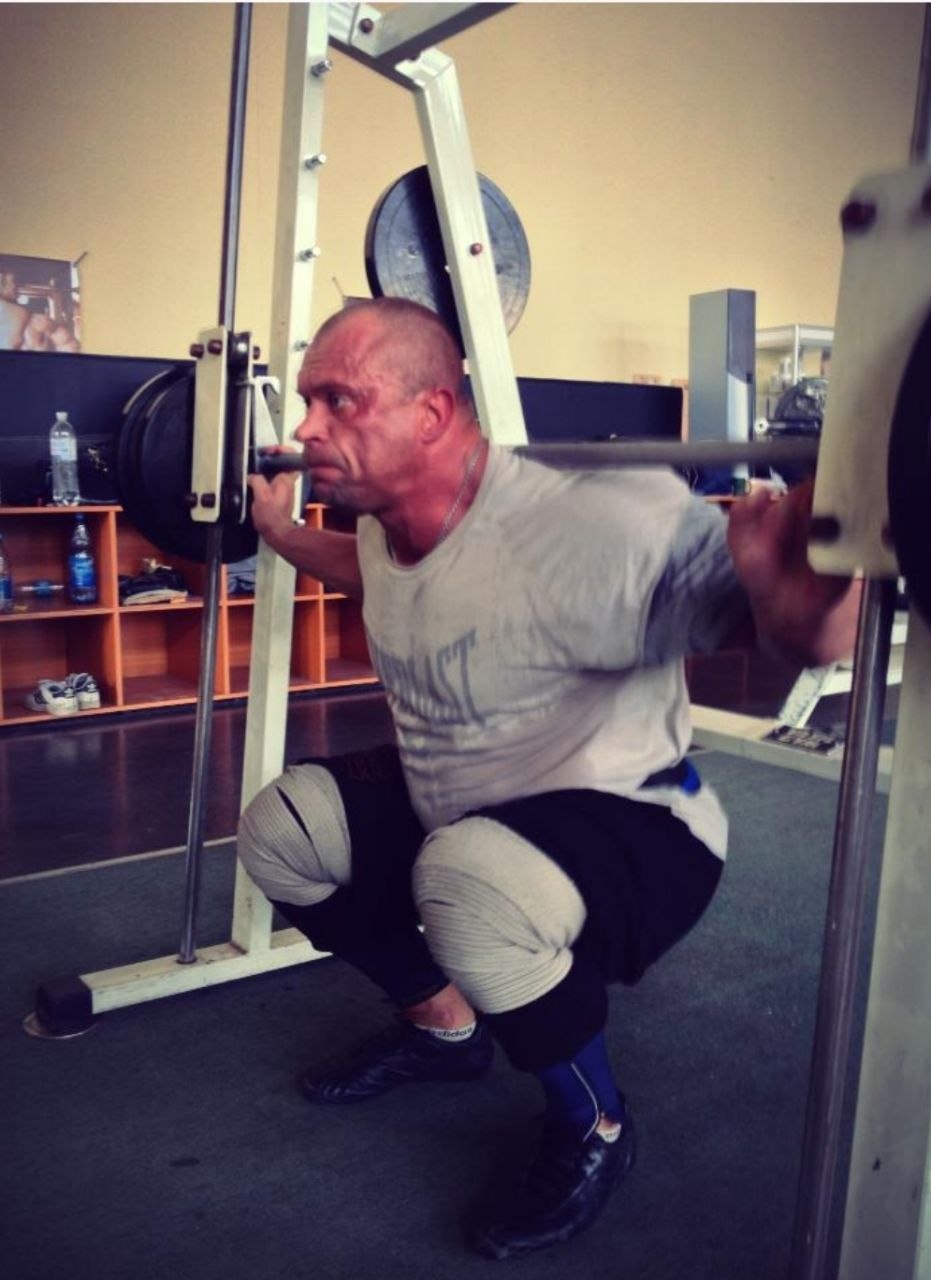
[An athlete performing a squat in a gym. Photograph: Олександр Єрмоленко]
Image Credits: Wikimedia Commons
What overload looks like in practice
The cleanest form of overload is adding a small amount of weight to a lift once the current weight feels manageable. A 2.5-kilogram jump on a barbell lift, or one extra rep per set, is enough. The increases should be small enough to keep good form, because sloppy reps shift tension away from the target muscle and onto joints and momentum.
When weight cannot go up, other variables can. Adding a set, slowing the lowering phase to three seconds, or cutting rest by 30 seconds all raise the challenge. The Nock Academy's guide on mechanical tension makes the same point: tension rises with challenging resistance, full range of motion, and good technique, not with any single variable.
Deload weeks belong in the plan too. After several weeks of rising loads, a lighter week lets fatigue clear while the built protein remains. Lifters who skip deloads often stall, not because the signal stopped working, but because accumulated fatigue masks it.
A common mistake is chasing soreness as proof of a good session. Delayed-onset muscle soreness fades as the body adapts to a movement, a phenomenon called the repeated bout effect, even while that movement keeps building muscle. Judging a program by soreness is like judging a harvest by how tired the farmer feels.
How fast should I add weight?
As slowly as progress allows. Small, regular increases beat large jumps that break form.
A beginner may add weight weekly; an experienced lifter may add it monthly on some lifts. The rate matters less than the direction: over months, the trend must point upward.
Do I need to train to failure?
No. Training close to failure, with one or two reps left in reserve, recruits the high-threshold fibers that drive growth while leaving less fatigue than true failure. Sets taken to absolute failure have a place, but using them on every set usually costs more recovery than they return.
Can light weights build muscle?
Yes, if the effort is high enough. Research summarized in the sources above shows growth across a wide rep range when sets are taken close to failure. Heavy weights are more efficient for strength, but light weights taken seriously still generate tension once fatigue forces full recruitment.
Why did my progress stop?
A plateau usually means one of three things: the overload stopped, recovery is insufficient, or fatigue is masking gains. Check the training log first.
If the weights have not moved in a month, the signal is flat. If sleep, food, or stress collapsed, recovery is the bottleneck.
The bottom line
Progressive overload triggers growth through a simple chain: more demand creates more mechanical tension, tension activates the mTOR pathway, and that pathway builds new muscle protein. Soreness and the pump travel alongside the process, but neither one drives it.
Train a little harder than last month, keep the form honest, and let the chain do its work. Growth is slow, but the mechanism behind it is not mysterious.
Tags: progressive overload, muscle growth, strength training
Rive News's research desk covers practical explainers across driving, work, and everyday science, checking each claim against published sources before writing.
Related
- How progressive overload builds muscle: the science explained
- What is progressive overload in simple terms for beginners
- Muscle soreness vs injury: how to tell DOMS from real damage
- How long does it really take to build noticeable muscle?
Subscribe for one practical explainer each morning.
Standards: facts checked against the sources listed above; corrections are published when an error is found.
Related stories

How long does it really take to build noticeable muscle?
Strength gains start in week one, but visible muscle takes 8-12 weeks for most beginners. What the Oklahoma CT-scan study measured,

Why you feel dizzy after a workout: the 5 common causes
Post-workout dizziness usually comes from a blood pressure dip, dehydration, or low blood sugar. The numbers behind each cause, and when
Why Do Knees Hurt When Squatting but Not Running?
Knees hurt when squatting but not running because deep bends multiply force on the kneecap. Learn the mechanics, common causes, fixes,