
What Is the Maillard Reaction in Simple Terms?
Key takeaways
- The Maillard reaction is the chemical reaction between amino acids (from protein) and reducing sugars that makes browned food taste good.
- It needs heat, typically 140 to 165 degrees Celsius, plus a fairly dry surface. That is why searing works and steaming does not brown.
- It is different from caramelization, which is the browning of sugar alone. It is why bread crusts, seared steaks, and roasted coffee share a family resemblance.

A grilled steak with a deep brown crust. That color and the roasted flavor beneath it come from the Maillard reaction. Photograph: PattayaPatrol/Wikimedia Commons
Image Credits: Wikimedia Commons
The Maillard reaction is the reason a seared steak tastes better than a boiled one, why bread crust is the best part of the loaf, and why roasted coffee smells the way it does. It is a chemical reaction, but you do not need a chemistry degree to understand it.
In simple terms, it is what happens when protein and sugar meet high heat. The result is browning, plus hundreds of new flavor and aroma compounds. This article explains the Maillard reaction in simple terms: what it is, how it works step by step, what it needs to happen, and how it differs from caramelization.
What the Maillard reaction is
The Maillard reaction is a chemical reaction between amino acids, the building blocks of proteins, and reducing sugars such as glucose and fructose. When the two are heated together, they transform into melanoidins, brown pigments, and a large family of flavor and aroma molecules.
It is named after French chemist Louis Camille Maillard, who first described it in 1912 while trying to reproduce biological protein synthesis in the lab. He was not studying cooking at all. Cooks had been using the reaction since the discovery of fire. Maillard just gave it a name.
The reaction is a form of non-enzymatic browning, meaning no enzymes are involved. It is responsible for the golden crust on bread, the sear on a steak, the color of fried potatoes, the flavor of roasted coffee, and the browned skin on a roast chicken. Wherever food turns brown and delicious in dry heat, the Maillard reaction is usually at work.
How it works, step by step
The chemistry is complex, but the outline is simple enough to follow.
First, a sugar molecule links up with an amino acid. The sugar's carbonyl group reacts with the amino acid's amino group, forming an unstable compound and releasing a molecule of water. This first step is reversible, so nothing dramatic happens yet.
Second, that unstable compound rearranges itself through what chemists call the Amadori rearrangement. This is the point of no return. The rearranged molecules, called ketosamines, are the starting material for everything that follows.
Third, the ketosamines break down and recombine in a cascade of further reactions. This is where the magic happens.
The cascade produces hundreds of distinct compounds, including pyrazines with their toasted flavor, meaty furans, and sweet furanones, per BBC Science Focus. Finally, the reactions build large brown polymer molecules called melanoidins, which give browned food its color.
The key insight is that the reaction does not make one new substance. It makes a crowd of them, and that crowd is what we experience as the rich, complex flavor of cooked food.
A boiled steak has the same protein as a seared one. What it lacks is the hundreds of compounds the Maillard cascade creates.
What the reaction needs
Four conditions control how well the Maillard reaction works, and cooks manipulate all of them.
Heat is the first. The reaction proceeds rapidly from around 140 to 165 degrees Celsius (280 to 330 degrees Fahrenheit). It can occur slowly at lower temperatures, even at room temperature over long periods, but heat is what makes it fast enough to matter in the kitchen.
A dry surface is the second. Water boils at 100 degrees Celsius, so as long as the food's surface is wet, it cannot climb past that temperature.
That is why a crowded pan steams instead of sears: the moisture keeps everything too cool for browning. Patting meat dry and giving it space in the pan are Maillard techniques, even if cooks do not call them that.
The right ingredients are the third. Both amino acids and reducing sugars must be present.
Pure sugar browns through a different process, and pure starch browns poorly. Milk-rich doughs brown faster than lean ones partly because milk brings extra protein and sugar to the surface.
Alkalinity is the fourth, and it is the least known. The reaction speeds up in alkaline conditions, because the amino groups react more readily when deprotonated.
This is why pretzels are dipped in a lye solution before baking: the alkaline bath darkens and flavors the crust. A pinch of baking soda in caramelizing onions works on the same principle.
There is one caution worth knowing. At high temperatures, the Maillard reaction can produce acrylamide, a probable carcinogen, in starchy foods.
It can be reduced by cooking at lower temperatures or for shorter times. Normal browning of bread and potatoes is not a reason to panic, but charring food black routinely is not wise either.
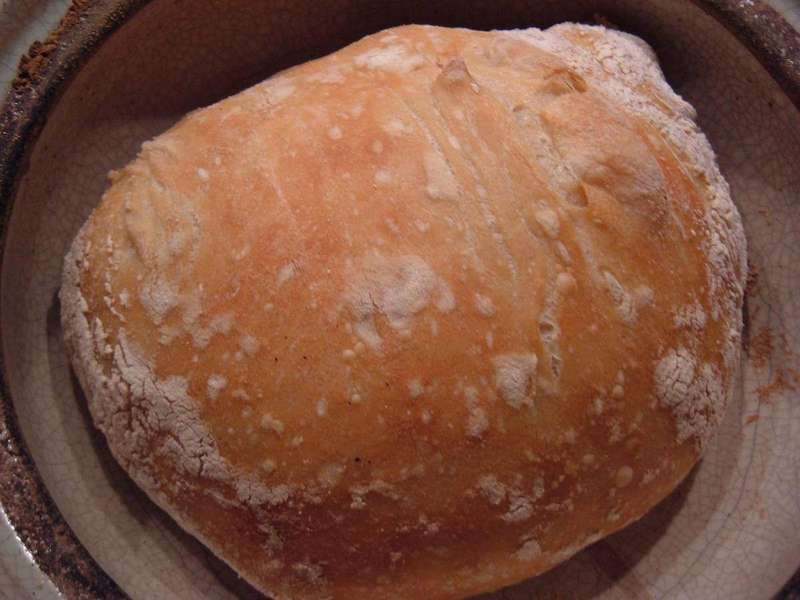
A finished loaf with a golden-brown crust. The crust browns while the crumb stays pale because the surface gets hotter and drier than the interior. Photograph: daisybush/Wikimedia Commons
Image Credits: Wikimedia Commons
Maillard vs caramelization: the difference
People often confuse the Maillard reaction with caramelization, but they are different processes.
Caramelization is the browning of sugar alone. When sugar is heated to high temperatures, it breaks down and reforms into new compounds with a characteristic sweet, nutty flavor. No protein is required, and no amino acids are involved.
The Maillard reaction always needs both partners: amino acids and reducing sugars. That is why a steak browns but a spoonful of heated table sugar caramelizes. Table sugar (sucrose) is not even a reducing sugar until it breaks down, which is one reason pure sugar behaves differently.
The two reactions often happen side by side. Caramelized onions, for example, involve both: the onions' sugars caramelize while their proteins and sugars undergo the Maillard reaction. The flavor is a blend of both processes.
Temperature separates them too. The Maillard reaction gets going around 140 degrees Celsius, while caramelization needs higher heat to really take off. In practice, a hot pan triggers Maillard first, and caramelization joins in as things get hotter.
Frequently asked questions
Is the Maillard reaction the same as caramelization?
No. The Maillard reaction needs both amino acids (protein) and reducing sugars, while caramelization is the breakdown of sugar alone. They often occur together, as in caramelized onions, but the chemistry is different.
Does the Maillard reaction happen at room temperature?
It can, very slowly. The reaction is not strictly heat-dependent, but heat accelerates it enormously. That is why bread left for weeks can darken slightly, while a steak browns in minutes in a hot pan.
Why doesn't boiled food brown?
Because water caps the temperature at 100 degrees Celsius. The Maillard reaction needs roughly 140 degrees or more to proceed quickly, and a wet surface cannot get there. Dry the surface and add heat, and browning begins.
Is browned food unhealthy?
Browning itself is not harmful, and it is one of the main sources of flavor in cooking. The caveat is acrylamide, which can form in starchy foods at high temperatures and is classified as a probable carcinogen. Avoiding heavy charring and not overcooking are sensible precautions.
The bottom line
The Maillard reaction is simply protein plus sugar plus heat, creating browning and flavor. Give food a dry surface and enough heat, past about 140 degrees Celsius, and amino acids and sugars will build hundreds of flavor compounds and the brown color we associate with delicious cooking.
The practical version fits on an index card. Pat food dry, do not crowd the pan, use high heat for searing, and remember that browning needs both protein and sugar. Everything from the perfect steak crust to a bakery loaf follows the same rules Louis Camille Maillard described in 1912.
Tags: maillard reaction, food science, cooking, browning, chemistry
Rive News is the research desk behind this explainer series, covering health, science, and everyday questions with sourced reporting.
Subscribe for one evidence-based explainer in your inbox every morning.
Related stories

Why Does Bread Go Stale Faster in the Refrigerator?
Bread goes stale faster in the fridge because starch recrystallizes fastest near 4°C. Here is the retrogradation science and the right way

Baking soda and baking powder: what's the difference?
Baking soda is pure sodium bicarbonate; baking powder adds two dry acids for double-acting lift. Learn when to use each, plus exact
Onions make you cry: the chemistry and how to stop it
Cutting an onion releases syn-propanethial-S-oxide, a gas that turns to mild acid on your eyes. The chemistry behind the tears