
Why Does Bread Go Stale Faster in the Refrigerator?
Key takeaways
- Bread stales faster in the fridge because starch recrystallization, called retrogradation, runs fastest near 4°C.
- Staling is mostly starch reorganizing, not drying out; even sealed bread firms up on schedule.
- Store bread at room temperature for a few days, or freeze it at -18°C for longer storage.

Image Credits: Wikimedia Commons
Bread staling is the process by which a soft loaf turns firm, dry-feeling, and less elastic over hours and days. Putting the loaf in the refrigerator feels like the right move.
Cold preserves most foods. With bread, the opposite happens: the fridge is the fastest place in the kitchen to make it stale.
This article explains why bread goes stale faster in the refrigerator, including what starch retrogradation is, why fridge temperatures speed it up, what freezing does instead, how to store bread properly, and how to revive a stale loaf.
What starch retrogradation is
Flour is mostly starch, and starch in its natural state is crystalline and highly organized. When you add water and bake, the starch granules swell, burst, and unwind into a disorganized gel.
This is called gelatinization. It is what makes fresh bread soft and pillowy.
That gel is unstable. As soon as the loaf cools, the starch molecules start drifting back toward their ordered, crystalline state. Food scientists call this retrogradation.
As the molecules realign, they squeeze water out of the gel network and lock into a rigid lattice. The crumb stiffens and elasticity fades.
Retrogradation happens in two waves. Linear amylose chains reassociate within hours and cause the first firming.
Branched amylopectin chains recrystallize over days and drive the long-term staling. This is why a loaf keeps getting firmer day after day, not just in the first hours.
Here is the part that surprises people: staling is not mainly drying. BBC Science Focus explains that recrystallization makes bread go hard even in humid conditions. A loaf sealed in a bag, with its water content intact, still firms up on schedule.
The bread still contains water. The water is just bound differently inside a tighter starch structure.
Why the fridge is the worst place for bread
Retrogradation runs fastest at refrigerator temperatures. Starch crystals form fastest near 4°C, because the molecules still have enough energy to move and find each other, but not so much that the new crystals break apart. Most home fridges sit between 1°C and 4°C, which is exactly the peak zone.
Delicious. com. au puts it plainly: the 1 to 4°C range is the danger zone for starch, and bread firms up faster there than at room temperature.
One food-science video channel, citing differential scanning calorimetry measurements, reports that bread at 4°C goes stale roughly six times faster than the same loaf on the counter. Food scientists measure this by melting the starch crystals in stale bread and recording the energy required, which gives a quantitative staling rate.
The effect shows up in controlled studies too. Research on Chinese steamed bread stored at different temperatures, published on PubMed Central, found that bread held at 4°C developed the most orderly starch structures, meaning retrogradation had gone furthest. A separate study on cooked rice in the Journal of Food Science found that rice stored at 3°C retrograded steadily, while rice stored at 36°C showed no measurable retrogradation at all.
Eat it warm or freeze it fast. The fridge is the worst of both worlds.
What freezing does instead
Freezing nearly stops retrogradation. At -18°C, molecular movement slows so much that starch chains can barely migrate and realign.
The steamed-bread study found that storage at -18°C still produced a small amount of recrystallization, but far less, and in a more disordered form. It does not halt the process entirely, but it slows it to a crawl.
This is why bakeries and food scientists agree on the rule: counter for today, freezer for next week, fridge for never. Slice the loaf before freezing so you can pull out what you need. Toast reheats individual slices straight from frozen with no thawing step.
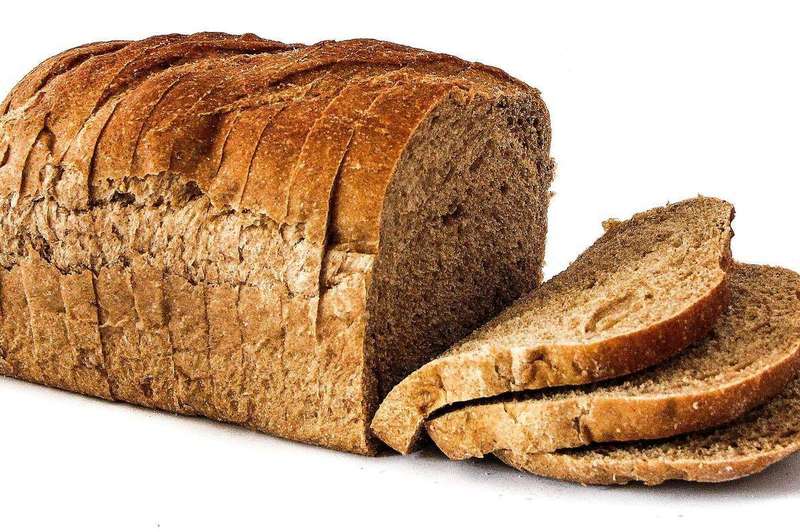
Image Credits: Wikimedia Commons
How to store bread for maximum freshness
For bread you will eat within two to three days, keep it at room temperature. A bread box, a paper bag inside a plastic bag, or a clean cloth bag all work. The goal is to slow moisture loss from the crust without inviting mold.
Plastic keeps the crust soft; paper keeps it crisp. Choose based on the bread.
Enriched breads with fat, sugar, or eggs, like brioche and sandwich loaves, stay soft longer at room temperature because those ingredients slow retrogradation. Lean crusty breads like baguettes stale fastest, often within a day. Buy those in quantities you will finish quickly.
For anything beyond a few days, freeze. Wrap the loaf tightly in plastic wrap, then foil or a freezer bag, squeezing out air.
Label it with the date. Most bread keeps well frozen for up to three months before flavor fades, though texture holds longer.
The refrigerator still has one legitimate use: it slows mold. In hot, humid climates where a loaf molds in two days, the trade-off can be worth it.
You are choosing faster staling to avoid mold. Most people in that situation are better off freezing half the loaf on day one and keeping the rest on the counter.
How to revive stale bread
Staling is partially reversible with heat. Gentle reheating melts the recrystallized starch and temporarily restores softness. That is why toast revives stale bread, and why a stale baguette comes back to life after a few minutes in a hot oven.
For a whole loaf, sprinkle or mist the crust lightly with water and bake at around 160 to 180°C for 10 to 15 minutes. The steam softens the crust while the heat resets the crumb.
Eat it soon after. Once it cools, retrogradation resumes and the loaf firms up again, faster the second time.
Stale bread also has a second career. It makes better French toast, bread pudding, croutons, and breadcrumbs than fresh bread does, because the firmer structure soaks up custard and holds its shape.
Stale is not spoiled. It is just bread in a different state.
Frequently asked questions
Does refrigerating bread prevent mold?
Yes, cold slows mold growth, but it accelerates staling through retrogradation. In humid climates the trade-off can make sense, though freezing half the loaf is usually the better strategy.
Why does bread go stale even in a sealed bag?
Because the main staling mechanism is starch recrystallization, not moisture loss. The starch network reorganizes and squeezes water out of its structure even when no water leaves the bag.
Is frozen bread as good as fresh?
Close, for most purposes. Freezing at -18°C nearly halts retrogradation, and reheating restores softness. Texture suffers slightly after months in the freezer, so use frozen bread within about three months.
What temperature makes bread stale the fastest?
Around 4°C, standard refrigerator temperature. Starch crystals form fastest when molecules can still move but the new crystals stay stable, which peaks in the 0 to 5°C range.
The bottom line
Bread goes stale faster in the refrigerator because cold accelerates starch retrogradation, the recrystallization process that firms the crumb. The peak happens near 4°C, right where your fridge sits. Room temperature slows the process for short-term storage, and freezing at -18°C nearly stops it for the long term.
Keep the counter loaf for the next couple of days, freeze the rest in slices, and revive what goes stale with heat. The fridge is for leftovers, not loaves.
---
About the author: Rive News is the research desk behind these explainers, covering practical questions with verified facts and named sources.
Related stories
- How Many Liters Backpack for a 2-Week Carry-On Trip
- Why Do Knees Hurt When Squatting but Not Running?
- When Do Babies Start Sleeping Through the Night by Month?
- Why Does My Dog Stare at Me While I Eat?
Subscribe for one practical explainer like this in your inbox every morning.
Rive News follows a corrections policy: factual errors are fixed promptly and noted with an update timestamp.
Related stories

Baking soda and baking powder: what's the difference?
Baking soda is pure sodium bicarbonate; baking powder adds two dry acids for double-acting lift. Learn when to use each, plus exact

What Is the Maillard Reaction in Simple Terms?
The Maillard reaction is the browning chemistry between amino acids and sugars above 140 C that creates the crust, color, and rich flavor
Onions make you cry: the chemistry and how to stop it
Cutting an onion releases syn-propanethial-S-oxide, a gas that turns to mild acid on your eyes. The chemistry behind the tears