
Why Does My Dog Stare at Me While I Eat?
Key takeaways
- Dogs stare during meals mostly because staring has earned them food before. It is learned behavior.
- A 2015 Science study found mutual gaze raises oxytocin in both dogs and owners. This deepens the bond.
- Inconsistent rewards make the staring stronger. The fix starts with never feeding from the table.

Image Credits: Wikimedia Commons
You sit down with dinner. Before the first bite, the eyes are on you.
Unblinking, silent, and weirdly effective. It feels personal, but it is mostly practical. Your dog has learned that the person with the food is worth watching. And watching sometimes pays.
That stare runs on two engines. One is learning history.
The other is chemistry. Both are worth understanding before you decide what to do about it.
This article explains why your dog stares at you while you eat: the reinforcement history behind begging eyes, the oxytocin bonding science, breed differences, and what to do about it.
The short answer: it worked before
Dogs are opportunistic feeders. If food exists, trying for it is a reasonable strategy.
You control every meal, every treat, and every dropped crumb. So all attention flows to you at mealtimes. The stare is a polite, low-energy bid for a share.
Erin Askeland is an animal health and behavioral expert at Camp Bow Wow. She told Adopt-a-Pet the mechanism plainly: dogs learn to stare and beg based on how their owner responds. If the behavior gets food, they repeat it. That is positive reinforcement doing exactly what textbooks say it does.
The learning often happens by accident. A puppy looks hopeful. Someone laughs and tosses a fry. A dog sits quietly through one dinner. A guest sneaks a bite of chicken.
The dog does not need a payoff every time. It needs one often enough to keep the habit alive.
This is why the behavior feels so hard to ignore. Humans are wired to respond to eye contact. Your dog is using a built-in attention override. It works on almost everyone who has shared a meal with a dog.
Reinforcement history in action
Behavioral research backs the owner's intuition. A 2011 study reported by ScienceDaily found that dogs and wolves can beg successfully by approaching an attentive human. Home dogs, with more daily exposure to people, were more sensitive to cues of an attentive human. The researchers concluded that dogs' ability to follow human actions comes from two things. They treat humans as social companions. And conditioning teaches them to watch human limbs and actions, because watching has been rewarded.
A 2020 review in Animal Cognition pushed the point further. In studies of the "impossible task," dogs look back at humans when a problem cannot be solved. Looking duration tracked reinforcement history. Older pet dogs, who had longer experience linking humans with food, looked at humans longer.
Dogs trained in activities that reward looking at the handler looked longer than untrained dogs. The gaze is not just instinct. It is a trained skill. Every household trains it whether they mean to or not.
The cruel twist is that inconsistency strengthens the habit. If you sometimes share food and sometimes do not, the dog tries harder and longer.
Variable rewards build the most persistent behaviors. That is the same principle behind slot machines. It is why "just this once" is the most expensive phrase in dog training.
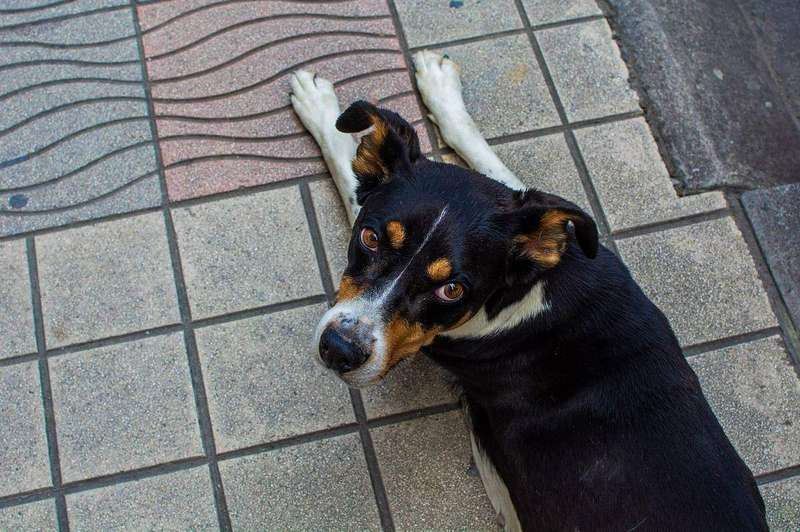
Image Credits: Wikimedia Commons
The oxytocin gaze loop
There is a second layer, and it is genuinely moving. In 2015, Miho Nagasawa and colleagues at Azabu University published a study in Science. They called it the oxytocin-gaze positive loop.
Thirty dog-owner pairs spent 30 minutes interacting in a room. Researchers timed how long each dog gazed at its owner. Urine samples came from both species before and after.
Owners of long-gazing dogs showed a clear rise in urinary oxytocin after the session. The dogs' oxytocin rose too. Short-gaze pairs showed much less change.
In a second experiment, dogs given nasal oxytocin gazed at their owners longer. The owners' oxytocin rose in turn. The same loop did not appear in hand-raised wolves tested with their caregivers.
Oxytocin is the hormone central to parent-infant bonding. The finding suggests dogs co-opted the human attachment system during domestication. The gaze triggers the chemistry, and the chemistry rewards the gaze.
Later commentary added nuance. The effect depends on sex, breed, prior experience, and context. But the core result has held up. It is one of the most cited findings in human-animal bond research.
So when your dog stares at you over dinner, two things are true at once. The dog wants your food. And the dog is bonded to you through the very act of looking. The begging and the affection share the same channel.
Breed and personality differences
Not every dog stares with equal intensity. Askeland points to Labradors, Beagles, Bulldogs, and Corgis as breeds that fixate more on food. Herding breeds like Border Collies and Australian Shepherds use strong eye contact as part of their working behavior. That intensity spills into mealtimes.
Personality matters too. A bold, confident dog parks itself directly in your line of sight. A timid dog hovers at the edge of the room, hoping for a dropped morsel.
Age plays a role: the Animal Cognition review found that older dogs with longer reinforcement histories look at humans longer than younger ones. Your dog's stare comes from its breed tendencies, its temperament, and every meal it has ever watched you eat.
None of this means the behavior is unchangeable. It means some dogs need more consistent training than others.
Should you share? What to do instead
Sharing table food is a bad deal on two fronts. It trains the staring you are trying to stop. And much human food is wrong for dogs.
Rich, fatty, salty, or seasoned food can cause stomach upset. Some common foods are toxic. The kitchen is not a second dinner bowl.
The fix is consistency from everyone in the household. Decide the rule once: no food from the table, ever.
Every exception resets the training. Variable rewards are the strongest kind. This is the hardest part. It needs guests and family members to comply too.
Give the dog a better job during meals. Feed the dog its own dinner at the same time you eat yours. Then the dog is busy.
A stuffed food puzzle or long-lasting chew in its bed turns mealtime into the dog's own project. Reward calm lying on a mat during human meals. The mat becomes the new habit that replaces the stare.
If the dog already stares, do not scold. Just give it nothing, every time. Redirect to the mat or the puzzle. Behaviors that earn nothing eventually fade.
Expect an extinction burst first: the staring will get more intense for a few days before it drops. That escalation is normal and temporary.
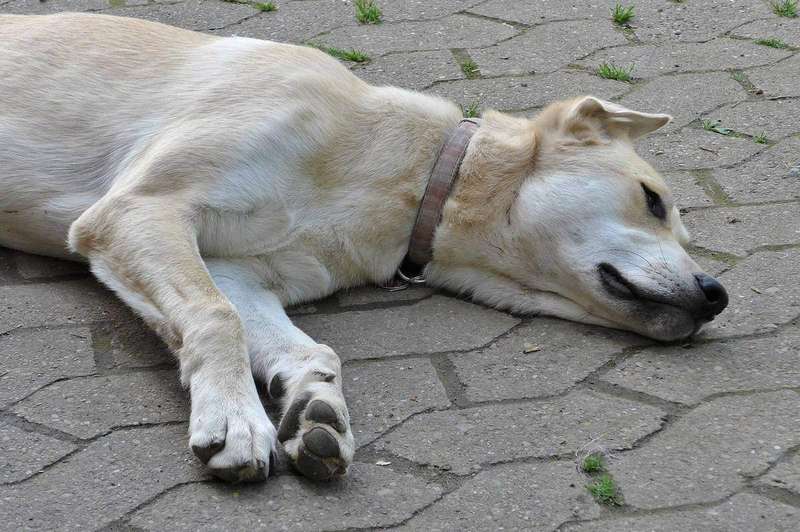
Image Credits: Wikimedia Commons
Frequently asked questions
Is it normal for dogs to stare while you eat?
Yes, completely normal. It combines learned begging behavior with the dog's natural eye contact for communication and bonding. Almost every pet dog does it to some degree.
Does my dog stare because it is hungry?
Usually not. Most staring dogs are well fed. They stare because food is present and staring has paid off before. True hunger looks different: restlessness, lip licking, and checking the food bowl.
Why does my dog stare at me even when I am not eating?
Eye contact is multipurpose. Outside meals it can mean affection, a request for a walk or play, a need to go out, or simply monitoring your behavior for cues. Context and body language tell you which.
Can I train my dog to stop staring at meals?
Yes, with consistency. Never feed from the table. Give the dog its own food puzzle during your meals. Reward settling on a mat. Expect the behavior to intensify briefly before it fades.
The bottom line
Your dog stares at you while you eat because the strategy works. Or it worked often enough to be worth trying. Behind the begging sits a real bond: mutual gaze raises oxytocin in both species. It is a loop that evolved with domestication. You do not need to punish the stare.
Just stop paying it. Give the dog its own mealtime job. Let consistency do the training. The eyes will find something else to watch.
---
About the author: Rive News is the research desk behind these explainers, covering practical questions with verified facts and named sources.
Related stories
- How Many Liters Backpack for a 2-Week Carry-On Trip
- Why Does Bread Go Stale Faster in the Refrigerator?
- Why Do Knees Hurt When Squatting but Not Running?
- When Do Babies Start Sleeping Through the Night by Month?
Subscribe for one practical explainer like this in your inbox every morning.
Rive News follows a corrections policy: factual errors are fixed promptly and noted with an update timestamp.
Related stories

Why Does My Dog Eat Grass and Vomit?
A UC Davis study of 1,571 owners found grass eating is normal dog behavior, not self-medication: only 10% were ill first. What the science

Foods toxic to dogs: the list, with reasons
Chocolate, xylitol, grapes, onions: common foods can harm dogs. Learn what makes each one toxic, the warning signs, and what to do if your
How to introduce a new cat to your resident cat: a slow method
Introducing a new cat takes weeks, not hours: a base camp, scent swapping, and gated hellos. The step-by-step method shelters