
Why do carrots fork into weird shapes underground?
Key takeaways
- A carrot's taproot bends, splits, or stalls when it hits rocks, compaction, or hardpan, producing forks and twists.
- Excess nitrogen, irregular watering, crowding, and root-knot nematodes create similarly strange shapes.
- Deep, loose, sandy-loam beds and steady moisture are the reliable route to straight roots.
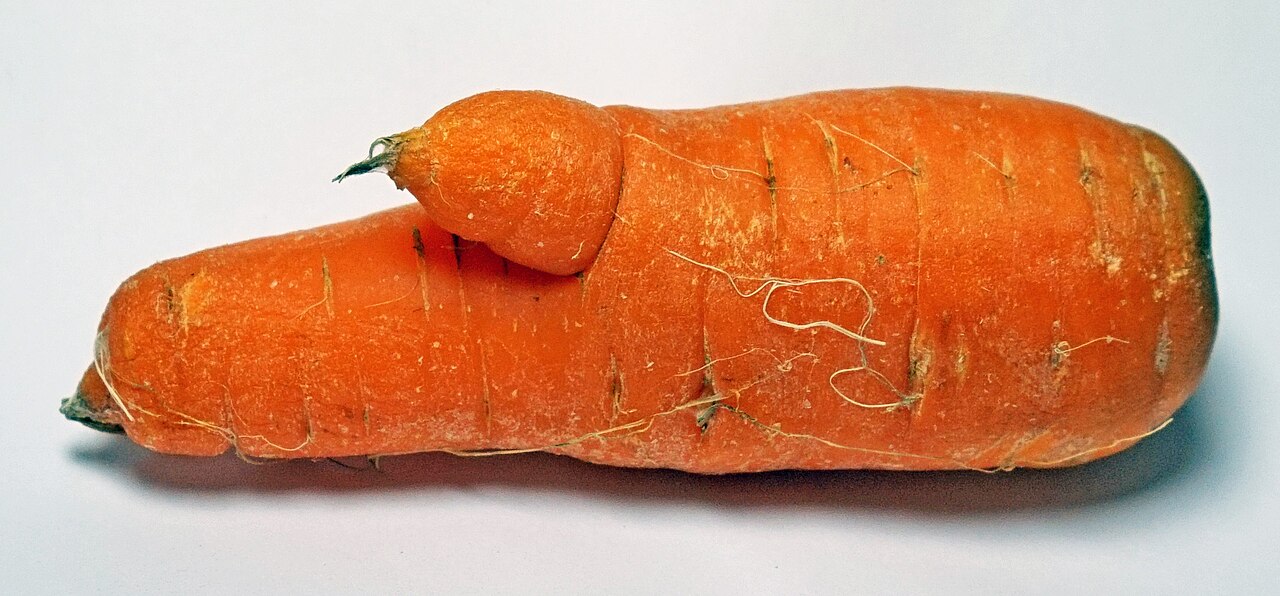
A deformed carrot with multiple prongs. Forking like this usually traces back to something the taproot hit on its way down. Photograph: Tiia Monto
Image Credits: Wikimedia Commons / Tiia Monto, Kulmalukko, Fructibus
Why do carrots fork into weird shapes?
The answer starts with what a carrot is. A carrot is a taproot, a single main root that grows straight down from the seed. When something interferes with that downward push, the root bends, splits, or stalls, and you pull a forked, twisted, or stunted carrot instead.
This article explains why carrots fork into weird shapes underground, covering soil obstructions, nutrient and water problems, pests and disease, how to grow straighter roots, and whether the odd ones are still worth eating.
The taproot: what a carrot is trying to do
A carrot grows from a single main root called a taproot, which begins forming almost immediately after germination. The growing tip is the engine of downward growth. Anything that blocks, injures, or redirects that tip can cause the root to branch, shorten, or coil on itself, as My Productive Backyard explains in its carrot deformity guide.
You never see any of this happening underground. The odd shape often appears only at harvest, when the carrot comes up looking nothing like the seed packet photo.
Short, fat, twisty, curvy, forked: gardeners have documented all of them. The misshapen roots were affected by everything from heavy clay to rock obstructions, as Garden Betty documented with photo examples.
Why do carrots fork into weird shapes? Soil obstructions come first
When carrots come up gnarled and branched, the most logical first suspect is what the root ran into on its way down. University of Minnesota Extension's carrot diagnosis guide identifies dense or compacted soil as a primary cause of forked and misshapen roots, and UC IPM's guidance on dense or rocky soil echoes that finding for home landscapes, according to Complete Gardening's review of extension guidance.
Picture a carrot root pushing downward like a tiny drill. A taproot that meets a hardpan layer, a buried rock, a clod of compacted clay, or an old plant root has nowhere to go but sideways, and that redirection shows up at harvest as a fork or a curl.
Carrots are not built to push through resistance the way some other roots are. When the growing tip meets something it cannot penetrate or move, the root deflects. A single embedded stone is the most literal version of this problem.
The growing tip contacts the stone, splits around it, and you end up with two or more prongs instead of one straight root. One stone, one forked carrot.
The pattern of the damage can tell you what caused it. Forking that varies from plant to plant, with some roots fairly normal and others branched, often suggests localized physical obstructions or uneven soil conditions. Uniform stubbing across the whole row, where nearly every root is short and blunt at the same depth, is more consistent with a hard layer or compacted zone at a specific point in the profile.
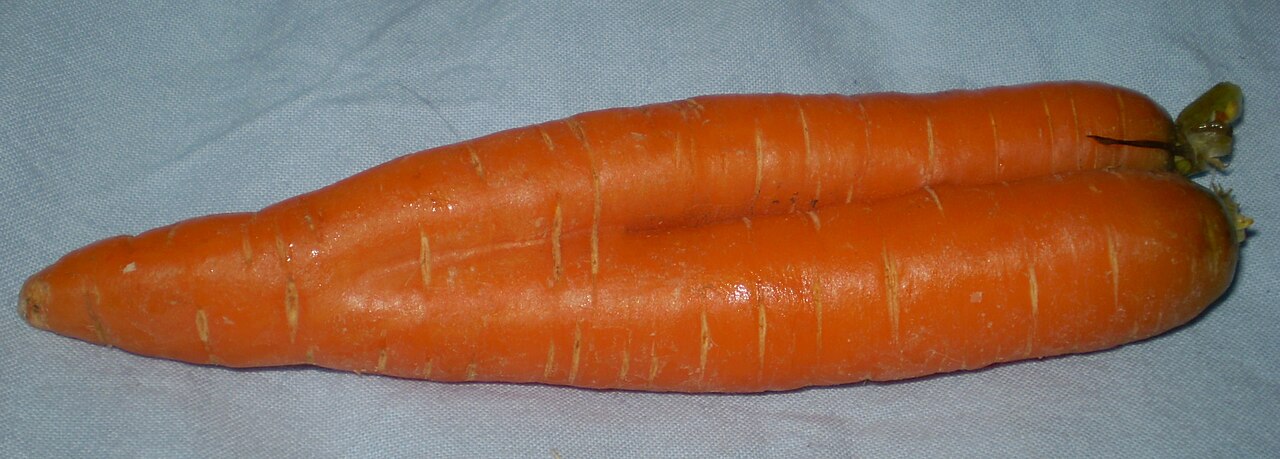
A carrot that split into two legs. When the growing tip cannot pass an obstacle, it splits around it. Photograph: Kulmalukko
Nitrogen, water, and crowding
Soil is not the only explanation. Iowa State University Extension notes that irregular moisture, overcrowding, excessive nitrogen, nematode pressure, and disease can each produce roots that look just as irregular, per Complete Gardening's summary.
Excess nitrogen is a common self-inflicted cause. Too much nitrogen encourages leafy growth at the expense of root development, notes the University of Minnesota Extension carrot guide.
The symptoms of overfertilizing include hairy roots, forked deformed growth, and excessive foliage up top with stubby roots below. Fresh manure is also on Minnesota Extension's list of forking causes, since it can burn or disrupt the young taproot.
Water swings leave their own signature. Splits running down the side of an otherwise normal-looking root point more strongly to irregular moisture, especially a heavy rain or deep irrigation that follows a dry stretch, according to Oregon State University's Ask Extension resource.
The root takes up water fast and grows in a spurt it was not prepared for. Watering in the morning and keeping moisture steady helps roots grow evenly.
Crowding matters too. Seed sown too thickly forces roots to compete, and thinned seedlings can disturb the neighbors' taproots if you yank them carelessly. Thin carrots by snipping extras at the soil line rather than pulling them.
Pests and disease: nematodes, Pythium, and galls
Living causes are on the list as well. UC IPM notes that Pythium, a soil organism, can damage a carrot taproot within two weeks of germination, and the root may branch afterward, according to My Productive Backyard. That is a fast strike: the damage happens long before you notice anything above ground.
Root-knot nematodes are another real possibility. These microscopic roundworms feed on plant roots and cause telltale knotted roots on vegetable crops.
If they attack early in the carrot's life, the main root forks, sometimes in several directions. As the nematodes develop, they keep damaging feeder roots, stunting the carrot's growth above and below ground.
Carrots infected with nematodes usually end up distorted with lots of legs, hairy roots, irregular bumps, and thickened skin, as Garden Betty describes. NC State Extension treats root-knot nematodes as a real problem in North Carolina home vegetable gardens, with carrots among the susceptible crops. In Florida, warm sandy soils let nematode populations build year-round, and UF/IFAS nematode management guidance identifies them as a significant cause of carrot forking and distortion in the region.
The diagnostic clue is texture. Firm, beadlike galls or nubs on the root surface are the most recognizable sign of root-knot nematode damage.
Minnesota Extension's hairy-root diagnostic page lists excess nitrogen, overwatering, aster yellows, and root-knot nematodes among the causes of excessive fine root development. If you suspect nematodes, the reliable move is a soil or root sample through your local extension office before treating anything.
How to grow straight carrots
The fixes follow directly from the causes:
Build a deep, loose bed. Carrots do best in deep, loose, well-drained soil, per UC IPM's cultural guidance. Sandy loam is ideal. Use a broadfork or shovel to fluff the bed well below the depth you expect the roots to reach, and pick out stones, sticks, and clods as you find them. Healthy soil biology from earthworms also keeps the profile open.
Go easy on nitrogen. Skip fresh manure in the carrot bed and avoid heavy nitrogen fertilizers. A bed that grew hungry feeders the previous season is often perfect. Remember that carrots are typically grown as annuals, so timing your sowing for the cool shoulder seasons also reduces stress.
Keep water steady. Even moisture prevents both splitting and the crusting that blocks emergence. Mulch the rows lightly once seedlings are up, and water deeply rather than in shallow bursts.
Give them space. Sow thinly and thin early by snipping, not pulling. Two to three inches between plants is a workable target for most varieties.
Pick the right variety for heavy soil. If your soil will never be sandy loam, choose short, round varieties like Parisian types that do not need to push deep. They shrug off the conditions that mangle long Nantes types.
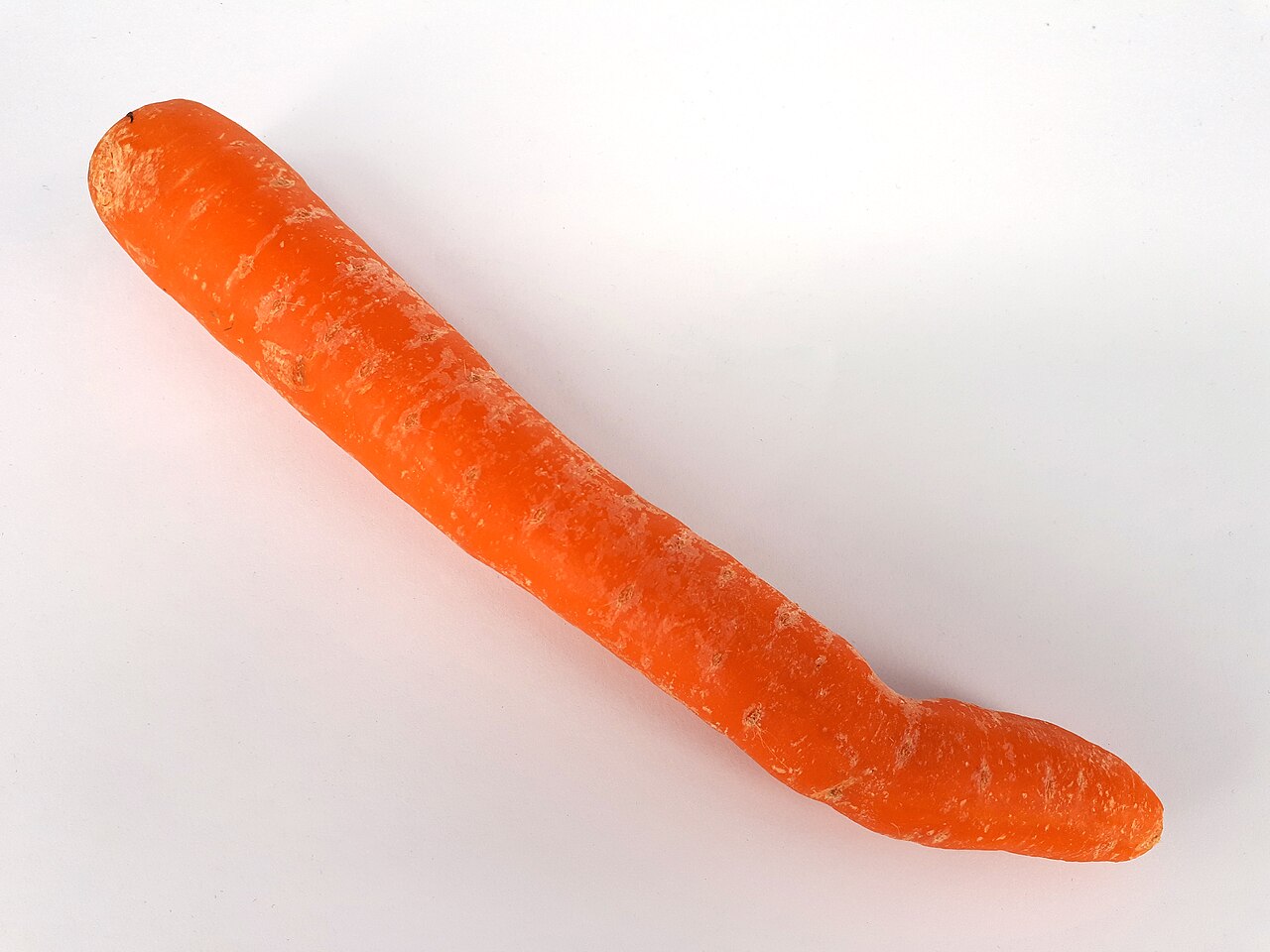
A bent carrot that curved around an underground obstacle. The root dodges what it cannot push through. Photograph: Fructibus
Are forked carrots safe to eat?
Yes. A forked or twisted carrot is perfectly edible, just odd-looking, as Epic Gardening notes.
The shape is a cosmetic issue, not a safety one. Scrub the crevices well, since soil hides in the folds, and cook them like any other carrot.
The one exception is rot or disease: soft spots, lesions, or off smells mean the root should go to the compost. Misshapen but firm roots are fine. Many gardeners find the ugly ones taste identical to the pretty ones.
Frequently asked questions
Why are my carrots short and forked instead of long?
The most common cause is soil the taproot could not push through: compaction, rocks, or a hardpan layer. University of Minnesota Extension lists dense soil as a primary cause of forked roots. Excess nitrogen, nematodes, and root injury during germination can produce the same look.
Do forked carrots mean I have nematodes?
Not necessarily. Forking alone usually points to physical obstruction or compaction.
Nematodes are more likely when you also see small beadlike galls, excessive hairiness, stunted tops, and patchy poor growth. Confirm with a soil sample through your extension office before treating.
Can you eat deformed carrots?
Yes, if they are firm and smell normal. Forked, bent, and split carrots are cosmetic defects.
Scrub them well and cook as usual. Compost any that are soft, slimy, or foul-smelling.
How deep should I loosen soil for carrots?
Loosen the bed deeper than the variety's expected root length: at least 10 to 12 inches for long types. UC IPM recommends fluffing the bed well below the depth you expect roots to reach, and removing stones and debris as you go.
The bottom line
Carrots fork into weird shapes when the taproot's downward journey is interrupted. Most of the time the culprit is physical: rocks, clods, or compacted soil that force the root to bend or split around them.
Nitrogen overload, water swings, crowding, nematodes, and Pythium round out the list. Give carrots a deep, loose, stone-free bed with steady moisture, and the harvest will look a lot more like the seed packet.
Latest in Gardening
- How earthworms improve soil
- Why you should water plants in the morning
- The difference between annual and perennial plants
- Why plants wilt in heat even when watered
Subscribe to the Rive News newsletter for one research-backed explainer every morning.
Related stories
What Is Companion Planting and Does It Work?
Marigolds work as a nematode cover crop, but the basil flavor claim failed repeated tests. An honest evidence review of what companion
Determinate vs. indeterminate tomatoes: growth, pruning, and harvest differences
Determinate tomatoes grow to a set size and ripen all at once, while indeterminate types vine all season. That one difference shapes
How to improve clay soil for gardening
Gypsum will not fix ordinary clay soil, say extension experts. What actually works: 2 to 3 inches of compost, mulch, better drainage,