
Why does your jaw ache after chewing gum too long?
Key takeaways
- Chewing gum for long stretches overworks the masseter and temporalis muscles, causing fatigue and soreness like any overused muscle.
- Research shows hard gum chewed for 40 minutes measurably increases jaw muscle pain and fatigue in healthy people.
- Chewing sessions longer than about three hours a day are classified as intense and linked to joint noises and muscle pain.
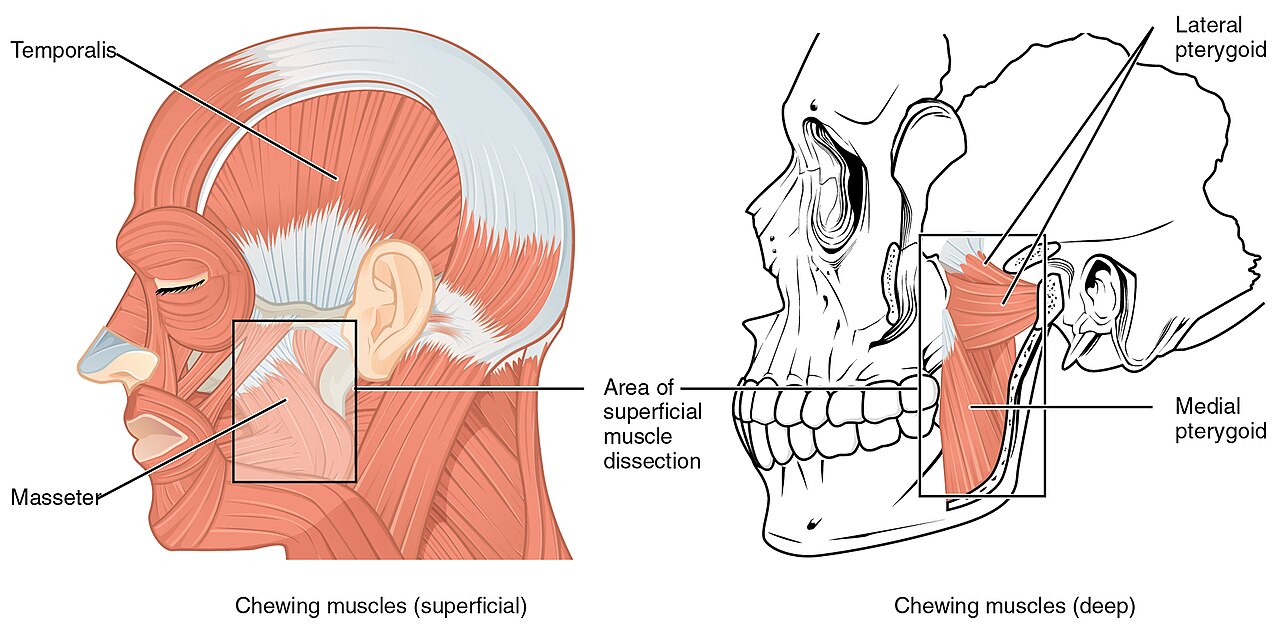
The muscles that move the lower jaw. The masseter and temporalis do most of the work when you chew gum. Image: OpenStax
Image Credits: Wikimedia Commons / OpenStax, Kevjonesin, Asaf Cygelberg
This article is an educational explainer, not medical advice. If jaw pain persists or limits how you open your mouth, see a dentist or doctor.
Why does your jaw ache after chewing gum too long?
The answer is overwork. That dull ache along your jawline after a long gum session is your chewing muscles complaining. Gum gives them a workout with no finish line: unlike a meal, which has varied textures and natural pauses, a piece of gum demands the same repetitive motion for as long as you keep chewing.
This article explains why your jaw aches after chewing gum too long, which muscles are involved, what the research actually shows, when the habit crosses into harmful territory, and how to chew without paying for it later.
The muscles doing the work
Chewing is orchestrated by a network of muscles, and the two heavy lifters are the masseter and the temporalis. The masseter is one of the strongest muscles in the body by weight. It closes the jaw and generates the force needed to grind food.
The temporalis, fanning across the side of the head, assists in closing and positioning the jaw. Smaller muscles, the pterygoids and the buccinator, help with side-to-side and fine movements.
The temporomandibular joint, or TMJ, is the sliding hinge that connects your jawbone to your skull, just in front of each ear. It is one of the body's most complex joints, capable of both rotation and gliding.
When you chew gum, you put this joint through thousands of extra repetitions. The human jaw is designed for mastication, but it is not necessarily designed for the marathon sessions gum chewers put it through, as iO Dentistry explains.
Why does your jaw ache after chewing gum too long? The overuse mechanism
The core mechanism is overuse. When you chew gum, your jaw muscles contract repeatedly to keep the gum moving between your teeth. Chew for too long and these muscles become overworked, similar to how your leg muscles feel sore after running a long distance, as the Dentist Peshawar guide puts it.
Three things make gum different from a meal. First, there is no natural endpoint: a meal ends when the food is gone, but gum can be chewed indefinitely. Second, the motion is highly repetitive with little variation in texture or force.
Third, the effort earns no nutritional reward, so there is no satiety signal telling you to stop. Sustained effort can lead to muscle fatigue, micro-inflammation, and reduced blood flow, all pathways to pain and stiffness.
According to the American Dental Association, cited by iO Dentistry, excessive chewing can lead to muscle fatigue and spasms. Just as overtraining a muscle at the gym without rest can cause a strain, overworking the masseter and temporalis can contribute to temporomandibular disorders.
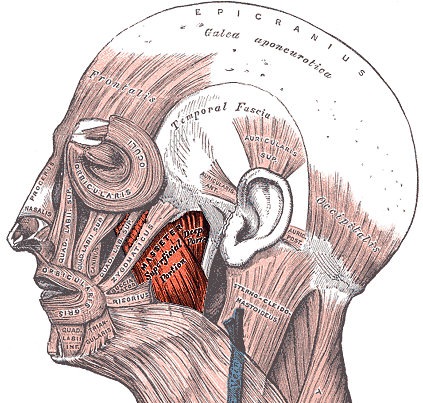
The masseter muscle highlighted. Overuse of this muscle is the most common cause of gum-related jaw ache. Image: Kevjonesin
What the research shows
The evidence is more nuanced than the scare pages suggest. A controlled study on prolonged gum chewing asked 15 women without temporomandibular disorders to perform chewing tasks in three separate sessions: chewing a very hard gum, chewing a soft gum, and empty chewing with no bolus. Each session involved 40 minutes of unilateral chewing at a constant rate of 80 cycles per minute, with pain, fatigue, and pressure tenderness of the masseter and anterior temporalis muscles measured throughout.
The results: perceived muscle pain and fatigue rose significantly only during the hard-gum chewing. After 10 minutes of recovery, the scores had fallen almost back to baseline.
No significant changes were found in pressure pain thresholds after either hard or soft gum chewing. The finding, published on ResearchGate, is reassuring for healthy jaws: the muscles recover quickly from prolonged chewing in people without existing jaw disorders.
The picture changes with chronic heavy use. Studies of chewing habits define intense gum chewing as more than 3 hours per day.
At that level, researchers report a strong association with joint noises, muscle soreness or pain at rest (especially in the masseter), and muscle hypertrophy, according to the ResearchGate literature review. Repetitive chewing may expose the chewing system to sustained low-load mechanical stress, potentially contributing to myofascial pain, limited jaw mobility, joint sounds, or tension headaches in people with predisposing factors such as stress or a misaligned bite.
Observational data points the same way. Teenagers who chewed gum more than three times a day were significantly more likely to report jaw fatigue and clicking sounds, according to one study cited by Oreate AI. And the background rate of jaw trouble is not trivial: temporomandibular disorders affect an estimated 20 to 30 percent of adults, per the Pakistan Oral and Dental Journal, cited by Moolchand Healthcare's jaw pain guide.
One caveat worth noting: another study found no statistically significant link between how much gum people chewed and the rate of diagnosed temporomandibular disorders, suggesting stress and other oral habits play a large role. Gum can stretch and stress the jaw muscles and joints, but the science is not conclusive that it directly causes jaw disorders in everyone.
When the habit becomes a problem
Watch for these warning signs after chewing:
- Clicking or popping near the jaw joint
- Headaches that follow long chewing sessions
- Jaw stiffness or soreness that lingers into the next day
- Difficulty opening your mouth wide
People with existing TMJ sensitivity, teeth grinding (bruxism), or a misaligned bite are more vulnerable. Bruxism already keeps the jaw muscles tense, and gum adds load on top of it.
Firmer or older gum requires more force and puts extra load on the joint. Chewing mostly on one side can also create imbalance, since the joint on the working side takes more of the strain.
How to chew gum without the ache
You do not have to quit gum. You just have to treat it like exercise: dose it, vary it, and rest.
Cap the session. Keep chewing to about 15 to 20 minutes at a time, then give your jaw a break. The 3-hour-a-day threshold is where researchers start seeing real associations with pain and joint noises, so stay far below it.
Choose softer gum. The controlled study found that only hard gum produced significant pain and fatigue. Softer gum is gentler on the muscles and the joint.
Chew on both sides. Alternate sides to spread the load evenly across both joints. One-sided chewing is a common and avoidable source of imbalance.
Do not chew through pain. Soreness is a signal, not a challenge. Rest the jaw, apply gentle warmth, and eat soft foods for a day. Most overuse soreness fades within a day or two once the load drops.
Watch the add-ons. Clenching during the day and grinding at night compound the load from gum. If you wake with a sore jaw, the gum may be only part of the story. Stress management and a night guard, discussed with your dentist, address the bigger drivers.
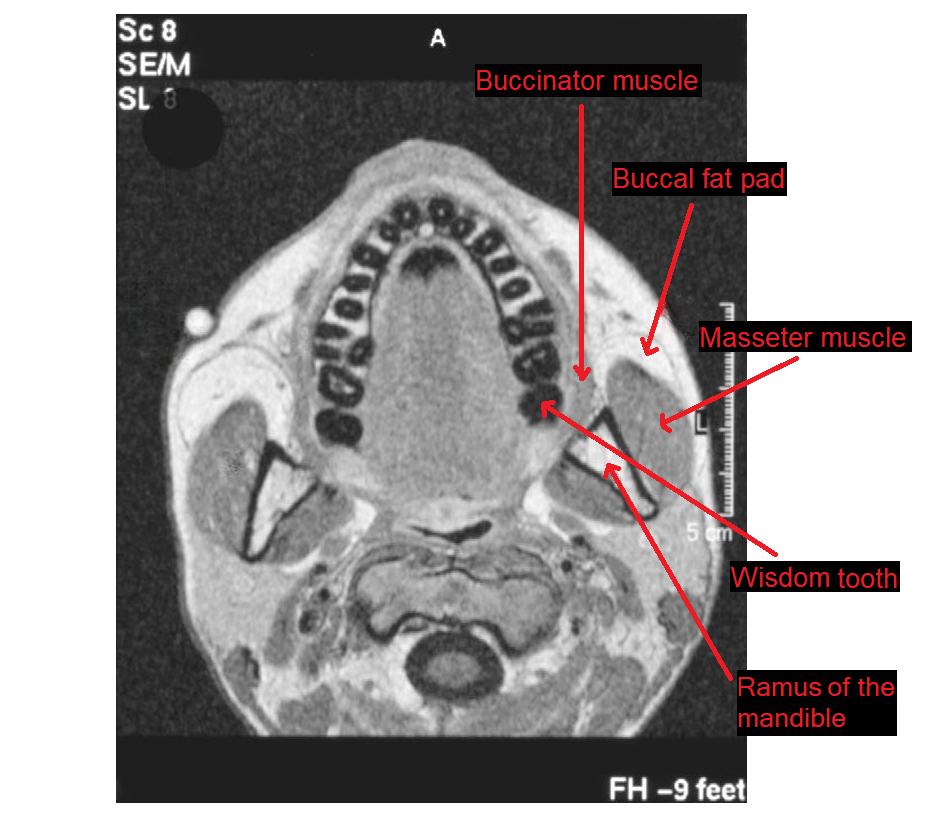
An MRI view of the masseter muscle and surrounding structures. Chronic overuse can enlarge this muscle over time. Image: Asaf Cygelberg
Frequently asked questions
How long is too long to chew gum?
Researchers classify more than 3 hours a day as intense chewing, a level strongly associated with joint noises and masseter pain. For comfort, most dental guidance suggests keeping sessions to about 15 to 20 minutes. Hard gum at 40 minutes measurably increased pain and fatigue in a controlled study, though healthy subjects recovered within 10 minutes.
Can chewing gum cause TMJ disorder?
The evidence is mixed. Excessive or prolonged chewing may contribute to muscle fatigue, pain, and TMJ symptoms, especially in people already sensitive to jaw strain, according to iO Dentistry.
One study found no significant link between chewing amount and diagnosed TMD rates, pointing to stress and other habits as bigger factors. Occasional gum chewing is unlikely to harm most healthy people.
Why does my jaw click after chewing gum?
Clicking usually involves the small cartilage disc inside the jaw joint slipping and snapping back into place. Heavy chewing can irritate the joint and make existing disc movement noisier. If clicking comes with pain or limited opening, have it assessed rather than chewing through it.
Should I stop chewing gum if my jaw hurts?
Take a break until the soreness resolves, then resume with shorter sessions and softer gum. If pain persists for more than a couple of weeks, recurs every time you chew, or limits how wide you can open your mouth, see a dentist. Most overuse cases improve within weeks once the load drops.
The bottom line
Your jaw aches after chewing gum too long because the masseter and temporalis muscles fatigue under sustained, repetitive load, much like any muscle worked past its comfort zone. Research shows healthy jaws bounce back quickly from a single long session, but daily marathons of three hours or more are linked to joint noises and persistent muscle pain.
Chew softer gum, keep sessions short, alternate sides, and rest when it aches. And if the ache keeps coming back, let a dentist take a look.
Latest in Health
- What happens to your body when you skip breakfast
- Why your stomach growls when you are hungry
- Why your fingers wrinkle in water like prunes
- Why your teeth feel fuzzy in the morning
Subscribe to the Rive News newsletter for one research-backed explainer every morning.
Related stories
ADHD linked to fourfold dementia risk in Pitt study of 187,000 adults
Adults with ADHD face four times the risk of dementia, a University of Pittsburgh study of 187,000 adults published in JAMA Psychiatry

Why Do Athletes Get Cramps Despite Drinking Water?
Muscle cramps strike even well-hydrated athletes because sweat drains electrolytes that plain water cannot replace. Here is why water alone

Do bananas actually prevent muscle cramps?
A medium banana has 422 mg of potassium, but the evidence says it cannot stop cramps. Here is what the research shows, and what actually