
Why do fingers wrinkle in water like prunes?
Key takeaways
- Pruney fingers are caused by blood vessels constricting under the skin, not by the skin swelling with absorbed water.
- The response is run by the autonomic nervous system, which is why nerve damage stops fingers from wrinkling.
- Studies suggest the wrinkles improve grip on wet objects, though researchers still debate the exact purpose.
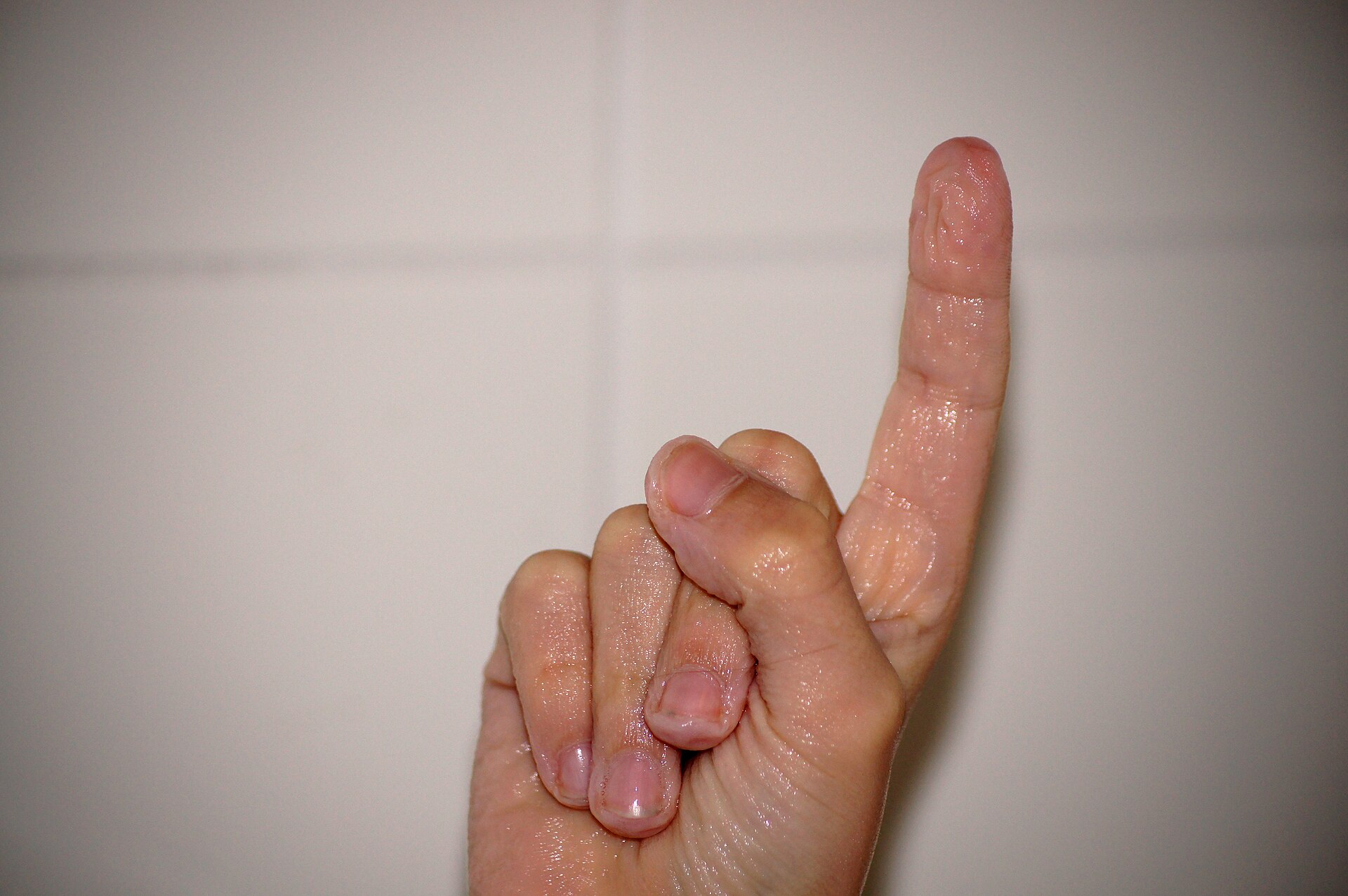
Soak in a bath for a while and your fingertips turn into tiny prunes. The folk explanation is simple: the skin absorbs water and swells. That explanation is wrong, and scientists have known it since the 1930s.
Wrinkling is not passive swelling. It is an active command from your nervous system, and it only happens in your fingers and toes.
This article explains what actually causes water wrinkling, the nerve pathway behind it, why evolution may have kept it, what the newest research found, and when wrinkling that seems off is worth mentioning to a doctor. This is general information, not medical advice.
What actually causes the wrinkles
Here is the sequence, as researchers currently understand it. When your hands stay in water for several minutes, water enters the skin through sweat ducts. That extra water dilutes the salt concentration in the surrounding tissue.
Nerve fibers detect the change and signal the brain.
The brain responds through the autonomic nervous system, the same involuntary system that controls breathing, heart rate, and sweating. The same system drives other everyday reactions, from a runny nose in cold air to goosebumps when you step into the cold. It orders the small blood vessels under the skin of the fingers and toes to constrict.
Less blood means less volume beneath the skin. The skin's surface area cannot shrink to match, so it puckers into wrinkles, like a grape drying into a raisin.
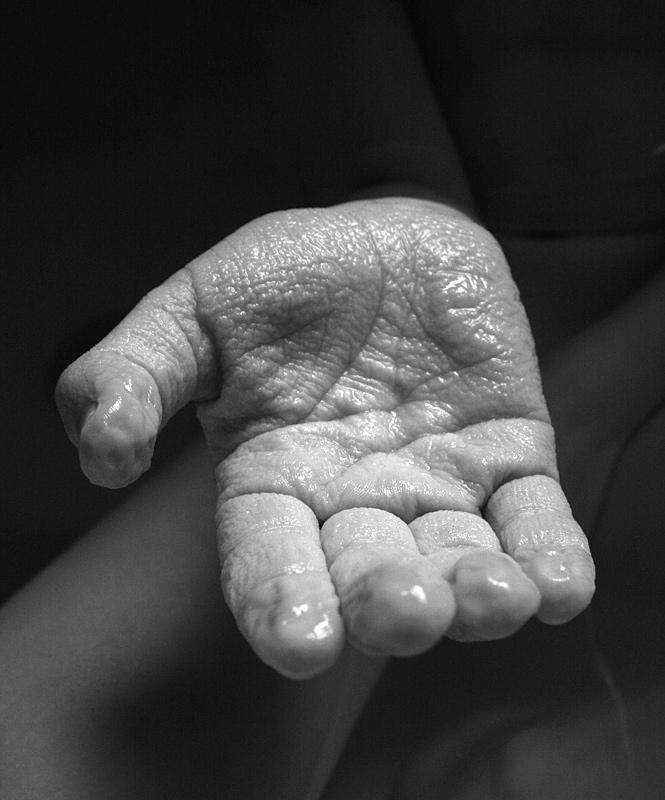
The paleness of pruney fingertips is part of the same event. Constricting the vessels pulls blood away from the surface, which is why soaked finger pads go pale. The process reverses within minutes of drying off, as vessels relax and volume returns.
The nerve evidence
The strongest proof that wrinkling is nerve-driven comes from people with nerve damage. Researchers have known since the 1930s that fingers with damaged nerves do not wrinkle, no matter how long they soak. If wrinkling were just water soaking into skin, deadened fingers would wrinkle like any others.
They do not.
In 2003, neurologists Einar Wilder-Smith and Adeline Chow measured blood flow in volunteers' fingers as they soaked them. They found that blood flow dropped right as the wrinkles formed, confirming the vasoconstriction story in real time.
A 2025 study by biomedical engineer Guy German at Binghamton University added a striking detail. German and his graduate student had three volunteers submerge their right hands in water at 40 degrees Celsius for 30 minutes, photographed the wrinkled finger pads, and repeated the process at least a day later. Overlaying the images showed that the wrinkle patterns matched almost perfectly between the two sessions.
The folds follow the paths of the blood vessels beneath the skin, which stay in place. German has suggested that because the patterns are so stable, they might one day help with biometric or forensic identification, similar to fingerprints.
Why would evolution keep this?
If wrinkling is an active, energy-spending response, it probably does something useful. In 2011, evolutionary neurobiologist Mark Changizi and colleagues proposed that the wrinkle pattern forms a drainage network, channeling water away from the fingertip like the tread on a car tire. The idea needed proof.
That proof came from Tom Smulders and his team at Newcastle University. Volunteers soaked their fingers in warm water for 30 minutes, then moved wet and dry objects (including marbles of different sizes) from one container to another, with wrinkled and unwrinkled fingers. With wrinkles, wet objects were transferred about 12 percent faster.
For dry objects, wrinkles made no difference. The results, published in Biology Letters in 2013, backed the rain-tread idea.
So why are our fingers not permanently wrinkled? Smulders suggested a trade-off: permanent wrinkles might reduce fingertip sensitivity or make fingers more likely to catch on things. The body deploys the texture only when wet, then smooths it away.
Not every researcher agrees. A separate study published in PLOS ONE tested touch sensitivity and dexterity with wrinkled versus smooth fingers and found no significant advantage for handling wet objects, concluding the response might be a byproduct of warm-water vasoconstriction rather than an adaptation. The honest state of the science: the grip story has the most support, but it is not settled.
Why only fingers and toes?
Only the thick, hairless skin of the finger and toe pads wrinkles this way. That selectivity is another clue that the process is specialized. The leading explanation is that these pads are the body's gripping surfaces, the exact places where extra wet-weather traction would matter.
Our ancestors may have used the advantage to gather food from wet vegetation or streams, and wrinkled toes could have given better footing in rain.
Timing fits the story too. Fingers and toes start wrinkling after about 5 minutes in water, with full wrinkling after roughly 30 minutes. Warm water speeds it up; cooler water slows it down.
Once you dry off, the whole thing reverses in minutes.
When to ask a doctor
For nearly everyone, pruney fingers are a normal, healthy reflex. Two things are worth mentioning to a doctor. If your fingers or toes never wrinkle even after a long soak, it can occasionally reflect reduced nerve function in the hands, since the response depends on intact nerves.
And if your skin wrinkles extremely fast, looks unusually pale or blue, or the change comes with pain or numbness, get it checked. Those are general cautions, not diagnoses; only a clinician can evaluate your situation.
Frequently asked questions
Does the rest of the body wrinkle in water?
No. Only the glabrous (smooth, hairless) skin of the fingers and toes shows this response. The rest of the skin may soften with long soaking, but it does not form the same nerve-driven wrinkles.
Do children wrinkle faster than adults?
There is no strong evidence for a big age difference in timing. The response appears across ages as long as the nerves and blood vessels are healthy.
Can I stop my fingers from wrinkling?
Wrinkling is involuntary, controlled by the autonomic nervous system, so you cannot will it away. Shortening the soak is the only practical lever, and there is no health reason to bother.
Is it true that vinegar makes fingers wrinkle faster?
Some reports claim soaking in warm vinegar speeds wrinkling to a few minutes, but the mechanism is the same nerve-and-vessel response. There is no need to experiment with acids on your skin.
Outlook
Pruney fingers are your nervous system doing quiet maintenance: sensing diluted salt in soaked skin, narrowing the vessels underneath, and trading a little blood volume for what looks like better wet grip. The 2025 finding that the pattern repeats exactly each time adds a new layer of intrigue, from evolution to possible biometrics. It is a good idea to see a doctor if your fingers never wrinkle at all or if skin changes come with pain, numbness, or color changes that worry you.
Topics: skin, nervous system, human body, evolution
By Rive News, Research desk | Rive News. Rive News covers health and the human body with reporting grounded in peer-reviewed research. This article is for general information, not medical advice.
Latest in Health
- Why do we get eye floaters and what are they
- Why do wounds itch when they are healing
- Why does your nose run in cold weather
- Why do we get goosebumps when cold or scared
Get one human-body explainer in your inbox every morning. Subscribe to the Rive News newsletter.
Related stories

ADHD linked to fourfold dementia risk in Pitt study of 187,000 adults
Adults with ADHD face four times the risk of dementia, a University of Pittsburgh study of 187,000 adults published in JAMA Psychiatry

Why Do Athletes Get Cramps Despite Drinking Water?
Muscle cramps strike even well-hydrated athletes because sweat drains electrolytes that plain water cannot replace. Here is why water alone

Do bananas actually prevent muscle cramps?
A medium banana has 422 mg of potassium, but the evidence says it cannot stop cramps. Here is what the research shows, and what actually