
Why do we get goosebumps when cold or scared?
Key takeaways
- Goosebumps happen when tiny arrector pili muscles contract and pull body hairs upright, puckering the surrounding skin.
- In furry ancestors, the response trapped insulating air and made animals look larger to predators.
- In humans it is mostly vestigial, but 2020 research found the same machinery helps trigger new hair growth.
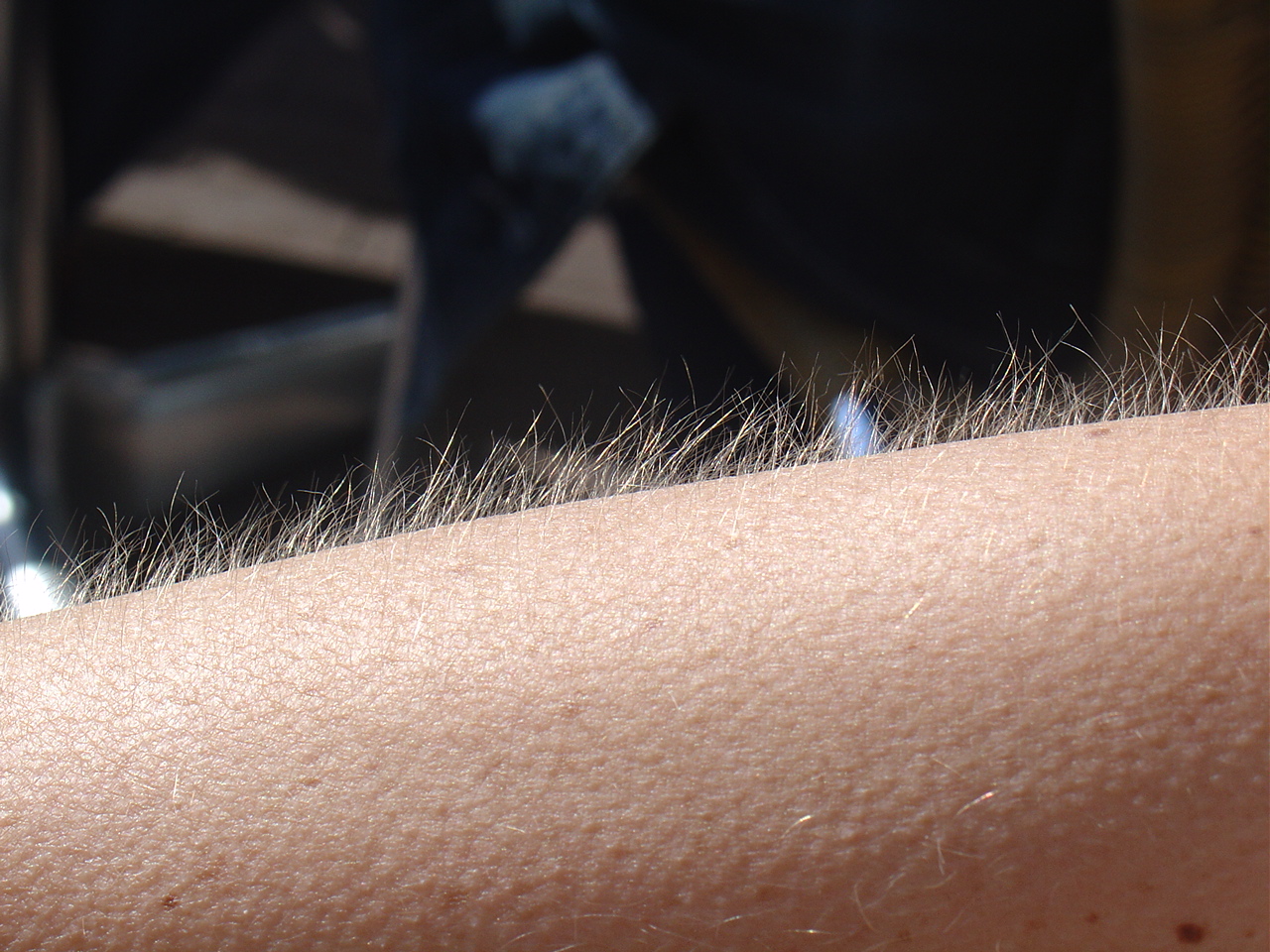
Cold wind, a scare, a piece of music that hits just right: the hairs on your arms stand up and your skin turns to tiny bumps. The name comes from the resemblance to a plucked goose. Doctors call it piloerection or cutis anserina.
It is one of the oldest reflexes in the mammalian playbook, and humans still carry it even though we lost most of the fur it was built for.
This article explains the muscle behind goosebumps, why cold and fear both trigger it, what it did for our ancestors, and what new research says it might still be doing. This is general information, not medical advice.
The muscle behind the bump
Every hair on your body has a tiny smooth muscle attached at its base: the arrector pili muscle. When the sympathetic nervous system (the branch behind fight-or-flight responses) fires, it releases the neurotransmitter norepinephrine. Norepinephrine binds to receptors on these little muscles, calcium flows in, and the muscle contracts, yanking the hair upright.
The tug puckers the surrounding skin into the familiar bump.
Family medicine doctor Donald Ford told the Cleveland Clinic that goosebumps, scientifically called horripilation or piloerection, result from the sympathetic nervous system stimulating these small muscles at the base of each hair follicle. The whole thing is involuntary. You cannot decide to raise your arm hairs any more than you can decide your pupils.
The response is fast and short-lived. Once the brain decides the threat or chill has passed, the signal fades and the skin smooths out, often within seconds.
Why cold triggers it
In mammals with real fur, piloerection is a heating system. Erect hairs trap a layer of still air against the skin, and still air is an excellent insulator. Fluffed-up fur keeps the animal warmer with no extra energy spent.
Think of a cat puffing up in winter or a bird fluffing its feathers.
Humans kept the reflex but lost most of the fur. With only fine body hair to raise, the insulation effect is negligible for us. The muscle contraction itself generates a trace of heat, but not enough to matter.
What remains is the wiring: the body still reacts to cold the way its furry ancestors did, even though the payoff is gone.
Why fear triggers it
The second ancient job of piloerection was intimidation. An animal with its fur standing on end looks bigger. Bigger can mean the difference between a predator attacking and thinking twice.
Porcupines raise their quills when threatened. Cats arch and puff. Chimps display with raised hair.
The same sympathetic surge that prepares the body to fight or flee also fires the arrector pili muscles, so fear and cold share one reflex.
That shared wiring explains why strong emotions of all kinds can raise goosebumps: awe, excitement, anger, even sexual arousal. The brain routes intense arousal through the sympathetic system, and the skin responds before the conscious mind has finished processing what it feels.
The music connection: frisson
One of the strangest triggers is beauty. Many people get chills from music, film scenes, or powerful speeches, a sensation researchers call frisson. Brain imaging work suggests frisson involves reward circuitry and emotional processing regions, with the sympathetic system carrying the signal out to the skin.
It is the same old reflex, fired by art instead of weather.
Some people can even trigger piloerection voluntarily, without any external stimulus. Research on this rare ability suggests it correlates with openness to experience as a personality trait, though the phenomenon is still poorly understood.
It may not be useless after all
For years, textbooks filed human goosebumps under vestigial leftovers, alongside the tailbone and appendix. A 2020 study in the journal Cell complicated that story.
Researchers led by Ya-Chieh Hsu of Harvard University and Sung-Jan Lin of National Taiwan University used mouse skin to map the full goosebump circuit: arrector pili muscle, sympathetic nerve, and hair follicle stem cells, all physically linked. When they removed the sympathetic nerves, hair follicle stem cells were slow to activate and new hair growth was delayed. Removing the nerves lowered norepinephrine in the skin, and mice whose stem cells lacked the norepinephrine receptor showed the same delay.
The team then tested cold exposure. Cold first caused goosebumps, then boosted sympathetic nerve activity and norepinephrine. Mice exposed to cold started growing new hairs from their stem cells in less than two weeks.
The researchers proposed a two-layer response: goosebumps give quick relief in the short term, and the same signal tells stem cells it may be time to grow a thicker coat for the long term.
There is a human hint too. Arrector pili muscle cells are often lost in the scalps of people with common baldness, and the researchers suggested that reactivating the sympathetic nerves in follicles might one day help boost hair growth. That is early science, not a treatment, but it reframes goosebumps from evolutionary baggage to a possible working part.
Frequently asked questions
Why do I get goosebumps from music but my friend does not?
Sensitivity varies. Frisson depends on how strongly your brain's emotional and reward systems respond to the stimulus, plus personality traits like openness to experience. It is normal for people to differ widely.
Can goosebumps be a sign of illness?
Piloerection is a classic sign of opioid withdrawal, and it can accompany fever chills and some neurological conditions. Ordinary goosebumps from cold, fear, or emotion are normal. If you notice persistent or unexplained piloerection, talk to a clinician.
This article is general information, not medical advice.
Do animals other than mammals get goosebumps?
Birds and reptiles show piloerection too, raising feathers or scales. The reflex is widespread across vertebrates, which is how old it is.
Why are they called goosebumps?
The bumps resemble the skin of a plucked goose, where feather follicles leave small protrusions. Other languages name the same phenomenon after chickens, ducks, or even ants.
Outlook
Goosebumps are a reflex from our furry past, kept alive by wiring that fires for cold, fear, and strong feeling alike. The newest research suggests the machinery may still earn its keep, nudging hair follicles toward regrowth when the cold sets in. It is a good idea to see a doctor if you experience persistent, unexplained piloerection or goosebumps paired with other symptoms that concern you.
Topics: skin, nervous system, evolution, human body
By Rive News, Research desk | Rive News. Rive News covers health and the human body with reporting grounded in peer-reviewed research. This article is for general information, not medical advice.
Latest in Health
- Why do fingers wrinkle in water like prunes
- Why do we get eye floaters and what are they
- Why do wounds itch when they are healing
- Why does your nose run in cold weather
Get one human-body explainer in your inbox every morning. Subscribe to the Rive News newsletter.
Related stories

ADHD linked to fourfold dementia risk in Pitt study of 187,000 adults
Adults with ADHD face four times the risk of dementia, a University of Pittsburgh study of 187,000 adults published in JAMA Psychiatry

Why Do Athletes Get Cramps Despite Drinking Water?
Muscle cramps strike even well-hydrated athletes because sweat drains electrolytes that plain water cannot replace. Here is why water alone

Do bananas actually prevent muscle cramps?
A medium banana has 422 mg of potassium, but the evidence says it cannot stop cramps. Here is what the research shows, and what actually