
How to Prepare a Child for a New Sibling: Steps That Work
Key takeaways
- Start with honest, age-matched talk: what will change, where you will be during delivery, and that babies mostly sleep and cry.
- Give the older child a real role (helper jobs, their own doll to care for) instead of just telling them to "be nice."
- Expect some regression: clinginess, accidents, or baby talk are normal and need patience, not punishment.
A new baby changes everything for the child who used to be the baby. No amount of preparation removes the shock entirely, and that is fine. The goal is not a seamless transition. It is a child who feels informed, included, and still securely loved when the household turns upside down.
This article covers how to talk about the new baby before the birth, how to give the older child a real role, what to do in the first days after delivery, and how to handle the regression that usually follows.

A newborn baby sleeping. Older children often imagine the baby will arrive ready to play; honest talk sets better expectations.
Image Credits: Wikimedia Commons
Talk about it early, honestly, and at their level
Children cope better with change they saw coming. Use simple, concrete language about what will happen: the baby is growing, the baby will come out at the hospital, and life at home will look different for a while. Avoid vague reassurances like "nothing will change," because everything will change and children notice.
Timing matters by age. Sanford Health's guidance suggests that for preschool-age children, roughly 2 to 4 years old, it can help to wait until later in the pregnancy to share the news. Children this age think in black and white, do not handle change well, and can find a months-long wait confusing or scary. School-age children, who understand time better, can be told earlier and included in more of the planning.
Be specific about the parts children actually worry about. Where will they stay while you are at the hospital? Who will put them to bed? Will you still read the bedtime story? Answer the logistics before they have to ask. Sanford Health advises being honest that babies can be cute and fun but also cry a lot. One mother interviewed by Standard Media put it plainly: children may assume the baby will be born ready to play on the swings, without understanding that newborns mostly sleep, cry, and feed.
Use the words "brother," "sister," and "new baby" often and positively, so the vocabulary feels familiar before the reality arrives. Show the older child their own baby photos and talk about how they were cared for. It reminds them they were once the baby too, and were loved exactly the same way.
Books help, especially for children under five. Sanford Health recommends titles like "The New Baby" by Mercer Mayer. Reading together gives the child a script for what is happening and a safe way to ask questions. A doll the child can diaper, feed, and put to sleep turns abstract ideas into practice. Pretend play is how young children process big changes.
Give the older child a real job, not a lecture
"Be nice to the baby" is too vague for a three-year-old to act on. Concrete jobs work better. Sanford Health suggests coming up with special tasks only the older sibling can do: fetching diapers, choosing the baby's outfit, singing during bath time. The exclusivity matters. Being the only person in the house who can do a job gives status, and status is exactly what a dethroned firstborn is missing.
Involve them in the preparations as a helper, not a bystander. Take them shopping for baby things and let them pick something small, like the blanket. Go through old toys together and let them choose which ones the baby can have, and just as importantly, which ones are off limits. Respecting the boundary around their special toys teaches them that their territory still counts.
Language in the first weeks shapes the relationship more than parents expect. Instead of "Shhh, the baby is sleeping," which frames the baby as the household tyrant, try "For the next hour we are going to play quietly. What fun things can we do together?" Instead of "I have to feed the baby, I can't play right now," try "I would love to play, and I'll be free in about 15 minutes. Can you set something up for us?" The information is the same. But the message is different: the older child is still a priority with a scheduled slot.
A small gift "from" the baby to the older sibling on arrival day is a tradition many families swear by. It is symbolic, not bribery: a concrete signal that the new arrival brings something for them too.

Newborns spend most of their time sleeping. Telling the older child this in advance prevents disappointment.
Image Credits: Wikimedia Commons
The first days: plan the introduction
The hospital first meeting sets a tone, so plan it. One widely shared approach: have the person bringing the older child call when they are close, move the baby to the nursery or a bassinet for a few minutes, and greet your firstborn with open arms and no baby on your lap. Let the reunion belong to them. Then bring the baby in together, with the older sibling helping.
Back home, protect one-on-one time deliberately. The standard advice, repeated across nearly every source, is to schedule special time with the older child that the baby cannot interrupt. It does not need to be long. Fifteen minutes of a parent's full attention, doing what the child chooses, while another adult holds the baby, tells the child more than a hundred reassurances. Bedtime is a natural slot: keep the older child's routine exactly as it was, same story, same song, same parent if possible.
Expect visitors to rush toward the baby. Brief grandparents and friends in advance: greet the older child first, ask about their new role, notice them. A "big brother" or "big sister" guest book that visitors sign at the door is one family's trick for redirecting attention to the child who actually understands what is happening.
Watch your own bandwidth too. As a psychologist interviewed by Standard Media noted, hormonal shifts, sleep deprivation, and stress make it harder to manage everyone's needs. Parents should talk honestly with their partner or support network rather than running on empty. You cannot pour from an empty cup.
Expect regression, and do not punish it
This is the part that blindsides most parents. A toilet-trained four-year-old starts having accidents. A chatty toddler becomes clingy and whiny. A child who gave up the bottle a year ago suddenly wants one. This is regression, and it is normal.
Regression is the child's way of saying, "I need reassurance." Gentle parenting author L.R. Knost advises parents not to respond with punishment, shaming, or pressure to "be a big boy or girl." Instead, give the child space to feel like a baby again, while also noticing the perks of being bigger: strong legs that can walk anywhere, shoes they can put on themselves, foods the baby cannot eat yet.
Sanford Health gives the same guidance in clinical terms: expect regression at the preschool age, stay patient, and remember it passes. The timeline varies, but most regression fades within a few months as the child settles into the new family shape. What makes it linger is punishment, which confirms the child's fear that love is now conditional on acting big.
If you want the science behind why children this age react so strongly to change, why toddlers say no to everything explains the developmental stage, and what the 4-month sleep regression is covers the sleep disruption the whole household is about to share. For the fighting that often follows once the baby is mobile, see why siblings fight and what actually reduces it.
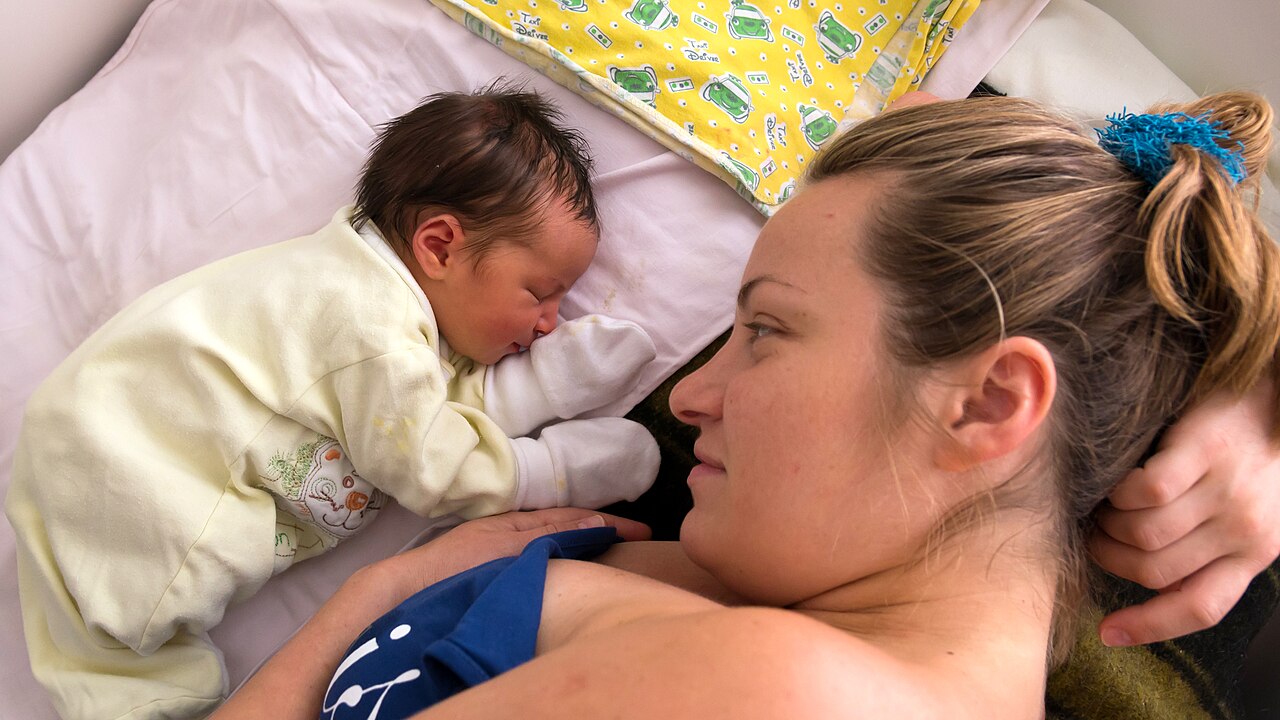
A mother with her newborn daughter. The older child's adjustment goes smoother when their own bond with each parent is visibly protected.
Image Credits: Wikimedia Commons
FAQ
When should I tell my child about the new baby?
School-age children can be told early. For toddlers and preschoolers aged 2 to 4, many experts suggest waiting until later in the pregnancy, since long waits are hard for young children to grasp.
Is jealousy toward the new baby normal?
Yes. Jealousy, clinginess, and attention-seeking are normal responses to a major family change. They signal a need for reassurance, not a character flaw.
How long does regression usually last?
It varies by child, but most regressive behavior fades within a few months as the child adjusts. Patience speeds it up. Punishment slows it down.
Should the older child be at the hospital for the birth?
That depends on the child's age, temperament, and hospital policy. What matters most is planning the first meeting so the older child feels welcomed, not displaced: greet them first, baby aside.
The bottom line
Preparing a child for a new sibling comes down to four moves: honest talk at their level, a real role with real jobs, a planned first meeting, and patience through the regression. None of them require perfection. They require the child to feel, on the roughest days, that their place in the family is as secure as ever.
Start this week with the smallest step: read one new-sibling book together, or let them pick one small thing for the baby's room. Inclusion starts long before the delivery date.
---
Topics: new sibling, big brother, big sister, toddler adjustment, family
Rive News is a research desk producing plain-language explainers from public sources. This article is for general information and is not medical or psychological advice.
Latest in Parenting
- Why siblings fight and what actually reduces it
- What is parallel play in toddlers?
- Why your baby wakes up the second you put them down
Subscribe for one practical parenting explainer in your inbox each week.
Rive News, 2026. Explainers are written from public sources and reviewed against our honesty checklist.
Related stories

Why babies cry more in the evening: the witching hour explained
The witching hour is the fussy evening stretch most newborns hit daily. Why overtiredness, cluster feeding, and overstimulation stack up

When Do Babies Start Sleeping Through the Night by Month?
Most babies sleep through the night between 3 and 6 months, with regressions at 4 and 8 to 10 months. See the month-by-month table

Why Your Baby Wakes Up the Second You Put Them Down
Newborns wake when put down as the startle reflex, light sleep, and lost warmth hit at once. It is normal and peaks early, fading