
Why a compass needle always points toward north
By Rive News / Research desk | Rive News / Published October 29, 2026 at 9:00 AM PKT
Key takeaways
- A compass needle is a small magnet that lines up with Earth's magnetic field.
- That field is built by moving molten iron and nickel in Earth's outer core.
- The needle points to magnetic north, which sits apart from geographic north by an angle called declination.
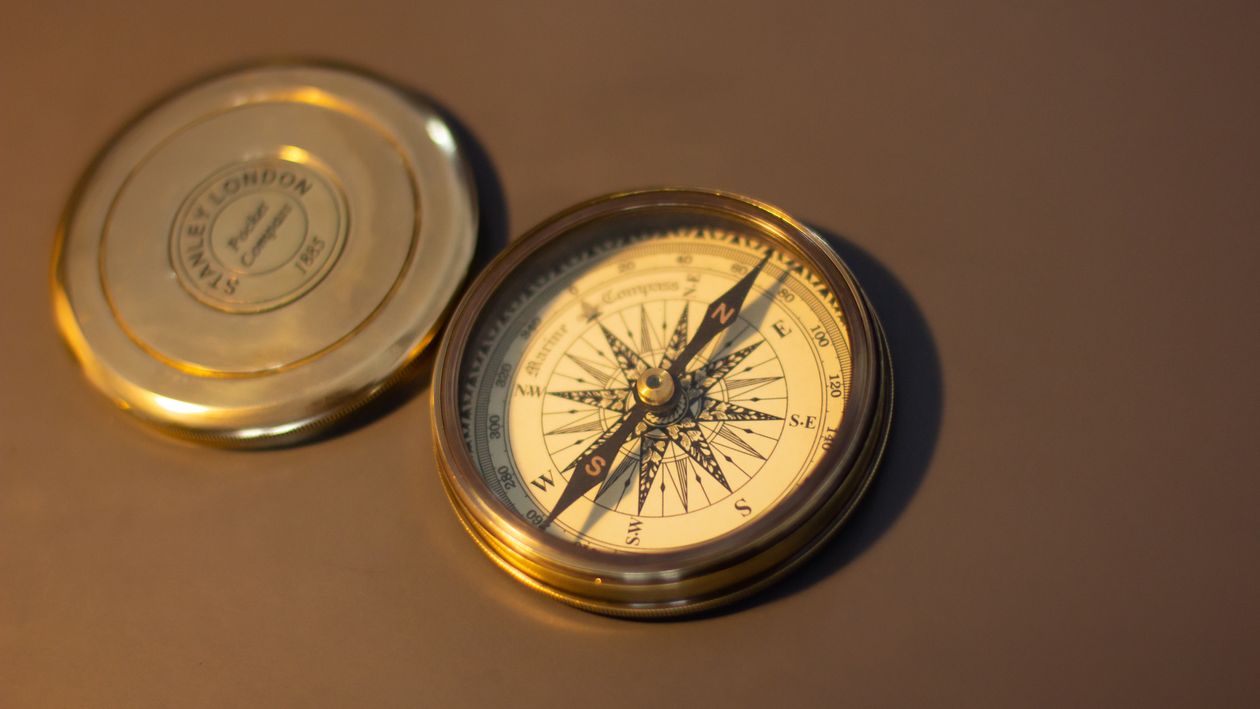
[A vintage brass compass shows its needle pointing north.] Photograph: Pexels
Image Credits: Pexels
A compass needle does not know where north is. It knows only one thing: how to line up with a magnetic field.
Earth happens to supply a planet-sized field, and the needle obeys it the way any magnet obeys a field. North is simply where that field points.
The field itself comes from deep underground, from a churning ocean of liquid metal. This article explains how a tiny magnetised needle reads a planetary field, why the north it finds is not quite the North Pole, and where the whole trick stops working.
A needle is a magnet on a pivot
At the heart of a magnetic compass sits a small, lightweight magnet, usually shaped as a needle. It balances on a pivot with so little friction that Earth's weak field can turn it. Hold the compass flat and the needle rotates until it settles along the local field direction.
The end painted red, or marked with an N, is the needle's north-seeking pole. Opposite poles attract, so that end is drawn toward the pole of Earth's field that acts like a magnetic south pole. That naming twist confuses many readers, and it is worth stating plainly: the place we call magnetic north behaves, magnetically, like the south pole of a bar magnet.
The other end of the needle points south for the same reason. A compass therefore shows a north-south line, not a single direction. The marked end tells you which end of the line is north.
This is also why an unmagnetised needle is useless as a compass. Without its own magnetic field, it has nothing for Earth's field to pull on. Magnetise it by stroking it with a strong magnet, float it on water on a leaf, and it will swing toward north-south alignment.
The pivot only removes friction. The magnetism does the pointing.
Earth is a giant, imperfect magnet
Earth's magnetic field stretches from the interior out into space, where it meets the solar wind, a stream of charged particles from the Sun. Near the surface, the field is often pictured as a huge bar magnet tilted about 11 degrees from Earth's rotation axis, running through the planet's centre.
The picture is an approximation, but a useful one. Field strength at the surface ranges roughly from 30,000 to 60,000 nanoteslas, according to a 2019 survey cited in the Earth's magnetic field reference. That is strong enough to turn a balanced needle, yet far too weak to feel or to pick up objects.
The tilt explains part of the compass's imperfection. Because the magnetic axis leans about 11 degrees from the spin axis, magnetic north does not sit on top of geographic north. The two poles are hundreds of kilometres apart, and the gap changes with location.
The field is also uneven. It is stronger near the poles and weaker near the equator, and local rocks and ore deposits bend it slightly. A compass reads the local field, not an ideal textbook field, so careful navigators always allow for local quirks.
The geodynamo: a generator in the outer core
Earth's field is generated by electric currents in the outer core, a layer of molten iron and nickel surrounding the solid inner core. Heat escaping from the interior drives convection in that liquid metal, and Earth's rotation twists the flows into organised patterns.
Moving conductive fluid plus rotation generates electric current, and current generates magnetism. Physicists call the whole self-sustaining process the geodynamo.
More than 90 percent of the surface field comes from this core process, according to the Hong Kong Observatory's geomagnetism guide. Smaller contributions come from electric currents in the upper atmosphere and from magnetised rocks in the crust.
The geodynamo is not steady. Its flows shift, so the field drifts and changes strength over years and decades.
The magnetic north pole wanders, sometimes by tens of kilometres a year. Every few years, mapmakers update magnetic models so that compasses, phones, and aircraft systems stay accurate.
Over geological time, the field has even flipped entirely, swapping magnetic north and south. The last full reversal happened about 780,000 years ago.
During a reversal, which takes thousands of years, a compass would slowly become unreliable, then settle pointing the other way. No reversal is under way today, though the field's current weakening is watched closely by researchers.
Magnetic north is not true north
Maps point to true north, the direction of the geographic North Pole, where Earth's axis meets the surface. Compasses point to magnetic north, where the field dives vertically into the Earth. The angle between those two directions is called magnetic declination, or variation by sailors and pilots.
Declination varies by place and changes over time. The US Geological Survey notes that the geographic North Pole sits about 1,200 miles from the magnetic pole, and that declination is zero only along a line called the agonic line.
West of that line, a needle points east of true north. East of it, the needle points west of true north.
For casual walks, a few degrees of declination hardly matter. For surveyors, sailors, and hikers crossing open country, it matters a great deal.
A 10-degree error over 10 kilometres puts you nearly 2 kilometres off course. Good maps print the local declination, and good navigators adjust for it.
Smartphones hide this work. A phone's magnetometer reads the same field as a needle compass, then software applies a declination correction from a stored magnetic model. The number on screen is true north, but the sensor underneath still found magnetic north first.

[A compass rests on a detailed map.] Photograph: Pexels
Image Credits: Pexels
Where compasses stop working
A compass is dependable at moderate latitudes, but it fails near the magnetic poles. There, the field points steeply downward rather than horizontally. A standard needle, which only measures the horizontal part of the field, has almost nothing to align with, so it wanders or sticks.
Nearby metal and electricity cause trouble anywhere. A compass held next to a car, a steel bridge, or a power line reads the local interference as well as Earth's field. That is why navigators hold compasses away from their bodies and away from other gear before trusting a reading.
Cheap compasses add their own failure mode. A sticky pivot or a bent needle can freeze in the wrong position, especially in cold weather. A compass that does not swing freely when you rotate the case is not giving a reading at all.
Gyrocompasses and GPS receivers avoid magnetism entirely. A gyrocompass finds true north from Earth's rotation, and GPS computes direction from movement between positions. Ships and aircraft carry both, because a magnetic compass alone is not enough for precision work.
A short history of a simple tool
People noticed lodestone, a naturally magnetic rock, pointing consistently long before anyone understood why. Ancient Chinese inventors built early compasses, known as Si-nan, from lodestone spoons on smooth plates. Later versions floated magnetised needles on water.
European sailors adopted the compass for open-sea navigation in the Middle Ages, and it reshaped exploration. A ship that could hold a course out of sight of land could cross oceans with confidence. The compass did not tell sailors where they were, but it told them which way they were going, and that was enough to change the world.
Modern compasses still use the same principle as those first needles. The materials improved, the housings got better, and liquid damping steadied the needle, but the physics is unchanged. A tiny magnet, free to turn, reads a planetary field.
Frequently asked questions
Why does the needle point north instead of south?
The needle's north-seeking end is attracted to Earth's magnetic north region, which acts magnetically like a south pole. Opposite poles attract, so the marked end settles toward the north.
Is magnetic north the same as the North Pole?
No. Magnetic north sits hundreds of kilometres from the geographic North Pole, and it moves over time. The angle between them is magnetic declination.
Can a compass work anywhere on Earth?
At moderate latitudes, yes, away from metal and electrical interference. Near the magnetic poles, the horizontal field is too weak for a standard compass to give a useful direction.
Why does my phone compass need calibrating?
Phone magnetometers pick up interference from the phone itself and nearby metal. Waving the phone in a figure-eight helps the software separate Earth's field from local interference.
The bottom line
A compass needle points north because it is a magnet, and Earth is a magnet. Molten iron churning in the outer core builds a planetary field, and the needle lines up with it wherever you stand. The north it finds is magnetic north, offset from true north by declination, and it fails only where the field dives too steeply or local interference drowns it out.
That is the whole trick, and it is a remarkable one. A sliver of magnetised steel, balanced on a pin, reads a generator thousands of kilometres below your feet. Hold it flat, step away from metal, and it will show you north.
Tags: compass, Earth magnetic field, navigation, science
Rive News's research desk covers everyday science questions with sourced explainers, not lab reports.
Related
- How a compass finds north using Earth's magnetic field
- How does a compass actually find north so reliably
- Why magnets stick to fridges but ignore most metals
Subscribe for one plain-English science explainer each morning.
Rive News publishes sourced explainers; claims are checked against public sources before publication.
Related stories
Why diamond is hard and graphite is soft when both are carbon
Diamond and graphite are both pure carbon, yet diamond is 10 on the Mohs scale and graphite is 1 to 2. The difference is not the atoms;

Why Hot Water Can Freeze Faster Than Cold: The Mpemba Effect Explained
Hot water can freeze faster than cold under specific conditions. The Mpemba effect, named for a 1963 schoolboy experiment, still divides
How Magnets Work at the Atomic Level: Spins, Domains, and Iron
Magnetism comes from electrons: their spin and orbits make each atom a tiny magnet. In iron, quantum forces align these atomic magnets into