
How Does a Compass Actually Find North So Reliably
Key takeaways
- A compass needle is a tiny magnet. It lines up with Earth's magnetic field, and its painted end points toward magnetic north.
- Magnetic north is not true north. The gap between them, called declination, shifts with place and time and must be corrected.
- Earth's field comes from moving iron in its outer core, which is why the poles drift and the needle follows the local field.

A compass finds north without batteries, signals, or moving parts beyond a single needle. The trick is that the needle itself is a magnet, and Earth is a much bigger one. The small magnet lines up with the big one, and that alignment is what you read as north.
This article explains how the needle works, where Earth's field comes from, why magnetic north differs from true north, and how navigators correct for the gap.
The needle is a magnet
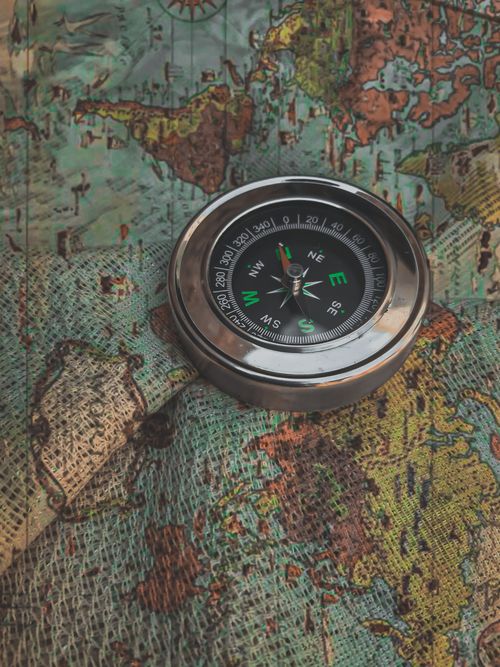
A compass needle is a thin piece of magnetized steel, balanced on a low-friction pivot so it can spin freely. In better compasses the pivot is a jewel bearing, which keeps friction so low that the needle settles quickly. The needle has two poles, just like any magnet.
One end is marked, usually with paint or a luminous tip, and that marked end is the one that points north.
Put two bar magnets near each other and they twist into alignment. The compass works the same way, on a planetary scale. Earth's magnetic field exerts a torque on the needle, pulling the north end of the needle toward Earth's north magnetic region and the south end toward the south.
When the compass is held level, the needle turns until it settles into line with the field around it. That takes a few seconds while the swings die down.
The needle does not sense distance or direction to a place. It senses the field right where it sits. NOAA makes this point directly: the compass points in the direction of the horizontal component of the magnetic field where the compass is located, and not to any single point.
That detail matters, because it explains why a compass can misbehave near metal or magnets.
Earth is the big magnet
Earth behaves roughly like a giant bar magnet buried inside the planet. The field comes from electric currents in the liquid iron-nickel outer core, thousands of kilometers below the surface. The same deep Earth that drives this field also drives the pull you feel every day, and why gravity pulls things down explains that side of the story.
Moving conductive fluid generates the field, a process called the geodynamo. The field then stretches far into space, forming the magnetosphere.
The field is not a neat, symmetrical shape. NOAA describes it as having non-dipolar ingredients, and the main dipole is not perfectly aligned with the rotation axis. The result is a field that dips and bends from place to place.
Local rocks, iron deposits, and nearby metal objects can bend it further.
The field is also weak. Compass apps commonly cite a typical surface strength of about 25 to 65 microtesla, depending on location. A fridge magnet is far stronger at close range, which is why storing a compass next to a magnet or a speaker can throw it off.
Keep the compass away from metal, and hold it level, and the weak planetary field is all it feels.
Magnetic north is not true north
Here is the part that trips people up. True north is the geographic North Pole, where the rotation axis meets the surface, at 90 degrees north. Magnetic north is where the field lines converge, and it sits somewhere else.
The compass points to magnetic north, not to true north.
The angle between the two directions is called magnetic declination, or magnetic variation. The United States Geological Survey defines it as the deviation of the compass from true north, and notes that it varies with both location and time. In some places the gap is only a degree or two.
In others it runs past 20 degrees. At very high latitudes, the USGS notes, a compass can even point south.
Declination also changes over time, because the field itself changes. The same deep Earth that shifts the field also shakes the ground, which is why earthquakes happen and why some places get more. The magnetic north pole drifts as the outer core moves, and its movement has sped up since the 1970s, according to NOAA.
Old maps carry old declination values, which is one reason navigators check current figures before trusting a bearing.

How to correct for declination
Maps are drawn to true north. Compasses read magnetic north. To move between the two, you apply the local declination.
NOAA gives the rule: compute the true bearing from a magnetic bearing by adding the magnetic declination to the magnetic bearing, treating west declination as negative.
A simple example makes it concrete. If your compass reads 45 degrees and the local declination is 10 degrees east, the true bearing is 55 degrees. If the declination is 10 degrees west, treat it as minus 10, and the true bearing is 35 degrees.
Hikers and surveyors print the declination on the map margin, and NOAA runs an online calculator for any longitude, latitude, and date.
Declination is only the horizontal part of the story. The field also tilts downward toward the ground, an angle called inclination or dip. Near the magnetic equator the field runs nearly flat.
Near the poles it points almost straight down. Compass makers balance needles for the dip of the region where the compass will be used, which is why a compass built for one hemisphere can drag or stick in the other.
A short history of the needle
People noticed lodestone, a naturally magnetized rock, long before anyone built a compass. The magnetic compass was first invented as a device for divination as early as the Chinese Han dynasty, around 206 BC, and later adopted for navigation by Song dynasty Chinese during the 11th century. The first recorded use in Western Europe came around 1190, and in the Islamic world in the 13th century.
Early compasses were simple: a magnetized needle floating in water or resting on a pivot. Later designs added the compass card, the liquid-filled bowl that steadies the needle, and the sighting tools used by surveyors and soldiers. The physics never changed.
Every version is a small magnet free to line up with a large one.
Modern navigation still uses the same principle in places where satellites cannot reach. Ships, aircraft, and hikers carry magnetic compasses as backups, because the tool needs no signal and no power. Phone compasses use magnetometers, tiny electronic sensors that measure the field along three axes, then turn the reading into a heading.
Unlike satellite signals, which are bound by why nothing can go faster than the speed of light, a magnetic compass needs no signal at all. The sensor replaces the needle, but the field it reads is the same one.
Why a compass sometimes lies
A compass is honest about the field it feels, and that is the problem. Anything that changes the local field changes the reading. A steel belt buckle, a phone, a car dashboard, or a nearby power line can pull the needle off.
Iron-rich rocks can bend the field over a whole hillside. Even a second compass held too close will disturb the first.
The fix is distance and a level hold. Step away from metal, hold the compass flat, and let the needle settle. If the needle slumps or refuses to settle, the local field is probably disturbed.
Move a few steps and try again. On a ship or near machinery, compasses are corrected with small magnets placed around the bowl, a process called compensation, and the leftover error is recorded in a table.
The strangest case comes at the poles themselves. The USGS notes that if you stand at the north geomagnetic pole and hold a compass flat, it has no preferred direction to point. Hold it on its side and the north-pointing end points down, following the field lines as they plunge into the ground.
The tool is working perfectly. It is the geometry of the field that has changed.
The bottom line
A compass finds north because its needle is a magnet that lines up with Earth's magnetic field. The field comes from moving iron in the outer core, and it points to magnetic north rather than true north. The gap between the two, called declination, varies by place and time, so real navigation means adding the local correction.
Keep the compass level, away from metal, and the small needle tells the truth about a planet-wide field.
Tags: compass, magnetism, navigation, earth science
Latest in Science
- Why Leap Years Happen and What Happens Without Them
- Why Gravity Pulls Things Down
- Why Earthquakes Happen and Some Places Get More
- Why Nothing Can Go Faster Than the Speed of Light
Subscribe for one practical science explainer each week.
Related stories

Why diamond is hard and graphite is soft when both are carbon
Diamond and graphite are both pure carbon, yet diamond is 10 on the Mohs scale and graphite is 1 to 2. The difference is not the atoms;

Why Hot Water Can Freeze Faster Than Cold: The Mpemba Effect Explained
Hot water can freeze faster than cold under specific conditions. The Mpemba effect, named for a 1963 schoolboy experiment, still divides

How Magnets Work at the Atomic Level: Spins, Domains, and Iron
Magnetism comes from electrons: their spin and orbits make each atom a tiny magnet. In iron, quantum forces align these atomic magnets into