
How do earthquakes happen and why do some places get more of them
Key takeaways
- Earthquakes happen when a stuck fault suddenly slips, releasing stored energy as seismic waves.
- Most quakes strike at plate boundaries, where moving plates grind, collide, or pull apart.
- Quiet interiors shake too, because old weaknesses in the crust can fail under stress from far away.
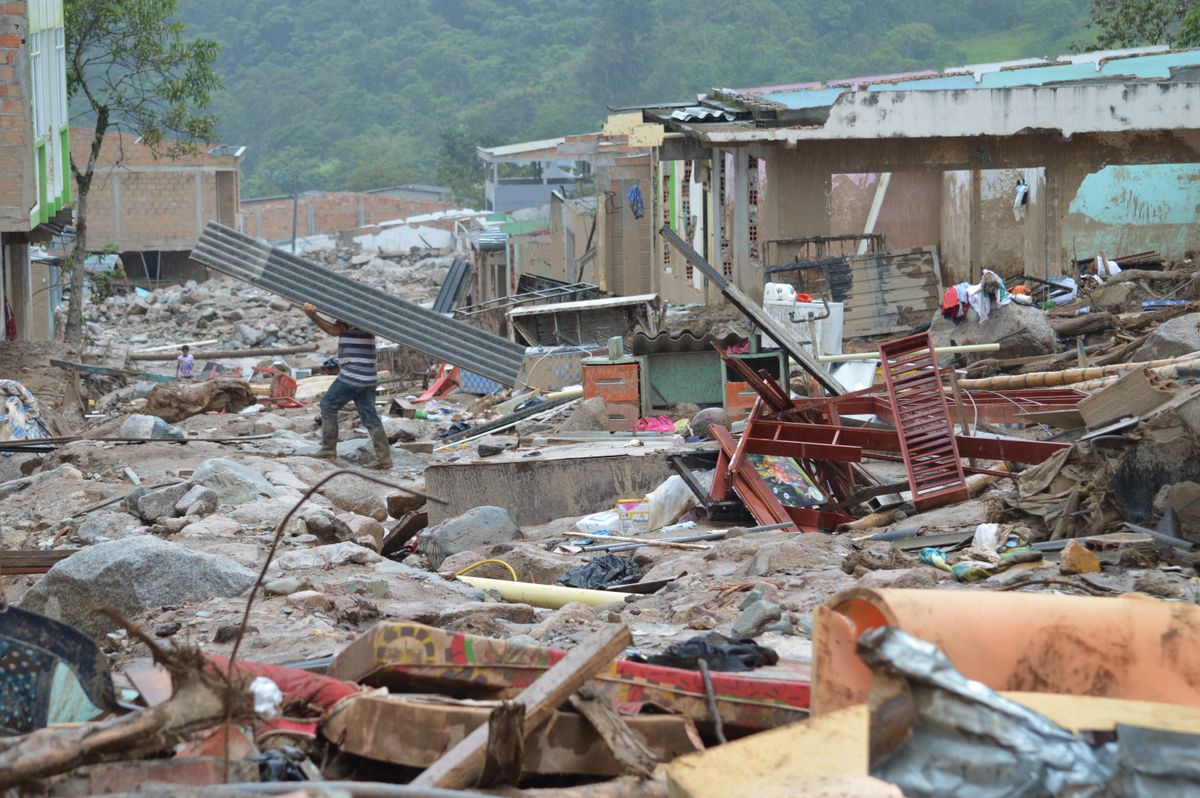
The ground moves without warning. Buildings sway, dishes fall, and within seconds it is over. An earthquake feels like a random event, but it follows a physical logic.
It is the moment when the Earth's crust, pushed past its limit, suddenly gives way.
This article explains how earthquakes happen, what faults and seismic waves are, and why some places shake often while others stay quiet for centuries.
The Earth is cracked into moving pieces
The Earth has four major layers: the inner core, the outer core, the mantle, and the crust. The crust and the top of the mantle form a thin skin on the surface of the planet. That skin is not in one piece.
It is broken into many pieces like a puzzle, and the pieces keep slowly moving around, sliding past one another and bumping into each other.
Those pieces are called tectonic plates, and their edges are called plate boundaries. The boundaries are made of many faults, and most of the earthquakes around the world occur on these faults. The plates move because heat inside the Earth drives slow currents in the mantle below, dragging the plates along at roughly the speed your fingernails grow.
Plate boundaries come in three kinds. At divergent boundaries, plates pull apart, and new crust forms in the gap. At convergent boundaries, plates collide, and one may dive beneath the other in a process called subduction.
At transform boundaries, plates slide past each other sideways. Each kind produces earthquakes, but the biggest ones happen where one plate dives beneath another, in the locked zone where the plates are stuck together.
The stick-slip mechanism
Here is the core mechanism, described by the US Geological Survey. The edges of plates are rough, so they get stuck while the rest of the plate keeps moving. While the edges stay stuck and the block keeps moving, energy builds up, like a stretched rubber band.
Finally, when the plate has moved far enough, the edges unstick on one of the faults, and there is an earthquake.
An earthquake is what happens when two blocks of the Earth suddenly slip past one another. The surface where they slip is called the fault, or fault plane. The spot below the surface where the earthquake starts is called the hypocenter, and the spot directly above it on the surface is called the epicenter.
When the fault unsticks, the stored energy radiates outward in all directions as seismic waves, like ripples on a pond. Those waves shake the ground as they move through it, and when they reach the surface, they shake the ground and anything on it. The size of the quake depends on the size of the fault and how far it slips.
A short slip on a small fault makes a tremor. A slip of many metres along a fault hundreds of kilometres long makes a disaster.
Sometimes a quake has foreshocks, smaller earthquakes in the same place before the larger one. Scientists cannot tell that a quake was a foreshock until the larger quake happens. The largest quake is called the mainshock.
Mainshocks always have aftershocks that follow, smaller quakes in the same place. Depending on the size of the mainshock, aftershocks can continue for weeks, months, and even years.
Why plate boundaries shake most
The map of world earthquakes is not random. It traces the plate boundaries. The belt of faults around the Pacific, often called the Ring of Fire, hosts many of the world's most active zones, because plates converge and subduct all around that ocean.
Japan, Indonesia, Alaska, Chile, and New Zealand all sit on or near these boundaries, and all of them shake often.
California shows the transform version. The state sits on the boundary between the Pacific Plate and the North American Plate. The main boundary is the San Andreas Fault, which is more than 650 miles long and extends to depths of at least 10 miles.
The Pacific Plate grinds northwestward past the North American Plate at a rate of about two inches per year. Where the fault creeps steadily, the movement comes out as many tiny shocks. Where creep is not steady, strain can build up for hundreds of years, producing great earthquakes when it finally releases.
The western United States as a whole is active for the same reason. The region has been tectonically active since the supercontinent Pangea broke up roughly 200 million years ago, and it sits close to the western boundary of the North American plate. Since the San Andreas Fault system formed 25 to 30 million years ago, the meeting of the Pacific and North American plates has built many faults across California.
The crust there is thinner and hotter than in the east, which favours faster deformation and active faulting.
Subduction zones produce the largest quakes of all. Where an oceanic plate dives under another plate, the locked zone between them can span a huge area. When that zone ruptures, the slip can run for hundreds of kilometres and lift the sea floor, which is how the biggest tsunamis begin.
These megathrust earthquakes, as geologists call them, are the largest earthquakes on Earth.
Why quiet places shake too
If most quakes happen at boundaries, why do places far from any boundary shake? The central and eastern United States are thousands of miles from active plate boundaries, yet they have had large earthquakes. A series of major quakes struck near New Madrid, Missouri, in 1811 and 1812. A large quake hit Charleston, South Carolina, in 1886. An earlier one struck near Cape Ann, northeast of Boston, in 1755.
The explanation lies in old weaknesses. As plates move and boundaries change over geologic time, weakened boundary regions become part of the interiors of the plates. These zones of weakness can cause earthquakes in response to stresses that start at the edges of the plate or in the deeper crust.
Stress travels through the plate like pressure through a table, and when it meets an old fracture or fault from a long-ago mountain-building event, the crust can fail there.
In the central and eastern United States, the crust is thicker, colder, older, and more stable than in the west, so deformation is slow. Quakes there are rare, but they can be widely felt, because cold, rigid crust carries seismic waves further. A moderate quake in the east can rattle dishes across several states, while a similar quake in the west may be felt only nearby.
Human activity can also trigger small quakes in quiet areas. Filling large reservoirs, injecting wastewater deep underground, and geothermal extraction can all change pressure on faults. These induced quakes are usually small, but they show that faults respond to any change in stress, natural or human.
How scientists record and measure quakes
Earthquakes are recorded by instruments called seismographs. The recording they make is called a seismogram. A seismograph has a base set firmly in the ground and a heavy weight that hangs free.
When the ground shakes, the base shakes too, but the hanging weight does not. The difference in position between the shaking part and the motionless part is what gets recorded.
The size of an earthquake is called its magnitude. There is one magnitude for each earthquake. Scientists also talk about intensity, which is how hard the shaking feels in a given place, and intensity varies with distance, ground type, and building design.
Two towns at different distances from the same quake can report very different shaking.
Location comes from timing. Seismic waves come in types that travel at different speeds. P waves are fast, and S waves are slower.
By comparing when each wave arrives at three or more seismograph stations, scientists can triangulate the epicenter, the same way you judge a storm's distance by counting seconds between lightning and thunder. Modern networks do this automatically within minutes.
One question has no satisfying answer yet: can scientists predict earthquakes? The US Geological Survey says no, and that it is unlikely they will ever be able to predict them. Scientists know another quake will happen on a given fault someday, but they have no way of telling when.
Forecasts can state the odds over decades, which helps building codes and insurance, but nobody can give a date.
The bottom line
Earthquakes happen when a stuck fault slips and stored energy races outward as seismic waves. Plate boundaries shake most because that is where the Earth's moving pieces meet, grind, and collide. Quiet interiors shake rarely, along old weaknesses, when stress from far away finds a flaw.
You cannot predict the next quake, but you can understand the map: the closer you live to a plate boundary, and the older and colder the crust under you, the more the ground's history matters. If the physics of the planet interests you, see why gravity pulls things down or how a compass finds north.
Tags: earthquakes, plate tectonics, faults, geology
Latest in Science
- Why gravity pulls things down
- How a compass finds north
- How vaccines train your immune system in simple terms
- Why nothing can go faster than the speed of light
Subscribe to the Rive News newsletter for one science explainer each week.
Related stories

Why diamond is hard and graphite is soft when both are carbon
Diamond and graphite are both pure carbon, yet diamond is 10 on the Mohs scale and graphite is 1 to 2. The difference is not the atoms;

Why Hot Water Can Freeze Faster Than Cold: The Mpemba Effect Explained
Hot water can freeze faster than cold under specific conditions. The Mpemba effect, named for a 1963 schoolboy experiment, still divides

How Magnets Work at the Atomic Level: Spins, Domains, and Iron
Magnetism comes from electrons: their spin and orbits make each atom a tiny magnet. In iron, quantum forces align these atomic magnets into