
What is the difference between a theory and a hypothesis
Key takeaways
- A hypothesis is a tentative, testable prediction made before research. A theory is an explanation built on data already substantiated by testing.
- In science, "theory" signals high confidence, not a guess. The casual everyday meaning reverses this.
- A hypothesis can be disproven but never fully proven. Theories survive repeated testing but remain open to revision.
- Scientific laws describe what happens, often mathematically. Theories explain why it happens.
What the two words mean in science
In the scientific method, the hypothesis is constructed before any applicable research has been done, apart from a basic background review. You ask a question, read up on what has been studied before, and then form a hypothesis, according to Merriam-Webster. A hypothesis is usually tentative: an assumption or suggestion made strictly for the objective of being tested.
A theory, in contrast, is a principle formed as an attempt to explain things that have already been substantiated by data. Because of the rigors of experimentation and control, it is understood to be more likely to be true than a hypothesis is. The theory of evolution and the Big Bang Theory are examples Merriam-Webster gives of principles accepted in the scientific community under the name theory.
This article explains what a hypothesis is, what a theory is, where each sits in the scientific method, how scientific laws fit in, and why the everyday use of "theory" causes so much confusion.
What a hypothesis is
A hypothesis is a proposed explanation for an observation that can be tested through experimentation and data collection. It is usually formulated after observing patterns in data and serves as the starting point for scientific investigation, as the textbook publisher Vaia explains.
Three features define a scientific hypothesis. It is specific: it predicts a relationship between variables, such as "plants grow taller when exposed to more sunlight."
It is testable: you can design an experiment or observation that checks the prediction. And it must be falsifiable, meaning it must be possible to prove it wrong. A claim that cannot be proven wrong, even in principle, is not a scientific hypothesis.
A hypothesis can be disproven but not proven to be true, according to ThoughtCo. Even if you test a thousand cases and find no counterexample, the thousand-and-first test could still fail.
Support builds confidence, but proof in the absolute sense is not available. This is a feature of science, not a flaw: every conclusion stays open to better evidence.
What a theory is
A scientific theory is a well-substantiated explanation of some aspect of the natural world that is based on a body of evidence and has stood up to repeated testing and scrutiny. Theories are broader in scope than hypotheses and can incorporate multiple hypotheses that have been tested and validated over time, as Vaia puts it.
The key differences are scope, evidence, and confidence. A hypothesis is narrow and provisional. A theory is broad and robust.
A hypothesis needs testing. A theory has already survived it many times. A hypothesis is an early stage of research. A theory is the mature, established stage.
Scientists refer to basic scientific principles as theories rather than facts because scientific knowledge is always evolving and subject to revision.
Theories provide a comprehensive framework explaining a broad range of phenomena and making predictions about future observations. Calling something a theory does not downgrade it. In science, the word marks the highest level of explanation, not the lowest.
Real examples make this concrete. The germ theory of disease states that microorganisms cause infections, built on countless experiments.
The theory of plate tectonics explains Earth's geological activity, from earthquakes to mountain ranges. The theory of evolution explains the diversity of life based on evidence from genetics, paleontology, and biology.
How they fit in the scientific method
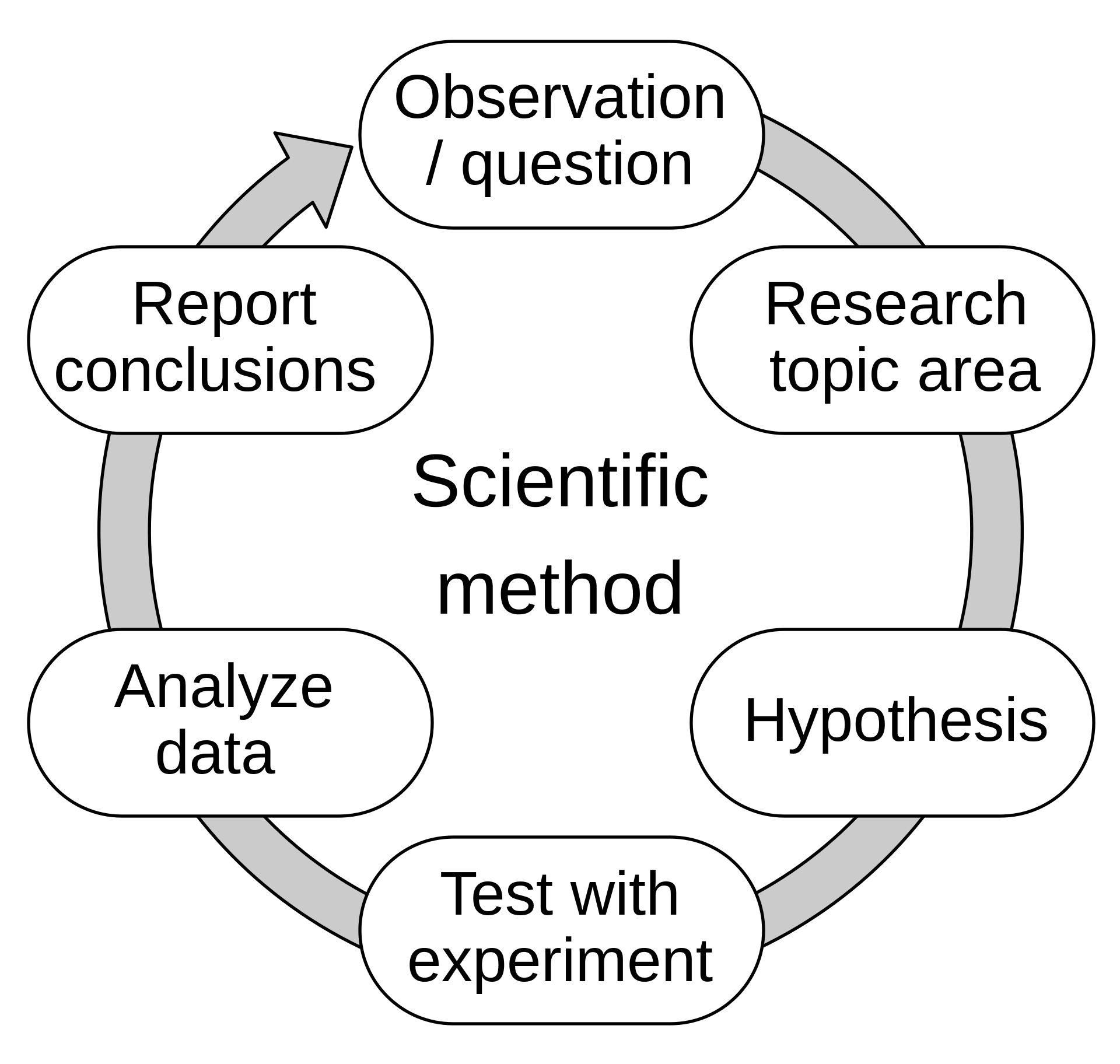
The scientific method runs in a loop, and hypotheses and theories enter at different points.
First comes observation and questioning. Then a specific, testable hypothesis is formulated. Next comes testing: experiments or data collection designed to support or refute the hypothesis.
The analysis then shows whether the evidence supports the prediction.
When hypotheses related to a phenomenon are consistently supported and integrated with other evidence, they build toward a theory. The theory then explains underlying mechanisms and predicts new outcomes, which generate new hypotheses to test. This is why textbooks show the scientific method as a cycle rather than a straight line.
So a hypothesis does not "grow up" into a theory in one step. Many tested hypotheses, plus related observations and confirmed predictions, get unified into a theory. The germ theory of disease, for instance, rests on generations of experiments testing specific hypotheses about particular microbes and particular infections.
Where scientific laws fit
A scientific law is a statement based on repeated experimental observations that describes some aspects of the universe. It expresses a relationship between variables and is consistent with known facts. A law can often be expressed mathematically and is generally accepted as universally true, according to Vaia.
The crucial difference: a law describes and predicts, but does not explain why. ThoughtCo puts it sharply: a scientific law describes observations and predicts phenomena but does not explain why they happen.
Newton's law of universal gravitation describes how masses attract each other with mathematical precision. The theory of gravity explains the mechanism behind that attraction. Laws and theories are different kinds of knowledge, and one does not outrank the other.
This also clears up the common myth that a theory becomes a law once it is "proven." That is not how science works. Laws and theories answer different questions, and a theory never graduates into a law no matter how well supported it gets.
Why the confusion matters
In non-scientific use, hypothesis and theory are often used interchangeably to mean simply an idea, speculation, or hunch, with theory being the more common choice, Merriam-Webster notes.
This casual use reverses the scientific meaning. When someone says "evolution is just a theory," they are using the everyday sense of theory as a guess. In the scientific sense, the theory of evolution is one of the best-supported explanations in all of science.
This is not a word game. The distinction shapes public debates about climate change, vaccines, and the age of the Earth. Downplaying a theory because the word sounds uncertain is a mistake of projection: it treats scientists' technical term as if it carried the casual meaning, as Merriam-Webster's usage note explains.
Understanding the real meanings helps you read science news more carefully. A report about a "new hypothesis" is describing an early, untested idea.
A report about a theory is describing something that has already survived a gauntlet. This same care applies across science topics, from the physics behind an orange sunset to why leap years exist every four years and how entropy works. In each case, the explanations rest on theories and laws, not guesses.
Frequently asked questions
Is a theory less certain than a law?
No. They are different kinds of statements, not ranks. A law describes what happens, often in mathematical form.
A theory explains why it happens. One does not outrank the other, and a theory never becomes a law.
Can a hypothesis become a theory?
Not directly. A hypothesis that survives testing joins other supported findings, and over time that body of evidence can be unified into a theory. The theory of plate tectonics, for example, grew from many tested hypotheses about continental drift, seafloor spreading, and earthquakes.
Why do scientists say theories can be disproven?
Because testability is what makes science work. A theory that could never be challenged by evidence would not be scientific. In practice, well-established theories have survived so much testing that overturning them would require extraordinary evidence.
What is an example of a hypothesis in everyday science?
"If I increase fertilizer, then plant growth will improve" is a classic example. It predicts a specific relationship, it can be tested with a controlled experiment, and it can be proven wrong if the fertilized plants grow no better.
Is the Big Bang a theory or a hypothesis?
It is a theory: the Big Bang Theory is a well-substantiated explanation supported by evidence such as the cosmic microwave background radiation and the observed expansion of the universe. Merriam-Webster lists it as an example of a theory accepted in the scientific community.
The bottom line
A hypothesis is a starting point: a specific, testable, falsifiable prediction made before the research.
A theory is the destination: a broad explanation built on data that has already survived rigorous testing. The everyday habit of using "theory" to mean "guess" flips the scientific meaning upside down. Once you see the distinction, you can read scientific claims with much better judgment, and you will stop mistaking the strongest explanations in science for the weakest.
Related stories

Why diamond is hard and graphite is soft when both are carbon
Diamond and graphite are both pure carbon, yet diamond is 10 on the Mohs scale and graphite is 1 to 2. The difference is not the atoms;

Why Hot Water Can Freeze Faster Than Cold: The Mpemba Effect Explained
Hot water can freeze faster than cold under specific conditions. The Mpemba effect, named for a 1963 schoolboy experiment, still divides

How Magnets Work at the Atomic Level: Spins, Domains, and Iron
Magnetism comes from electrons: their spin and orbits make each atom a tiny magnet. In iron, quantum forces align these atomic magnets into