
Why magnets attract iron yet ignore wood entirely
By Rive News / Research desk | Rive News / Published October 29, 2026 at 9:00 AM PKT
Key takeaways
- A magnet pulls iron because iron's atomic magnetic domains can line up with the magnet's field.
- Wood has no such domains, so a magnet's field finds nothing to align and nothing to pull.
- Iron, nickel, and cobalt are the common ferromagnetic metals; most other everyday materials are not.
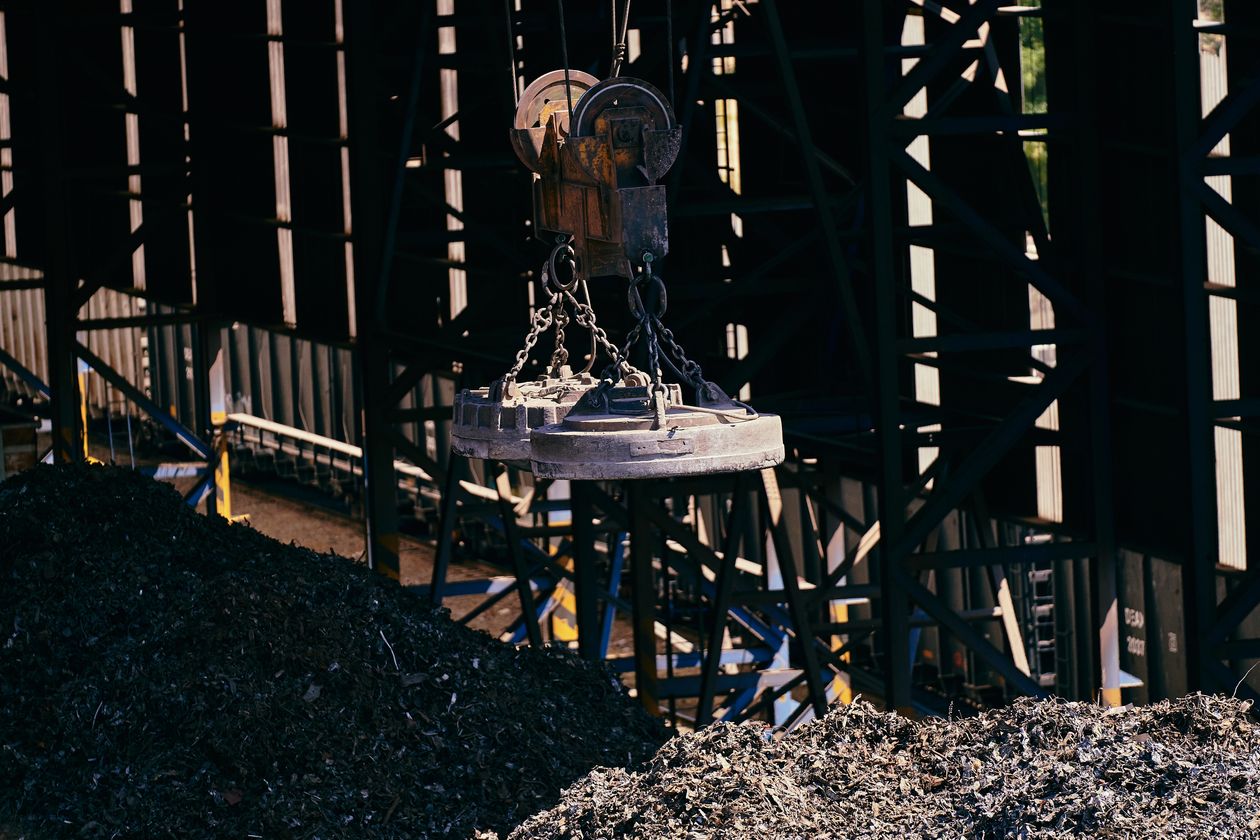
[An industrial lifting magnet hangs above piles of scrap metal in a recycling plant.] Photograph: Pexels
Image Credits: Pexels
A magnet sticks to a fridge door, a steel paperclip, and an iron nail. It slides straight off a wooden table, a plastic ruler, and a glass window. The difference is not about weight, hardness, or how solid the material looks.
The difference sits at the atomic scale. Iron contains tiny magnetic regions that a magnet can line up.
Wood does not. This article explains what a ferromagnetic material is, how magnetic domains work inside iron, why wood stays silent in a magnetic field, and how heat can switch iron's magnetism off.
What makes a material magnetic
Magnetism comes from moving electric charge. Inside atoms, electrons carry charge and spin, and that spin gives each electron a tiny magnetic effect, according to OpenStax College Physics.
In most materials, those tiny effects cancel out. Electrons pair up with opposite spins, so their magnetic contributions wipe each other out. The material as a whole shows no useful magnetism.
A ferromagnetic material breaks that pattern. Its atoms have unpaired electrons whose spins can cooperate instead of cancelling. Iron, nickel, and cobalt are the three familiar examples, and alloys built from them behave the same way.
That cooperation is the whole story. When a material's atomic magnets can act together, an outside magnet can organise them. When they cannot, the outside magnet has nothing to work with.
Inside iron: domains that line up
Inside a piece of unmagnetised iron, atomic magnets group into patches called domains. Within one domain, the atomic magnets point the same way. Across the whole piece, the domains point in different directions.
That is why an ordinary iron nail is not itself a magnet. Its domains cancel each other out on average, so the nail shows no net pull. The potential is there, but it is disorganised.
Bring a permanent magnet close, and the field starts to organise the nail. Domains already pointing along the field grow, while others rotate toward it, as OpenStax describes. The aligned domains add up, the nail becomes a temporary magnet, and it jumps toward the magnet.
The effect works at either pole. Iron is attracted to both the north and the south end of a magnet, because the magnet induces alignment in the iron either way. That is one reason a fridge magnet holds no matter which side faces the steel door.
Steel is magnetic for the same reason. Steel is mostly iron, so its domains behave like iron's domains. A tin can is usually steel under a thin coating, which is why a magnet grabs it despite the name on the label.
Why wood stays silent in a magnetic field
Wood is built from cellulose, lignin, and hemicellulose, made mostly of carbon, hydrogen, and oxygen. Its electrons sit in pairs with opposite spins, so their magnetic effects cancel out before any field arrives.
With no unpaired spins to organise and no domains to grow, a magnet's field passes through wood without inducing a matching field. Duramag puts the point plainly: with no induced internal field, there is no field interaction and no attraction.
This is not a matter of the magnet being too weak. A far stronger magnet still will not pick up a wooden block, because the block has no magnetic structure to respond. Strength scales up a real response; it does not create one where none exists.
The same logic covers plastic, glass, and rubber. They lack the unpaired-electron structure that makes iron responsive. Their atoms are magnetically quiet, so a magnet ignores them.
What about copper, aluminium, and other metals
Being a metal is not enough. Copper and aluminium are metals, yet an ordinary magnet will not pick them up. They are not ferromagnetic, because their atomic magnets do not cooperate in domains the way iron's do.
Copper is diamagnetic, meaning it responds only very weakly, and in the opposite sense. Aluminium is paramagnetic, meaning it responds weakly in the same sense as the field. Both effects are far too faint to feel with a household magnet.
Nickel and cobalt are the exceptions among common pure metals. Like iron, they are ferromagnetic at room temperature. That is why some coins, batteries, and alloys respond to a magnet while others do not.
Stainless steel shows how composition matters. Some stainless steels contain enough iron in the right crystal structure to attract a magnet.
Others, with more nickel and a different structure, barely respond. A magnet test therefore tells you something about a steel's makeup, not just whether it is steel.

[Souvenir magnets cling to a steel refrigerator door.] Photograph: Pexels
Image Credits: Pexels
Why heat and hard knocks weaken magnets
Heat scrambles order. As temperature rises, thermal motion shakes the aligned domains, and past a threshold called the Curie temperature, the alignment collapses. OpenStax gives iron's Curie temperature as 1043 K, which is 770 degrees Celsius.
Above that point, iron stops being ferromagnetic and becomes paramagnetic. It can still respond weakly to a strong field, but it cannot hold its own magnetism. Cool it back below the Curie temperature and ferromagnetism returns.
Hard blows do similar damage at room temperature. A sharp knock can jolt domains out of alignment, which is why a dropped magnet may come back slightly weaker. The effect is small for a single drop, but repeated abuse adds up.
This also explains why a magnetised nail loses its pull over time. Its domains slowly drift back toward random orientations, especially if the nail is knocked around. The nail was never a permanent magnet, only a borrowed one.
A simple test you can try at home
Gather a fridge magnet and a mix of household objects: an iron nail, a steel paperclip, a copper coin, an aluminium foil ball, a wooden spoon, and a plastic bottle cap. Hold the magnet near each object in turn and note which ones it grabs.
The nail and the paperclip should jump to the magnet. The copper coin, foil, wooden spoon, and plastic cap should not. If a coin does respond, check what it is made of: some coins contain nickel or a steel core under plating.
Try the same test through a thin sheet of paper or cardboard. The magnet still grabs the nail, because the field passes through non-magnetic materials. That is how a fridge magnet holds a note to a steel door: the paper is simply in the way, not in the circuit.
One caution applies to the test. Keep strong magnets away from phones, bank cards, and medical devices, and keep small magnets away from young children. The physics is safe to watch, but strong magnets deserve respect.
Frequently asked questions
Why does a magnet stick to a fridge but not a wooden door?
A fridge door is usually steel, which is mostly iron, so its domains align with the magnet's field. A wooden door has no domains to align, so the magnet finds nothing to hold onto.
Can a magnet ever attract wood?
No household magnet can, and even a laboratory magnet produces only an immeasurably tiny effect. Wood's paired electrons cancel out, leaving no magnetic structure for a field to organise.
Why is iron attracted to both poles of a magnet?
The magnet induces alignment in the iron whichever pole approaches. The iron's domains line up with the field direction, so the resulting pull is always toward the magnet.
Does a magnet lose strength by picking up iron?
No. Picking up iron does not drain a permanent magnet in any practical sense. A magnet loses strength mainly through heat above its Curie temperature, hard knocks, or a strong opposing field.
The bottom line
Magnets attract iron because iron's atoms can act together. Their unpaired electrons form domains, and a magnet's field lines those domains up into a single pull. Wood cannot join in, because its paired electrons cancel out and its structure holds no domains at all.
That single contrast explains the fridge door, the paperclip, and the wooden table. It also explains why only a short list of metals responds, and why heat can switch the whole effect off.
The magnet is not choosing favourites. It is simply talking to the only materials built to listen.
Tags: magnets, iron, physics, materials
Rive News's research desk covers everyday science questions with sourced explainers, not lab reports.
Related
- How magnets work at the atomic level
- Why magnets only attract some metals
- Why magnets stick to fridges but ignore most metals
Subscribe for one plain-English science explainer each morning.
Rive News publishes sourced explainers; claims are checked against public sources before publication.
Related stories
Why diamond is hard and graphite is soft when both are carbon
Diamond and graphite are both pure carbon, yet diamond is 10 on the Mohs scale and graphite is 1 to 2. The difference is not the atoms;

Why Hot Water Can Freeze Faster Than Cold: The Mpemba Effect Explained
Hot water can freeze faster than cold under specific conditions. The Mpemba effect, named for a 1963 schoolboy experiment, still divides
How Magnets Work at the Atomic Level: Spins, Domains, and Iron
Magnetism comes from electrons: their spin and orbits make each atom a tiny magnet. In iron, quantum forces align these atomic magnets into