
Why you can see your breath on a cold day
By Rive News / Research desk | Rive News / Published October 27, 2026 at 9:00 AM PKT
Key takeaways
- You are not seeing cold air. You are seeing your own breath turned into a brief cloud of tiny water droplets.
- Breath leaves your lungs warm, near body temperature, and close to saturated with water vapour.
- Whether breath shows depends on humidity and the dew point, not on cold alone.

[Snowboarders on a cold day breathe out visible white clouds against the winter air.] Photograph: Unsplash contributor, via Wikimedia Commons
Image Credits: Wikimedia Commons
Step outside on a cold morning, breathe out, and a small white cloud appears in front of your face. It lasts a second or two, then vanishes. The cloud is not smoke, and it is not the cold air itself becoming visible.
It is your own breath, briefly turned into something your eyes can catch. This article explains what your breath contains, why cold air reveals it, and why the same breath can be invisible on a different cold day.
What you are actually seeing
Every breath you exhale carries water vapour, the invisible gaseous form of water. You cannot see water vapour itself, any more than you can see the air in a room. What you see on a cold day is what happens after that vapour cools.
When warm breath meets cold air, the vapour loses energy and changes from a gas into a liquid. That change is called condensation. The result is thousands of tiny liquid droplets, each far smaller than a raindrop, floating in the air in front of your mouth.
Together they scatter light, which is why they look white.
The National Science Teaching Association describes the same process in plain terms: moist air cools, water vapour changes to liquid droplets, and the result is fog. Your breath cloud is, in effect, a personal fog bank about the size of your head.
In extreme cold, some of that vapour can turn straight into tiny ice crystals instead of liquid droplets. That is why breath on a bitterly cold day can look sharper and whiter, and why eyelashes and scarves can pick up frost from repeated exhaling.
Why breath leaves your lungs warm and wet
Your lungs are warm and wet by design. Air you inhale picks up moisture as it travels through your airways, and it leaves your body at roughly 31 to 35 degrees Celsius, close to saturated with water vapour. One estimate puts exhaled air near 90 percent relative humidity.
That combination matters. Warm air can hold far more water vapour than cold air can. So your breath arrives outside carrying a load of moisture that the cold air around it cannot absorb as a gas.
Think of it as a capacity problem. Warm breath is a crowded room full of water molecules moving fast enough to stay gaseous. Cold air outside is a much smaller room.
When the two mix, the molecules slow down, crowd together, and condense into droplets.
This is also why a mirror fogs when you breathe on it. The mirror is simply a cold surface doing the same job as cold air: it cools your breath below the point where its vapour can stay gaseous.
The dew point decides everything
The key concept is the dew point. That is the temperature at which air becomes saturated with water vapour and condensation begins. When your breath cools to its dew point, droplets form.
When it stays above that point, the vapour stays invisible.
That is why cold alone does not guarantee visible breath. The Library of Congress notes that visible breath commonly begins showing up below about 45 degrees Fahrenheit, but stresses there is no single magic temperature. Humidity sets the actual threshold on any given day.
On a humid day, the surrounding air is already close to saturation, so your breath does not have to cool much before it crosses its dew point. You may see your breath when the temperature is in the 40s. On a very dry day, the surrounding air can absorb much more vapour, so your breath may stay invisible even well below freezing.
Wind matters too. A still, calm day lets the droplet cloud hang together for a second or two. A breeze tears it apart almost immediately, which is why breath can seem to vanish faster on a windy morning even when the temperature is the same.
Why the cloud disappears so fast
A breath cloud is temporary by nature. The droplets form in a small pocket of air that is warmer and wetter than its surroundings. Within a second or two, that pocket mixes with the wider air, the droplets evaporate back into invisible vapour, and the cloud is gone.
Slow exhales make thicker clouds because they give the vapour more time to cool and condense before it disperses. Fast, forceful exhales scatter the droplets sooner, so the cloud looks thinner and shorter-lived. Breathing through your nose produces a smaller, less visible cloud than breathing through your mouth, because the air leaves more slowly and in a narrower stream.
The same physics explains why you can sometimes see your breath indoors. A cold room, a draughty hallway, or a walk-in freezer can all cool your breath past its dew point. Temperature difference and humidity do the work, not the season.
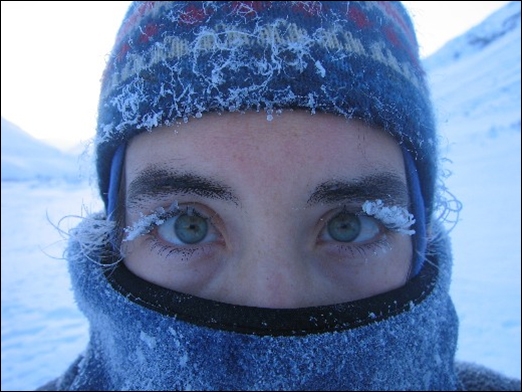
[In extreme cold, exhaled breath condenses and freezes quickly, frosting eyelashes and clothing.] Photograph: Wikimedia Commons contributor
Image Credits: Wikimedia Commons
The same science everywhere else
Visible breath is one member of a large family. Fog forms when a whole body of air cools to its dew point. Dew appears on grass when surfaces cool overnight and water vapour condenses on them.
The droplets on the outside of a cold drink come from the air, not from the drink leaking.
Clouds work the same way at a larger scale. Rising air cools, its vapour condenses around tiny particles, and droplets gather into a visible mass. The National Oceanic and Atmospheric Administration describes condensation at the dew point as the process behind both clouds and fog.
That family resemblance is useful for checking your understanding. If you know why a bathroom mirror fogs after a hot shower, you already know why your breath fogs on a winter morning. The only difference is the source of the warm, moist air.
A balloon shrinks in cold air for a related reason: gases contract as they cool. Breath clouds and shrinking balloons are both everyday demonstrations of how temperature changes what air can do.
Frequently asked questions
At what temperature can you see your breath?
There is no single cutoff. Visible breath commonly appears below about 45 degrees Fahrenheit, according to the Library of Congress, but humidity shifts that line. On a humid day it can appear in the 40s, while on a very dry day it may not appear even below freezing.
Why can I sometimes see my breath when it is not that cold?
Because the air is already humid. When surrounding air sits near saturation, your warm breath needs only a small temperature drop to reach its dew point and condense. Humid autumn mornings are a classic case: mild air, but visible breath.
Why does my breath show more on some cold days than others?
Humidity, wind, and exhale speed all play a part. Humid, calm air produces the thickest clouds. Dry or windy air disperses droplets quickly.
Slow exhales through the mouth produce the most visible plumes.
Is visible breath smoke?
No. Smoke is made of solid particles from burning material. A breath cloud is liquid water droplets, or in extreme cold, tiny ice crystals.
It contains no combustion products, and it evaporates within seconds rather than drifting away as smoke does.
The bottom line
Visible breath is your own warm, wet exhalation meeting air too cold to keep its moisture gaseous. The vapour condenses into droplets at the dew point, scatters light for a second or two, and then evaporates as the air mixes.
Cold helps, but humidity decides. That is why breath can appear on a mild humid morning and hide on a dry freezing one. Next time you see that little cloud, you are watching condensation happen in real time, at the scale of a single breath.
Tags: weather, physics, condensation, everyday science
Rive News is a research desk that explains everyday questions from published sources and expert guidance, without invented case studies or first-hand claims.
Related
- Why does a balloon shrink in cold air
- Why does metal feel colder than wood at equal temperature
- How do clouds stay up in the sky if they are made of water
Subscribe for one everyday explainer in your inbox each morning.
Rive News publishes research-based explainers and corrects errors when readers point them out.
Related stories
Why diamond is hard and graphite is soft when both are carbon
Diamond and graphite are both pure carbon, yet diamond is 10 on the Mohs scale and graphite is 1 to 2. The difference is not the atoms;

Why Hot Water Can Freeze Faster Than Cold: The Mpemba Effect Explained
Hot water can freeze faster than cold under specific conditions. The Mpemba effect, named for a 1963 schoolboy experiment, still divides
How Magnets Work at the Atomic Level: Spins, Domains, and Iron
Magnetism comes from electrons: their spin and orbits make each atom a tiny magnet. In iron, quantum forces align these atomic magnets into