
How Do Clouds Stay Up in the Sky If They Are Made of Water
Key takeaways
- A typical 1 kilometre cube cumulus cloud holds about 1.1 million pounds of water, spread across a billion cubic metres of air.
- Cloud droplets are tiny, about 1 to 100 micrometres across, and fall at roughly 1.3 centimetres per second in still air.
- Rising air currents move faster than the droplets fall, so updrafts hold the cloud up until droplets grow into rain.
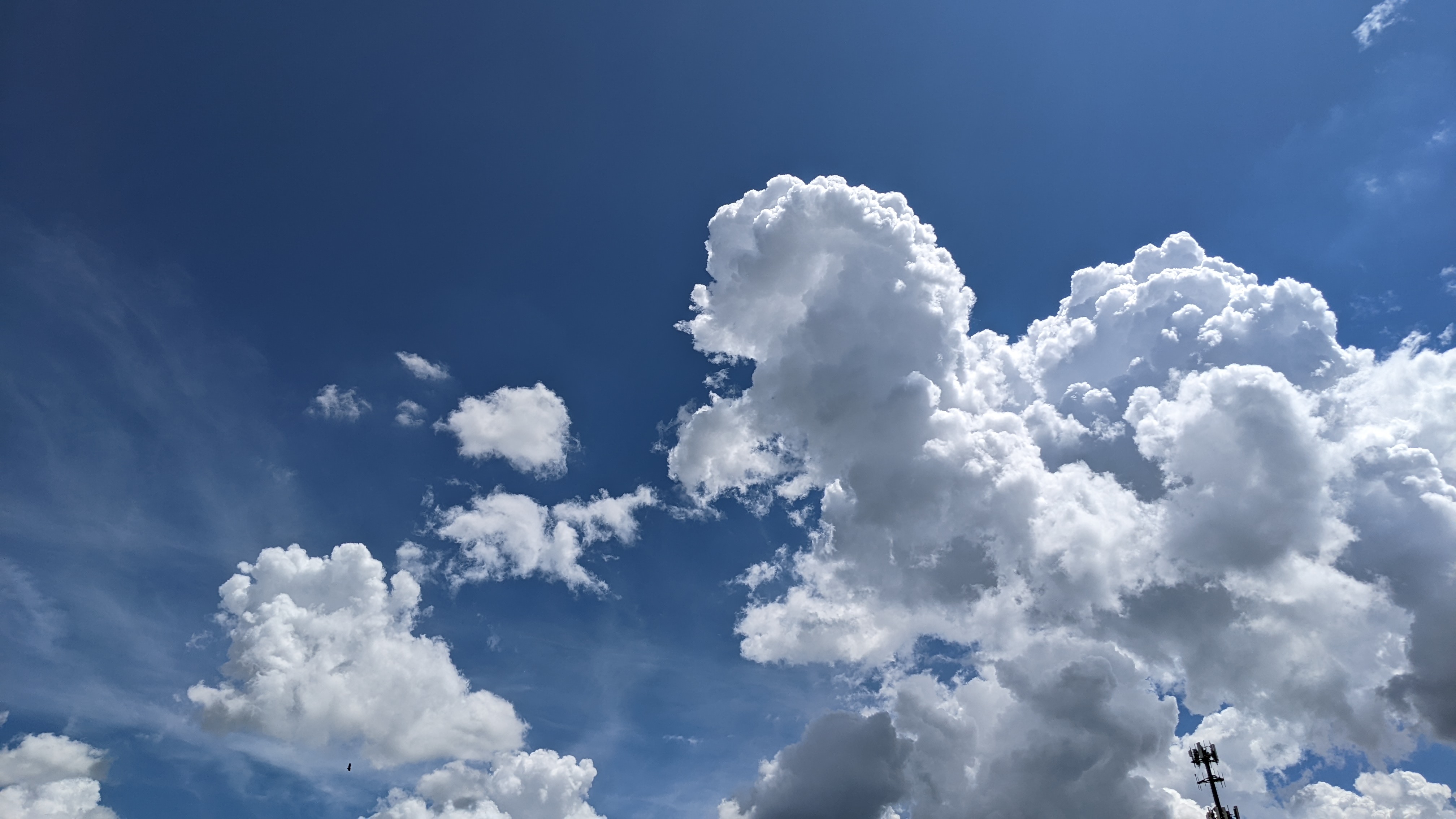
A cloud looks like soft, weightless cotton. It is made of water, and water is heavy. A bucket of it strains your arms, so a whole sky full of it should crash down at once.
The puzzle is real, and the answer comes from three facts working together: the water is split into droplets too small to see, those droplets fall extremely slowly, and the air around them is usually rising faster than they fall.
This article explains how clouds stay up in the sky if they are made of water, covering how much a cloud weighs, how droplets form, why they fall so slowly, how updrafts hold them aloft, why moist air floats, and what finally makes droplets fall as rain.
How much does a cloud weigh
The US Geological Survey (USGS) works through the arithmetic with a representative cumulus cloud about 1 kilometre on each side. That cube holds 1 billion cubic metres of air. At a liquid water content near 0.5 grams per cubic metre, the cloud holds about 500 million grams of water droplets.
That is about 500,000 kilograms, or 1.1 million pounds, which is roughly 551 tons. For scale, that is more than twice the weight of a fully loaded Boeing 747. A big thunderstorm cloud, kilometres tall, can hold hundreds of thousands of tonnes of water, ice, and hail.
The weight is real, but it is spread thin. Each cubic metre of that cloud holds only half a gram of water, which is about the weight of a small paperclip spread through a box the size of a washing machine. No single part of the cloud is heavy.
The total only looks alarming when you add up a whole cubic kilometre.
What clouds are actually made of
Clouds are not bags of liquid water. They are visible masses of minute water droplets, ice crystals, or both, suspended in air. The American Meteorological Society glossary defines a cloud as a visible aggregate of minute water droplets or ice particles in the atmosphere above the surface, with drops generally ranging from 1 to 100 micrometres in diameter.
Those droplets start as water vapour, the invisible gas form of water. Water evaporates from oceans, lakes, rivers, and land into the air. When air rises, it expands and cools, and the vapour condenses into liquid.
Condensation needs a starting surface, so vapour gathers on tiny particles called condensation nuclei, such as dust, pollen, or salt.
The University Corporation for Atmospheric Research explains that clouds are made of water droplets or ice crystals so small and light that they stay up in the air. Each droplet is far smaller than a raindrop. About a million cloud droplets must merge to make a single raindrop, which is why most clouds produce no rain at all.
Why tiny droplets fall so slowly
Everything in a cloud is falling, including the droplets. Gravity pulls on them just as it pulls on everything else. The surprise is how slowly they fall, because air pushes back hard on objects this small.
The National Weather Service puts the average cloud droplet's terminal fall velocity at 1.3 centimetres per second in still air. Terminal velocity is the steady speed where air resistance balances gravity. A droplet falling from a typical low cloud base 500 metres up would take more than 10 hours to reach the ground in perfectly still air.
Physicist Louis J. Battan gave a vivid comparison in his book Cloud Physics: "A droplet of 10-micron radius falls at a speed of 1 cm/sec, while droplets of 50-micron radius fall at a speed of 26 cm/sec." The bigger droplet falls faster, but even 26 centimetres per second is a gentle drift, not a plunge.
Dust motes in a sunbeam behave the same way. Each speck is falling, but so slowly that the slightest air movement sends it back up. Cloud droplets are the sky's version of that dust, spread across kilometres.
How updrafts hold clouds aloft
Still air almost never exists in the real sky. Air rises and sinks in currents all day, and the rising currents, called updrafts, are far faster than the droplets' fall speed. A fair-weather updraft of 1 to 5 metres per second moves air upward hundreds of times faster than a droplet drifts down at 1.3 centimetres per second.
The result is a standing pattern. Individual droplets sink slowly through the air, but the air itself carries them up faster than they sink. Droplets also evaporate at the cloud edges and fresh vapour condenses inside, so the cloud holds its shape while its particles cycle through.
The cloud you watch for an hour is not the same water all hour.
NOAA describes the engine behind this lift. As a parcel of air rises, it expands because pressure is lower higher up, and expansion cools the parcel. Rising air cools by about 5.5 degrees Fahrenheit for each 1,000 feet of climb, which is 9.8 degrees Celsius per kilometre.
Once the parcel cools to saturation, vapour condenses onto nuclei and a cloud droplet is born.
Heat released during condensation adds lift. When vapour turns to liquid, it gives up latent heat, which can warm the air inside a growing cloud. Warmer air is buoyant, so it rises faster, feeding the updraft that built the cloud in the first place.
Why moist air floats on dry air
Density adds a second reason clouds stay up. The USGS explains that the density of a volume of cloud material is less than the density of the same volume of dry air, so the cloud floats on the drier, denser air below it, just as oil floats on water. Moist air is less dense than dry air at the same temperature and pressure, which surprises many people.
The reason sits in the makeup of air. Dry air is mostly nitrogen and oxygen molecules, which are heavier than water vapour molecules. When water vapour joins the mix, it replaces some of those heavier molecules, so the parcel gets lighter.
A cloud is therefore not a heavy object resting on air. It is a lighter pocket of moist air floating in denser surroundings.
This density gap is small, and on its own it would not hold a cloud up forever. Combined with slow-falling droplets and steady updrafts, it keeps the cloud aloft for hours. When the updrafts weaken, the balance shifts, and the cloud thins and fades.
What finally makes droplets fall as rain
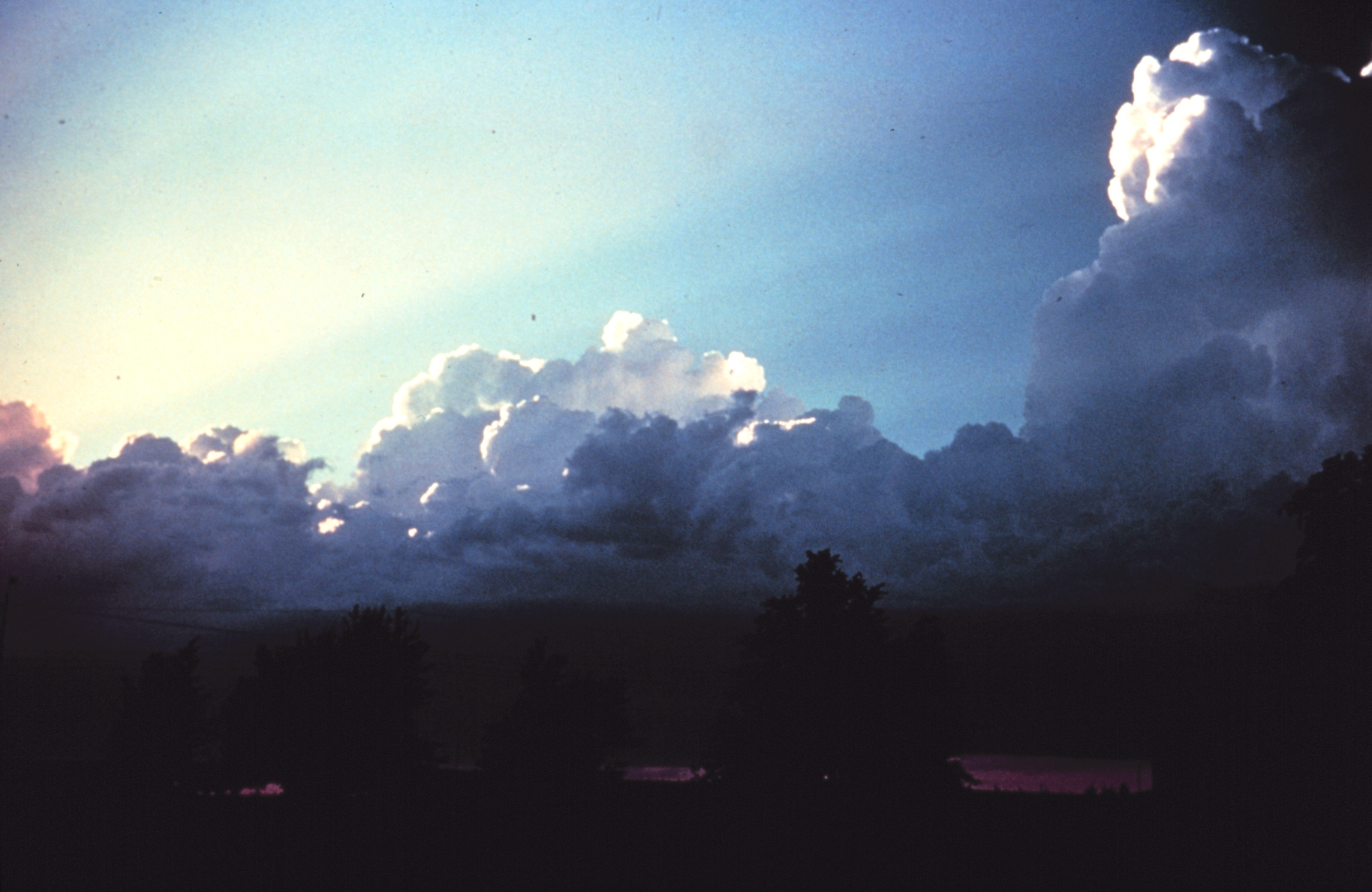
Clouds rain when droplets grow too large for the updrafts to hold. Droplets collide and merge as they drift and churn inside the cloud, a process called collision and coalescence. In cold clouds, ice crystals grow by grabbing vapour and by colliding with supercooled droplets.
Size changes everything. A droplet's weight grows with its volume, which scales with the cube of its radius, while air resistance grows with surface area, which scales with the square of its radius. As droplets grow, weight wins.
Once a drop's radius passes about 0.1 millimetres, updrafts can no longer hold it, and it starts to fall as rain.
That is why only some clouds rain. A thin, fair-weather cloud never grows droplets large enough to beat the updrafts, so it evaporates instead. A tall storm cloud, with strong updrafts and deep moisture, grows drops that outgrow the lift and fall.
Even then, much of the cloud's water stays aloft, and some rain evaporates before it reaches the ground.
The same physics explains why clouds look flat on the bottom. The cloud base marks the level where rising air first cools to saturation and condensation begins. Below that level, droplets evaporate, so the visible cloud stops in a sharp line.
Frequently asked questions
If a cloud weighs a million pounds, why does it not fall like a rock?
Because the weight is spread across a billion cubic metres of air, and each droplet is tiny. Droplets fall at about 1.3 centimetres per second in still air, while updrafts lift air hundreds of times faster. The cloud is a pattern of rising air and condensing water, not a solid object.
Are clouds made of water vapour or water droplets?
Both, but the visible part is droplets or ice crystals. Water vapour is invisible gas. A cloud becomes visible when vapour condenses into liquid droplets or ice crystals large enough to scatter sunlight.
Why do some clouds rain and others do not?
Rain needs droplets large enough to beat the updrafts. In thin clouds, droplets stay small and evaporate. In deep, moist clouds, droplets collide and grow until their weight wins, and then they fall as rain.
What is the difference between a cloud and fog?
Fog is a cloud at ground level. The American Meteorological Society notes that cloud differs from fog only in that fog sits within a few metres of the surface. The same droplet physics applies to both.
Can a cloud fall out of the sky?
No. A cloud cannot fall as a single object because it is not a solid. When updrafts fade, the cloud evaporates and fades away instead.
Its water returns to vapour or falls as scattered rain, not as a falling mass.
The bottom line
Clouds stay up because their water is divided into microscopic droplets that fall slower than a garden snail, because rising air lifts them faster than they sink, and because moist air is less dense than the dry air below. The million-pound total is real, but it is spread across a cubic kilometre of sky. When droplets grow large enough to beat the lift, they fall as rain, and the cloud thins.
Next time you watch a cumulus drift past, you are watching slow-falling water held up by rising air. The same patient physics shows up across the sky, from the flash of a storm that makes you wonder about why you see lightning before you hear thunder to the quiet work of how photosynthesis keeps nearly all life fed.
Tags: clouds, weather, water cycle, physics
Latest in Science
- Why You See Lightning Before You Hear Thunder
- How Photosynthesis Keeps Nearly All Life Fed
- How Bees Make Honey, Step by Step
Subscribe for one clear science explainer in your inbox each week.
Related stories

Why diamond is hard and graphite is soft when both are carbon
Diamond and graphite are both pure carbon, yet diamond is 10 on the Mohs scale and graphite is 1 to 2. The difference is not the atoms;

Why Hot Water Can Freeze Faster Than Cold: The Mpemba Effect Explained
Hot water can freeze faster than cold under specific conditions. The Mpemba effect, named for a 1963 schoolboy experiment, still divides

How Magnets Work at the Atomic Level: Spins, Domains, and Iron
Magnetism comes from electrons: their spin and orbits make each atom a tiny magnet. In iron, quantum forces align these atomic magnets into